Nobel Prize in Physics
Paris-Saclay University has welcomed six Nobel laureates in Physics, who have either studied there or worked in one of its laboratories. Their research, ranging from soft matter to quantum physics, is a testament to the university’s excellence and international reputation.
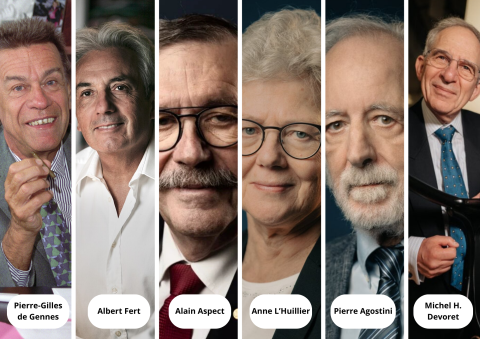
Pierre-Gilles de Gennes
Pierre-Gilles de Gennes (1932–2007) was a leading French physicist, educated at the École Normale Supérieure, who spent most of his career at the Laboratory of Solid State Physics in Orsay. He is best known for his work on soft matter, such as polymers, colloids and liquid crystals. In 1991, he was awarded the Nobel Prize in Physics ‘for discovering that methods developed for the study of order phenomena in simple systems can be generalised to more complex forms of matter, in particular to liquid crystals and polymers’. His research has paved the way for numerous practical applications, notably in liquid crystal displays and the design of new flexible materials, whilst revolutionising our theoretical understanding of disordered and flexible systems.
Albert Fert
Albert Fert (born 1938) is a French physicist best known for winning the Nobel Prize in Physics in 2007 for the discovery of giant magnetoresistance (GMR). This phenomenon, in which the electrical resistance of a material varies significantly under the influence of a magnetic field, revolutionised hard disk technology and data storage, paving the way for spintronics. His work, carried out mainly at the Laboratory of Solid State Physics in Orsay, combined fundamental physics with major technological applications.
Alain Aspect
Alain Aspect (born 1947) is a French physicist recognised for having been awarded the Nobel Prize in Physics in 2022 ‘for his experiments on entangled photons, establishing the violation of Bell’s inequalities and paving the way for the science of quantum information’. His work confirmed that particles can remain instantaneously correlated, even when separated by vast distances, validating fundamental aspects of quantum physics and paving the way for technologies such as quantum computing and quantum cryptography. The majority of his career and research has been conducted within the Paris-Saclay scientific ecosystem.
A professor at the Institut d’Optique Graduate School / Université Paris-Saclay, Alain Aspect has been awarded the 2022 Nobel Prize in Physics. He shares this award with the American John F. Clauser and the Austrian Anton Zeilinger for their pioneering experiments on quantum entanglement, which paved the way for quantum technologies. This distinction recognises a lifetime of revolutionary work in this field. Find out more
Anne L'Huillier
Anne L'Huillier (born 1958) is a French physicist renowned for her pioneering contributions to attosecond physics, a field that enables the observation and measurement of the ultra-fast movements of electrons on the scale of an attosecond (10⁻¹⁸ seconds). She was awarded the Nobel Prize in Physics in 2023, which she shared with Pierre Agostini and Ferenc Krausz, for the development of experimental methods generating attosecond light pulses, used to study the dynamics of electrons in matter — a fundamental breakthrough in physics that opens up new avenues for understanding previously invisible atomic and molecular phenomena.
Pierre Agostini
Pierre Agostini (born 1941) is a Franco-American physicist whose career has been devoted to ultrafast optics and laser-matter interactions. After training in France, he conducted a significant part of his research at CEA Saclay, before continuing his career in the United States. He is internationally recognised for his pioneering work in attosecond physics, a field that aims to observe electronic phenomena on extremely short timescales. In 2023, he was awarded the Nobel Prize in Physics, shared with Anne L’Huillier and Ferenc Krausz, for the development of experimental methods enabling the generation and measurement of attosecond light pulses, thereby paving the way for the direct observation of the movement of electrons in atoms and molecules.
Anne L’Huillier and Pierre Agostini won the Nobel Prize in Physics alongside an Austro-Hungarian scientist for “experimental methods that generate attosecond light pulses for the study of electron dynamics in matter”. Thanks to them, this research has become a flagship activity in physics at our Paris-Saclay campus. Find out more
Michel H. Devoret
Michel H. Devoret (born in 1953 in Paris) is a Franco-American physicist who trained in France, where he obtained his PhD from Paris-Saclay University before pursuing his career at CEA Saclay and subsequently in the United States. He is internationally recognised for his pioneering work in quantum circuit physics, in particular the demonstration of macroscopic quantum behaviour — showing that phenomena such as the quantum tunnelling effect and energy quantisation can manifest themselves in electrical circuits large enough to be manipulated directly. In 2025, he was awarded the Nobel Prize in Physics, shared with John Clarke and John M. Martinis, for these fundamental discoveries which have broadened our understanding of quantum mechanics and opened up major prospects for quantum technologies, notably quantum computing.