Search


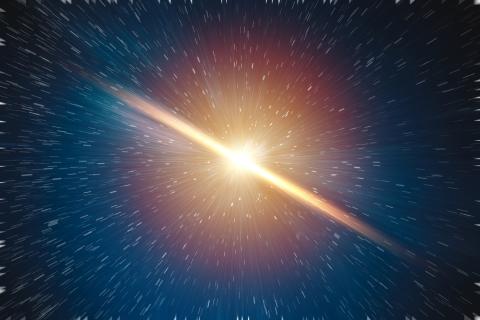
David Elbaz: The Big Bang, and after that?
… takes us with him tens of billions of light-years away, where everything began, and where stars are born and … is the history of light. Interferometry, which combines the wavelengths of light, makes it possible to obtain … this galaxy is 53 million light-years away from us. No longer forming stars, it is considered to be 'dead'. …
Published on:

Hadi Quesneville: The hidden side of the genome
… “I had a sudden revelation and I said to myself that I wanted to do genetics. Everything suddenly became crystal … in 1996. He followed this with two post-docs. The first was at Généthon (where he also taught at Évry University) … responsible for changes which have been known about for a long time. “The shape of tomatoes, the colour of grapes or …
Published on:

Olivier Schiffmann: The mathematical (hidden) side of physical theories
… start directly from the group of symmetries. “Symmetry is always a group,” the mathematician explains. “If we carry out … the system as a whole.” A system that also works the other way around, to return to the initial state. The ensemble … to a Lie algebra). For example, a sphere can be rotated along one axis and then rotated along another axis. “We …
Published on:

The emergence of gravity and black holes
… between the theory of relativity and quantum mechanics has long been a source of defeat for physicists. Since 2016, … the framework of the Emergent-BH project, which has been awarded an ERC Starting Grant. Her theories bring the … focus for theoretical physicists. Although their existence was contemplated thanks to Isaac Newton’s law of universal …
Published on:

Rebeca Ribeiro-Palau: Exploring graphene and states of matter
… the formation and control of topological states in van der Waals heterostructures earned her the Ernest Déchelle prize … especially how to change these properties in a continuous way. This is the quest for many researchers in the field of … to industry.” The aim of this work is that, in the long term, manufacturers will be able to calibrate their …
Published on:

Jean-Pierre Hermier: the optics of semiconductor nanocrystals
… of Light of Université Paris-Saclay. Jean-Pierre Hermier was attracted by astrophysics when he began his higher education. Along the way, he discovered quantum physics and its developments in … of Light of Université Paris-Saclay. Jean-Pierre Hermier was attracted by astrophysics when he began his higher …
Published on:

Fabrice Gatuingt: Predicting the resistance of constructions
… of this new laboratory at Université Paris-Saclay, which was created in early 2022. With more than 200 people, the … path were in line with the scope of Paris-Saclay, as he was interested in technology and attended a 2-year … to complement that of CEA Paris-Saclay, with which it has long collaborated on the simulation of extreme stresses. …
Published on:

Évelyne Contejean: Avoiding computer bugs
… science research focuses on designing efficient tools to thwart all potential bugs in the digital ecosystem at an early … reliability of various IT objects, such as programmes, software, protocols and systems." The objective is to provide … they are correct, except that they have been in use for a long time," says the researcher. Not only does Évelyne …
Published on:
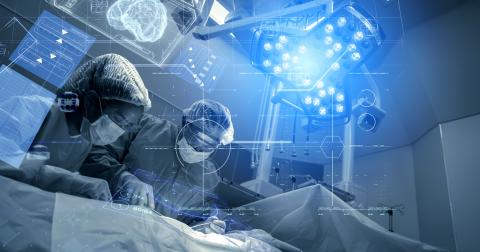
Beams: the Medtech serving surgical oncology
… at Université Paris-Cité and a member of IJCLab . He wanted to improve the quality of exeresis, or the removal of … to arrest real growth in tumours during surgery. The aim was to achieve a more precise definition of the resection … our laboratories, in order to continue the venture over the long term," notes Laurent Ménard. Because the two scientists …
Published on: