Research
Polar regions and ice: Territories and research undergoing change
Among the areas most exposed to global warming, the polar regions are particularly important given their role in regulating the...
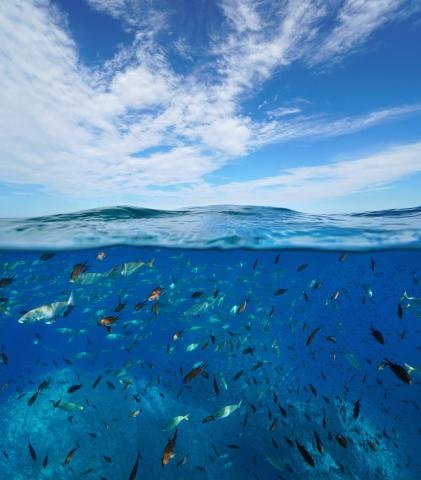
Although they cover three-quarters of the globe, the oceans remain poorly understood environments that are currently undergoing numerous changes: pollution, acidification, warming, loss of biodiversity… In response to these developments, scientists at Université Paris-Saclay are now involved in several research projects that are helping to unravel the complex interactions between marine species and their environment. (This article was originally published in L'Édition n°30.)
“The wonders of the ocean: keeping alive what keeps us alive.” This was the theme of World Oceans Day on 8 June. Organised under the aegis of the United Nations, this initiative aims to highlight the crucial role of the oceans, both as a reservoir of biodiversity and as a climate regulator. These characteristics are now well known. But the oceans remain a complex and largely unexplored ecosystem. To date, the mechanisms at the heart of how they function are not fully understood. And it is estimated that millions of marine species remain to be discovered and documented in this environment, which occupies 90% of the Earth’s habitable volume. So many mysteries, and so many research questions for scientists.
How, for example, can two closely related species of crustaceans be distinguished? What strategies do jellyfish use to adapt to their environment? What molecules do marine sponges produce? These questions may seem unrelated. Yet the ATLASea programme aims to find answers to them using a single resource: the genomes of these organisms.
Launched in 2023 by a consortium of around ten institutes and universities, including Université Paris-Saclay, and led by the French National Centre for Scientific Research (CNRS) and the French Alternative Energies and Atomic Energy Commission (CEA), the ATLASea programme aims to compile an atlas of the genomes of 4,500 marine species found in the waters of mainland France and its overseas territories. This represents around a third of the 15,000 eukaryotic species – whose cells have a nucleus – recorded in the French exclusive economic zone (EEZ). However, recorded does not mean described, meaning that knowledge of most of them is in fact patchy, or even non-existent.
Three years after its launch, ATLASea has already completed around ten sampling missions across mainland France and its overseas territories. And the teams are preparing to set off for New Caledonia at the end of the year. The aim of each of these campaigns is to collect organisms in their natural environment, by diving, shore fishing or dredging the seabed. “Sampling is done opportunistically. We collect whatever we find,” explains Jean-Marc Aury, head of the Bioinformatics Laboratory for Genomics and Biodiversity (LBGB) within the Metabolic Genomics unit at Genoscope (Univ. Paris-Saclay/Univ. d’Évry/CEA/CNRS). However, the expeditions do have certain objectives, such as obtaining at least one representative per group or collecting a species deemed of interest. The specimens are then sorted and identified by taxono-mists – specialists in species classification – before being photographed. “Each expedition takes around fifteen taxonomists to ensure there are specialists for each major marine group.” Finally, samples are taken and frozen before being sent for analysis. This is where Jean-Marc Aury, genome sequencing coordinator within the ATLASea programme, and his team come in.
The first step in the process involves isolating DNA fragments from the samples. Whilst this task is fairly well established for commonly studied species, it requires particular care when dealing with lesser-known organisms, such as microalgae. The next step is to sequence these fragments and reconstruct the chromosomes to which they belong. Sequencing is carried out using a technique that involves passing the DNA strands through a membrane perforated with nanometre-sized pores and through which an electric current flows. The DNA sequence is deduced from the analysis of the intensity of this current, which depends on the bases – the letters of the genetic code – present in the strand being studied. This technology is capable of deciphering fragments comprising tens of thousands of base pairs. However, a chromosome contains up to hundreds of millions. It is then up to the teams to piece the fragments back together. “It’s like a giant jigsaw puzzle,” explains the researcher. “The same base pair is sequenced thirty times, in order to obtain numerous readings of the fragments and identify overlaps to piece the fragments back together.”
The analysis is supplemented by a contact map that models the interactions between the different fragments. The closer two regions are on a DNA molecule, the more interactions they have. In this way, the chromosomes are reconstructed, the number of which varies from one species to another. Goldfish, for example, have fifty pairs of chromosomes, whilst many bivalve molluscs have nineteen. From thawing the sample to validating the genome, the entire process takes around two and a half months and involves around forty people in the laboratory. This demonstrates the phenomenal progress made in genetic sequencing: in the 1990s, the Human Genome Project, which aimed to sequence the human genome, took over ten years of effort and involved thousands of scientists.
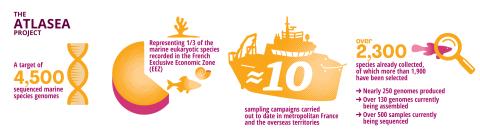
In September 2025, the teams involved in ATLASea passed the symbolic milestone of 100 sequenced genomes with a nautilus endemic to New Caledonia. Nine months later, the total now stands at nearly 250 genomes sequenced and more than 2,300 species collected. These include very different organisms such as the lionfish, an invasive species collected in Guadeloupe, and the short-snouted seahorse, a specimen of which was collected in the bay of Mont Saint-Michel.
In addition to compiling an inventory of French marine species, the ATLASea programme and its findings are a valuable resource for the wider scientific community. They offer a wide range of opportunities to inform various research projects. At Genoscope, the teams plan to use the genomes in two projects. The first focuses on invasive species and the adaptation strategies that give them such an advantage in a given environment. The second aims to identify molecules of particular interest.
“It all starts with a simple observation,” explains Patrick Wincker, director of Genoscope and the Laboratory for Eukaryotic Genomic Analysis (LAGE) within the Metabolic Genomics unit. “A great many chemical compounds used inmedicines, industry or agriculture come from plants or land animals. Why not explore marine biodiversity to find others?” In this type of research, the starting point is a specific target: for example, a biological function, a reaction to be catalysed or a specific protein. The associated genes are then identified in a species already known. The rest of the database is then scoured to identify species likely to show similarities. The more comprehensive the database, the greater the chances of finding interesting proteins. Hence the value of having a new inventory of thousands of marine species.
In addition to ATLASea, Patrick Wincker and his team are involved in other projects aimed at exploring the ocean and its ecosystem. “Since 2009, we have been working in particular with the Tara Foundation. We are responsible for sequencing the organisms found in water samples taken from the ship.” A litre of seawater contains several hundred thousand different organisms. “By analysing this data, we realised we lacked reference genomes to identify the species present. The data from ATLASea will be very useful for this, but also for identifying genetic variants, which are markers of adaptation to an environment.”
At LAGE, a partner in the scientific expeditions carried out by the Tara Foundation to study marine biodiversity and understand the consequences of climate change on the oceans, Éric Pelletier is a specialist in environmental genomics and systems biology. Since 2009, he has been interested in what makes up nearly a third of ocean biomass:
plankton.
The term “plankton” does not refer to a specific species or biological group. It encompasses all organisms that drift with the current, unable to swim against it, in contrast to nekton, which is capable of swimming. The term thus covers a wide variety of species, ranging in size from less than a micrometre (one millionth of a metre) to one or two metres. In his research, Éric Pelletier focuses on organisms – plants, fungi, bacteria and even archaea – that are no larger than two millimetres. Although they are tiny, these species are ubiquitous in the oceans. And they perform crucial functions there.
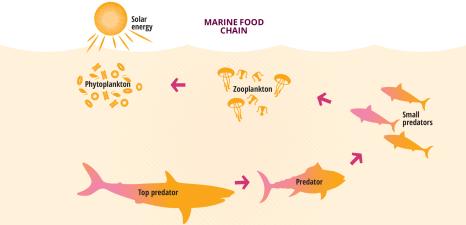
As a source of food for many marine organisms, plankton forms the basis of the food chain, also known as the trophic chain. The concentration and types of species found in a given location are therefore crucial to marine biodiversity. Furthermore, plankton plays a key role in regulating both the oceanic and atmospheric climate. On the ocean’s surface, the microscopic species that make up phytoplankton use sunlight and carbon dioxide (CO₂) to produce, via photosynthesis, organic matter and release oxygen, which accumulates in the atmosphere to the extent that it now accounts for 40 to 50% of it. Some of this organic matter produced from CO₂ is deposited on the ocean floor. This process is one of the stages of what is known as the “biological pump” which leads to carbon sequestration in the seabed. According to estimates, a third of the CO₂ emitted by human activities is captured in this way. More surprisingly, studies highlight the role of plankton in feedback loops involving, for example, species that secrete chemical compounds responsible for the formation of clouds over the ocean. This has consequences for both the water cycle and the greenhouse effect.
Given these vital roles, it is now essential to understand the planktonic system and anticipate how it will evolve. However, as Éric Pelletier points out, this analysis is missing from most climate models. Together with his team, he is therefore working to “identify the ecological niches of water bodies in order to understand the parameters that govern how organisms function”. Because the ocean is not a homogeneous whole. Physico-chemical conditions such as temperature, acidity, light levels and salinity vary greatly depending on various factors such as currents, depth, season, etc. In his research, the scientist is particularly interested in five key elements in the cycles that govern plankton metabolism: nitrogen, oxygen, carbon, sulphur and phosphorus. The aim is both to model the “budgets” of these nutrients – that is, the quantity present in an environment – and to understand the metabolism of various planktonic organisms. By combining these models with climate predictions, the aim is to estimate the species present and their condition, and from there, to predict how biodiversity will adapt.
These studies are not confined to the laboratory. Éric Pelletier is a member of the scientific crew on the Foundation’s schooner Tara. He has already taken part in three round-the-world expeditions and is preparing for the next one, Tara Polaris, aboard a new vessel, the Tara Polar Station. “It’s a rather special vessel, designed specifically to withstand the conditions of the (very) Far North,” explains the biologist. Fitted with a 20-millimetre-thick aluminium hull, the ship will set sail next September for its maiden Arctic drift. It will get caught in the ice off the coast of northern Russia in early autumn, then drift with the pack ice for nearly a year, before being released in late summer 2027 off the coast of Greenland. Éric Pelletier is part of the first crew, which will remain on board from September 2026 to April 2027, without any relief crews or resupply. The crew comprises a dozen people, including six scientists from different disciplines.
With this pioneering expedition, the Tara team plans to study, amongst other things, the adaptability of Arctic species. Although the sea ice may appear to be an inhospitable environment, it is in fact home to a wealth of organisms, particular-ly at the interface between the ice and the ocean. In this region beyond the Arctic Circle, there is no day-night cycle: daylight hours range from zero minutes to twenty-four hours during March, and vice versa in October. Faced with these extreme conditions, species develop fascinating adaptation strategies. Some gorge themselves on lipids before entering a dormant phase, whilst others use their glass-like shells to concentrate the rare photons that pass through the ice. These are all behaviours that scientists hope to observe and better understand during their stay amongst the ice of the Far North.
Serving as both an observatory and a laboratory, the Tara Polar Station is built around a “moonpool”. This is a hole nearly two metres in diameter providing direct access to the water beneath the sea ice. Samples will be collected using a winch and a remote-controlled robot, or, as a last resort, by two divers. The samples, stored in a cold room, will be analysed to identify the species present, sequence their genomes, understand their metabolism and identify potential mutations beneficial to their survival. This analysis will be carried out partly on board the ship and partly on land, at the end of the expedition. “We will also set up small installations on the ice near the ship, whilst taking great care with the wildlife, particularly polar bears,” says the research director.
Plankton and its ability to adapt are not the only issues occupying scientists’ attention, given the pressures currently weighing on the ocean and its ecosystem. As the first link in the food chain, plankton effectively acts as a gateway for many pollutants into the food chain. It is this aspect that interests Jean-Claude Dutay, research director within the CLIM team at the Laboratory of Climate and Environmental Sciences (LSCE - Univ. Paris-Saclay/UVSQ/CEA/CNRS).
The exposome refers to the totality of exposures to environmental factors that an organism undergoes over the course of its life. Typically used in medical research, this concept is now being adopted in environmental science to address pollution affecting natural environments. “The ocean exposome refers to the totality of exposures to pollutants that the ocean undergoes,” confirms Jean-Claude Dutay. This theme lies at the very heart of the project that the research director has been coordinating since 2024: PREVENT, which stands for PRedicting the EVolution and biological impact of the ocean exposome in the context of ENvironmental Transition. This initiative aims to “improve scientific understanding of the ocean exposome, from the water column to fish”, with the aim of “providing new tools and new knowledge for regulating ocean pollution in the context of climate change and the energy transition”.
To this end, the PREVENT project focuses specifically on three pollutants: mercury, lithium and microplastics. The first is a recognised long-standing pollutant, whilst the latter two are emerging pollutants whose release into the ocean is likely to increase dramatically as a result of industrial activities. Lithium has been chosen because it is an essential component of batteries, which play a key role in the energy transition. For each of these pollutants, the aim is to model their dispersion, toxicity, impact and evolution in the ocean. This modelling is carried out using a mechanistic approach, i.e. by taking into account various variables, such as physico-chemical conditions or the aquatic species present, and various parameters such as growth, mortality and reproduction rates.
This approach provides a detailed understanding of the mechanisms at play and the effects of each variable and parameter. It also makes it possible to achieve a high degree of complexity and to include phenomena with multiple consequences that are sometimes difficult to grasp. The increase in microplastics in the environment, for example, raises the likelihood of their uptake by zooplankton, which is detrimental to its growth. However, the decline in plankton directly affects the carbon cycle and deprives species higher up the food chain of their food.
Several data sources, including those from previous studies, are used to implement this approach. However, the project also has a strong experimental component to better quantify the processes that control the distribution of pollutants and calibrate the model parameters. The project’s scientists are also collecting seawater samples, in partnership with the oceanography laboratories in Villefranche and Palavas-les-Flots, for in situ measure-ments in the natural environment and to fill large containers known as mesocosms. These constitute controlled environments in which marine ecosystems are exposed to different physico-chemical conditions and concentrations of pollutants. These experiments are also useful “for studying the cocktail effect”, emphasises Jean-Claude Dutay. In other words, “the interactions between several components that alter the effect of each one”.
The PREVENT project is multidisciplinary and involves more than just researchers in environmental and climate sciences. The team also includes economists, political scientists and sociologists, who are contributing to another strand of the initiative, the Stakeholder Forum, which aims to create synergies between the political, industrial and civic spheres and scientific research. The work here involves considering various scenarios, such as the increased use of lithium batteries, regulatory approaches for certain activities and economic projections, and analysing them through the lens of the pollutant model. “This co-construction approach is quite innovative and ambitious for a research project,” explains Jean-Claude Dutay. By drawing on multidisciplinary scientific expertise and input from civil society, it anchors the study’s conclusions in a concrete framework, focused on “applicable and realistic solutions”.
Whilst this constructive approach lies at the heart of PREVENT, it is also found in initiatives such as ATLASea and Tara Polaris. Whether they focus on the genomes of marine species, the adaptation of Arctic plankton or the impact of ocean pollutants, these research projects are united by a common goal: to develop a rigorous, scientific knowledge base of this fragile and complex ecosystem so that, in the face of future changes, they can pave the way towards an “ocean of solutions”.
References :
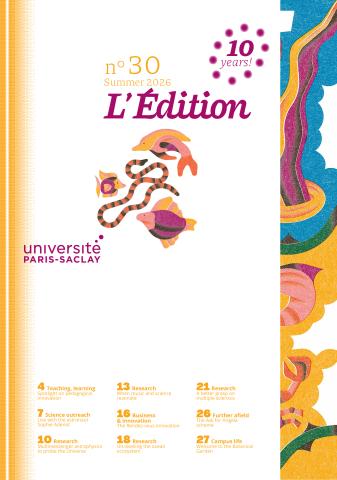
This article was originally published in L'Édition n°30.
Find out more about the journal in digital version here.
For more articles and topics, subscribe to L'Édition and receive future issues:
Among the areas most exposed to global warming, the polar regions are particularly important given their role in regulating the...
For the past decade or so, multimessenger astrophysics has opened up a unique window onto the most extreme phenomena in...
Due to its omnipresence in everyday life, music has, in recent years, become a major subject of study in the...