Multimessenger astrophysics: A new perspective on the extreme Universe
For the past decade or so, multimessenger astrophysics has opened up a unique window onto the most extreme phenomena in the Universe, by combining the study of light, gravitational waves, neutrinos and cosmic rays. But this approach is a race against time for research teams and observatories, which are now combining their data and expertise to explore every cosmic event. (This article was originally published in L'Édition n°30.)
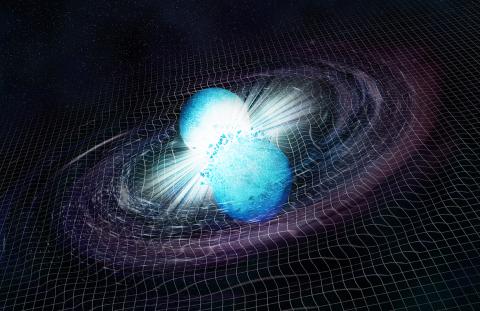
It was a “fireworks display” that made history in astrophysics on 17 August 2017. At 2.41 pm, a signal of a new kind appeared on the LIGO (Laser Interferometer Gravitational-Wave Observatory) and Virgo detectors, which monitor gravitational waves in the United States and Italy. Astronomers rushed to alert their community to this detection. Seventy observatories, on the ground and in space, took over to monitor the event. Analysis of the signal, named GW170817, indicated that it originated from the merger of two neutron stars occurring 140 million light-years from Earth (9.46 × 10¹² kilometres). Small but extremely dense, these remnants of giant stars orbited each other, drawing closer until they collided. This is the first time that a gravitational wave – in other words, a distortion of space-time – linked to such a phenomenon has been observed. Until now, and since thefirst direct detection of gravitational waves in 2015 by LIGO, all signals detected had been associated with the merger of two black holes.
But GW170817 marks another historic first. This is because the gravitational wave is not the only "messenger" bearing witness to this merger. Less than two seconds after the alert, NASA’s Fermi satellite observed a gamma-ray burst in a region consistent with the initial detection. Gamma-ray bursts are among the brightest phenomena observed in the Universe. They manifest as two electromagnetic emissions, including a very brief burst of gamma rays that Fermi is designed to detect. However, prior to GW170817, none of the satellite’s observations had yet coincided with other alerts. “After the first two detections, we tracked the phenomenon across all wavelengths. There was a huge amount of data,” recalls Fabian Schüssler, research director within the Department of Particle Physics (DPhP – Univ. Paris- Saclay/French Alternative Energies and Atomic Energy Commission, CEA) at CEA Paris- Saclay.
Combining signals fora new era in astrophysics
The event of 17 August 2017 is seen as one of the starting points for what is known as multimessenger astrophysics, which combines multiple signals to study cosmic phenomena. But this science is not entirely new, points out Fabian Schüssler. “It is based on multiwavelength astrophysics, which has been practised for centuries” and involves observing electromagnetic radiation across all wavelengths: from gamma rays to radio waves, including the visible spectrum, X-rays and infrared. In multimessenger astronomy, threeother types of signals are added: gravitational waves, cosmic rays and neutrinos.
In the latter field, another correlation emerged in September 2017. For the first time, it linked the detection of neutrinos – these elementary particles produced by a nuclear reaction – to a burst of gamma rays. The phenomenon was localised at the active nucleus of a particular type of galaxy known as a blazar. “2017 was a pivotal year,” summarises Fabian Schüssler. “Throughout my career, I have worked on cosmic rays, neutrinos and gamma rays. I have always tried to make the connection between these messengers, but at first it was considered a rather far-fetched idea.”
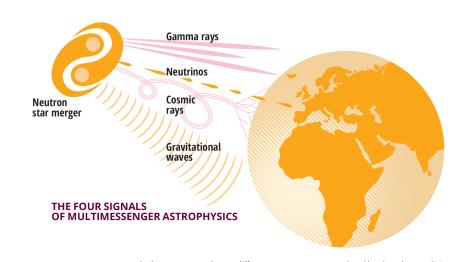
Multimessenger astrophysics focuses on violent and transient phenomena, such as the explosion of a star, the merger of black holes or neutron stars, or an active galactic nucleus. The aim is to analyse the different messengers to obtain as much information as possible about the phenomena. In the case of GW170817, “gravitational waves tell us about the initial system”. In other words, what the system was like before the merger, what the masses of the stars were, and so on. “The gamma-ray burst, for its part, provides a range of information about the system after the merger.” Without studying the electromagnetic counterpart, it would have been difficult to pinpoint the cosmic cataclysm with precision.
But analysing these signals together presents a number of challenges. “Not all phenomena emit the same signals, nor do they do so at the same time,” confirms the research director. And not all signals can be observed in the same way. Some can only be detected from space. Others can be observed using ground-based equipment, provided it is pointed in the right directionat the right time. In this sense, GW170817 was a stroke of luck: on that day, the three LIGO and Virgo detectors were on the lookout, as was Fermi. And the other observatories responded in large numbers to the alert. “With multimessenger astronomy, there is a real need to share information in real time. Because if you wait too long to point other telescopes, the phenomenon has disappeared.” With every alert, a race against time begins for the community
Astro-COLIBRI, a plateform for all detections
To maximise their chances of success, astronomers are now approaching their quest with a spirit of collaboration. Today, almost all observatories studying the transient sky issue public alerts to inform the international community. And several tools have been developed to facilitate the sharing of information. The Astro-COLIBRI plateform, created in 2017 by Fabian Schüssler and his colleagues, is one such example. This tool aims to catalogue all detections made across all wavelengths and all messenger types in real time. All these detections are made available in a shared, easily accessible database, available on the web and via a mobile app.
Astro-COLIBRI was born out of an observation: prior to 2017, “it took sometime to realise that there was a correlation between the detection of neutrinos and gamma-ray bursts. The problem was that the data was scattered across different platforms and wasn’t available in the same formats. So there was a whole lot of conversion work to be done.” The idea was then to create a programme bringing together all the information on transient events. Astro-COLIBRI quickly became a success. Currently, dozens of alerts from numerous observatories are shared everyday via the programme, which has 25,000 users. The platform allows users to select phenomena of interest and receive notifications alerting them to new detections.
Astro-COLIBRI is regularly updated with new tools to facilitate the monitoring of events, such as Tilepy, also developed by Fabian Schüssler’s team. This tool processes the location data from alerts to guide observations. “The distinctive feature of transient phenomena, particularly with gravitational waves, is that they are poorly localised in the sky,” notes the astrophysicist. This results in relatively large areas of uncertainty that are not easy to cover quickly with a telescope. Using the available information, Tilepy calculates an optimised observation plan to effectively reduce the area of uncertainty. “All that remains is to point the observatory towards the specified coordinates.”
Improving the detection of messengers
In this quest for transient astronomy, building collaborative networks has become an essential strategy for responding to alerts as effectively as possible. But first, there must be alerts to begin with. That is why scientists are also working to improve the detection capabilities of each instrument so that no signal is missed. This is precisely the mission of Angélique Lartaux, a researcher at the Laboratory of Physics of the Two Infinities – Irène Joliot-Curie (IJCLab – Univ. Paris- Saclay/Univ. Paris-Cité/CNRS) specialising in the detection of gravitational waves. “Working on the detectors is very interesting. Because if we double the sensitivity, that represents an eightfold increase in the volume of detection, which means almost ten times as many events are accessible.”
Gravitational waves are detected by devices known as interferometers. Their purpose is to measure the interference patterns produced by a laser beam split into two beams and reflected by mirrors. When a disturbance in space-time reaches Earth, the distances travelled by the beams are altered. A phase shift in the laser is then observed. The difficulty lies in the fact that these instruments measure very subtle movements and are therefore highly sensitive to the slightest disturbance. “My work involves reducing certain types of noise within the detector. Due to temperature, for example, the mirrors tend to move,” explains the researcher. “I am also working on another type of noise linked to quantum fluctuations in light, which causes the light received at a given moment to change.”
The performance of LIGO and Virgo, joined by the Japanese KAGRA (Kamioka gravitational wave detector), already demonstrates considerable progress. Since 2015, four data-taking campaigns have been carried out. Whilst the first recorded only three events, the latest, completed in November 2025, has surpassed the threshold of 200 detections. More importantly, this campaign has revealed the clearest signal ever detected of a blackhole merger. “The event is very similar to the first one observed in 2015, but the signal-to noise ratio is ten to a hundred times better, thanks to improvements in the detectors,” emphasises Angélique Lartaux. For the time being, these advances have not been enough to repeat the feat of 2017. However, the data collected provides valuable information for refining astrophysical models and our understanding of blackholes and neutron stars. This same information also helps to shape the future of gravitational waves detection.
Since March 2026, Angélique Lartaux has been deputy spokesperson for the Einstein Telescope collaboration, which aims to become Europe’s most advanced observatory in this field. To achieve this, the facility plans to utilise various innovations, including an underground infrastructure. It will also be equipped with arms measuring between ten and fifteen kilometres in length, compared to three and four kilometres for Virgo and LIGO. “The longer the arms, the better the detection.” The observatory is expected to be operational by around 2040, but the project is still only in the preparatory phase. Neither the location nor the design of the facility has been decided yet. Two options are under consideration: a triangular layout, with three double detectors, or an L-shaped layout, with two double detectors. “Our role is to highlight the advantages and disadvantages of the two designs from a scientific perspective,” explains the researcher. The aim of the Einstein Telescope is “to observe virtually all black hole mergers right back to the earliest moments of the Universe”.
SVOM on the trail of gamma-ray bursts
Whilst the future is being shaped by projects such as the Einstein Telescope, new space missions have already been launched to scan the transient sky. This is the case with the Franco-Chinese SVOM (Space-based multi-band astronomical Variable Objects Monitor) mission, which will celebrate its second anniversary in June 2026. Currently in orbit at an altitude of 625 km, the SVOM satellite is dedicated to the study of gamma-ray bursts. To this end, it is equipped with four main instruments, including the ECLAIRs wide-field telescope and the GRM (Gamma-Ray burst Monitor) gamma-ray detector. “These instruments are used to detect high-energy sources of gamma rays and X-rays in real time, and to pinpoint their location in the sky,” explains Damien Turpin, a researcher at the Department of Astrophysics (DAp - Univ. Paris- Saclay/CEA) at CEA Paris- Saclay and head of scientific operations for SVOM. It is then up to the other two telescopes, MXT (Microchannel X-ray Telescope) and the Visible Telescope (VT), to cover the targeted area within their respective wavelength ranges.
Inspired by the United States' Swift satellite, SVOM is a highly versatile platform. At the slightest sign of an alert, it is capable of automatically repositioning its telescopes in the correct direction. The mission is also unique in that it includes a network of antennas positioned along the satellite’s flight path, to receive real-time instrument status updates and alert information. Added to this are two robotic telescopes – one in Mexico, the other in China – as well as a network of small telescopes pointed at the same region of the sky as that observed by ECLAIRs. “SVOM’s added value lies in having an integrated ground segment as well as privileged collaborations with majort elescopes such as the Very Large Telescope in Chile.” As with gravitational waves, the aim is to disseminate SVOM alerts to call on the community to monitor the event as quickly as possible.
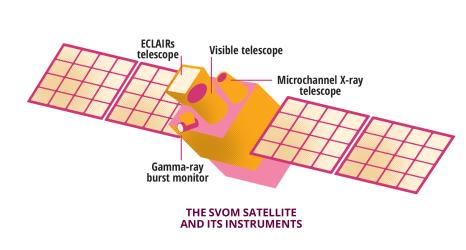
Two years after its launch, the mission is already proving its worth. By 2025, ECLAIRs had detected a total of 51 gamma-ray bursts on board. More than half of these were characterised by a redshift measurement, which provides information on the distance at which the event occurred. Another highlight: in March 2025, the instrument recorded GRB 250314A, one of the most distant gamma-ray bursts ever detected. It is thought to have originated from a star that exploded when the Universe was only 730 million years old, and whose signal is believed to have travelled for thirteen billion years before reaching ECLAIRs. “It has been twelveyears since we last detected such a distant explosion.” This observation also put the detection chain to the test. After the alert from ECLAIRs, it took MXT and VT a few hundred seconds to begin observations. Butit took a further seventeen hours for large telescopes on Earth to do the same. “This is one of our objectives: to develop the detection chain to reduce response times.”
“Gamma-ray bursts are a fascinating laboratory because we observe phenomena that occur on a timescale relevant to humans. But that means we have to be on standby 24 hours a day, seven days a week, so as not to miss a thing,” adds Damien Turpin. Fortunately, the story of GRB 250314A doesn’t end there, as 110 days later, the James Webb Space Telescope managed to detect the associated supernova. This type of observation is useful for deepening our understanding of the bursts and their origins. According to research, there are several types: short gamma-ray bursts – lasting less than two seconds – and long gamma-ray bursts.The former are thought to be produced by the merger of neutron stars, whilst the latter are believed to result from the death of a massive star. “It is therefore very important for us to know whether there is an associated supernova to validate the astrophysical scenario.” Whilst SVOM is set to make its mark on gamma-ray burst science, another observatory, whose commissioning has been long awaited, is expected to open a new chapter in the world of collaborative astronomy.
Millions of astronomical alerts to sort through
Perched on a mountain in Chile, the Vera C. Rubin Observatory is a truly extraordinary facility in the world of astronomy, boasting a field of view equivalent to forty times the surface area of the full Moon and a camera with a resolution of 3.2 billion pixels. Using its instruments, the Legacy Survey of Space and Time (LSST) project plans to produce, every three nights, a complete survey of the southern sky, taking 800 images per night. Whilst this data should help shed light on cosmological mysteries such as dark energy (see the Research article in L’Édition 26), the observatory also opens an unprecedented window onto transient phenomena. But these unprecedented capabilities bring with them equally unprecedented challenges.
Julien Peloton, a research engineer at IJCLab, knows this all too well. For several years, he has been working on developing a tool capable of processing the volume of data from LSST, which is set to be colossal compared to previous experiments. “In the 2010s, the best facilities were generating a few hundred detection alerts per night. Then that rose to 100–200,000 alerts. The Rubin Observatory aims to generate ten million.That’s clearly an order of magnitude higher,” explains the engineer. How can we sort through these millions of alerts? In 2019, whilst the observatory was still under construction, a call for proposals was launched to find a solution. Julien Peloton responded with the Fink project.
Fink is a piece of software that does more than simply receive data streams from the facilities to which it is connected. It is what is known as a broker. Once received, the stream is broken down into “alert packages” which are sent to different machines to be processed, analysed and enriched. The aim is to use the factual information extracted from the alerts to accurately characterise the detected variations and associated phenomena.The data is then stored, classified and made available. Thanks to filters, “users can customise their own settings to receive only the signals that interest them.” Depending on their choices, the alerts are then sent to them via an app or retrieved directly from the Fink database, hosted on the clouds of Université Paris-Saclay and the Computing Centre of the National Institute of Nuclear andParticle Physics (IN2P3), and available for open access.
To develop the broker, the team used another observatory, the Zwicky Transient Facility (ZTF) in California. Although it generates “only” 200,000 alerts per night, “ZTF is like a mini Rubin in every respect,” says Julien Peloton. Using data streams, including that from ZTF, Fink was built brick by brick, with a community-driven approach. “We asked experts to explain how to detect the sources they were interested in: supernovae, gamma-ray bursts, and so on. This created a sort of jigsaw puzzle that we filled in bit by bit.” In just a few years, the team grew from two people to over 150 contributors from around twenty countries, gradually developing the tool.
All that remained for Fink to do was to take the plunge. That has now been achieved with the launch of the Rubin Observatory. On the night of 24–25 February 2026, the facility issued its first official alerts: 800,000 in just a few hours. And the scale-up has certainly made an impact. “We’ve seen a tsunami of people flooding the database,” smiles Julien Peloton. “Within two weeks, we were getting over a million requests a day, compared to around 100,000 before.” Although it is still in the commissioning phase, the observatory has since reached several million alerts per night. This means plenty of work ahead for Fink, which is one of the seven brokers developed to handle the LSST data stream.
Integrated with other platforms, including Astro-COLIBRI, Fink is not limited to LSST, as it has extensions in many other projects. “Fink is already being used by other collaborations, including LIGO/Virgo/KAGRA, SVOM and GRANDMA.” Launched in 2018 under the leadership of Sarah Antier, a lecturer at IJCLab, GRANDMA (which stands for Global Rapid Advanced Network Devoted to the Multimessenger Addicts) is an international network of twenty-five telescopes dedicated to transient astronomy and alert monitoring. “The watchword today is really cooperation,” confirms Julien Peloton. Will these efforts soon be rewarded with another exceptional detection? “The last few years haven’t been as prolific in multi-messenger events as 2017, but we still believe in it and the community is ready to welcome the next event !”, concludes Damien Turpin.
References
- F. Schüssler et al., Astro-COLIBRI: A Comprehensive Platform for Real-Time Multi-Messenger Astrophysics, Proceedings of Science, 2025.
- A. Abac et al., The Science of the Einstein Telescope, Journal of Cosmology and Astroparticle Physics, 2026.
- A. Abac et al., GWTC-4.0: An Introduction to Version 4.0 of the Gravitational-Wave Transient Catalog, Astrophysical Journal Letters, 2025.
- B. Cordier et al., SVOM GRB 250314A at z ≃ 7.3: An exploding star in the era of re-ionization, Astronomy and Astrophysics, 2025.
- Fraga et al., Transient classifiers for Fink Benchmarks for LSST, Astronomy and Astrophysics, 2024.
This article was originally published in L'Édition n°30.
Find out more about the journal in digital version here.
For more articles and topics, subscribe to L'Édition and receive future issues: