Polar regions and ice: Territories and research undergoing change
Among the areas most exposed to global warming, the polar regions are particularly important given their role in regulating the climate. At Université Paris- Saclay, several research projects are currently underway in these regions to better understand the changes underway and anticipate those to come. (This article was originally published in L'Édition n°29.)
At first glance, the polar regions may appear similar: two vast, hostile, and inaccessible white expanses. However, while the two areas, delimited by the Arctic and Antarctic circles, account for most of the cryosphere - that is, all the water present in solid form on Earth - their apparent uniformity actually hides two very different realities. At the North Pole, the Arctic consists of an ocean largely covered by ice and bordered by inhabited continents; at the South Pole, Antarctica, an isolated continent, is covered by an ice cap several kilometers thick. Long perceived as extremely stable regions, these areas are in fact among the most sensitive to climate change, warming up to four times faster than the global average, according to recent research.
Reconstructing the climates of the past
Amaëlle Landais, research director at the Laboratory for Climate and Environmental Sciences (LSCE- Univ. Paris-Saclay/UVSQ/French National Centre for Scientific Research, CNRS/French AlternativeEnergies and Atomic Energy Commission, CEA), focuses her research specifically on Antarctica. A specialist in ice caps since her thesis in 2004, she leads the Ice, Climate, and Stable Isotopes (GLACIO) research team and works in particular on observing recent warming in Antarctica. Since 2019, she has also been an integral part of the Beyond EPICA project, whose team recently succeeded in drilling the oldest ice ever reached. Taken from the Antarctic ice sheet, the ice core obtained is 2,800 meters long and estimated to be over 1.2 million years old. It provides valuable data on past climates and global temperature changes.
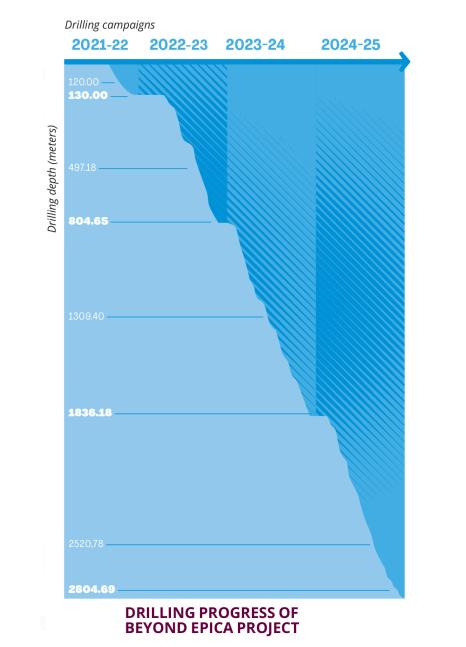
From 1996 to 2004, an initial European project called EPICA successfully obtained an ice core estimated to be 800,000 years old. The European project Beyond EPICA - Oldest Ice aims to reach one million years. Amaëlle Landais explains: “There was a major climate transition around a million years ago, during the mid-Pleistocene. The periodicity of glacial and interglacial cycles increased from 41,000 to 100,000 years. One of the questions the team is asking is whether this transition was due to a change in the atmospheric concentration of greenhouse gases, particularly carbon dioxide (CO₂ ).” Ice cores, whose trapped air bubbles provide direct evidence of the composition of the past atmosphere, are one of the most valuable tools for answering this question.
After extensive radar surveying to determine the most suitable location for drilling, the Petit Dôme C site, near the Franco-Italian Concordia Antarctic base, was finally selected for this study. It took four years to complete the drilling and reach the bedrock. As samples were collected, an isotopic analysis system deployed in the field enabled the team to track the succession of glacial and interglacial cycles in real time, and thus estimate the approximate age of the core during drilling. Based on these measurements, the research team believes it has reached 1.2 million years at a depth of 2,490 metres. The entire 2.8 km drill hole was completed in January 2025, but a replica of the deep parts of the drill hole will be initiated during the 2025-2026 season.
Now brought back and sliced up, the ice from the drilling is being analysed from every angle by the nearly thirty laboratories and ten countries participating in the project. At LSCE, priority is given to studying water isotopes, which are markers of past temperatures, and to dating via the analysis of argon, oxygen and nitrogen isotopes in air bubbles. “Our analyses, supplemented by those of teams in Grenoble and Bern (Switzerland) who measure greenhouse gases, will highlight the links between climate variation and greenhouse gas variation in a pre-anthropogenic context, i.e. a period when humans did not have a significant influence on the climate,” explains Amaëlle Landais.
Although it will take several decades to study all the data contained in these ice cores, the initial results, such as the age of the core up to 2.5 km and the first temperature curves, will be published at the end of 2026, according to the researcher. Highly awaited within the scientific community, the conclusions of the Beyond EPICA project will serve as a basis for many other research teams, particularly climate modelers, who depend on this type of data to refine and test their prediction models. “Studies have been showing and predicting a clear increase in temperature for several decades now, greater in the Arctic than the global average,” adds the researcher, “but the rate at which huge ice caps such as Greenland and Antarctica are melting remains very difficult to predict. The only certainty is that humans will have to change their habits and adapt. Prediction models help to estimate how much time will be left to do so.”
Permafrost thawing with consequences that are still largely unknown
On the other side of the globe, above the 66th parallel north, the Arctic is also particularly affected by climate change. According to Antoine Séjourné, a lecturer at the Paris-Saclay Geosciences laboratory (GEOPS - Univ. Paris-Saclay/CNRS), warming there is already +3 to +4°C over the last century, well above the global average. Fascinated by cold environments, the scientist spent many years studying Mars before devoting most of his research to permafrost, i.e. soil that has been frozen for at least two consecutive years. Generally formed during the last ice ages, tens of thousands of years ago, this soil covers about 20% of the northern hemisphere's surface, or 20 to 24 million km².
"With climate change, permafrost is thawing, i.e. rising above 0°C, which causes the permafrost ice to melt," explains Antoine Séjourné. "This phenomenon has a major impact on ecosystems and waterresources, but also on global carbon stocks". He continues: "When organic matter from the permafrost is released into lakes during thawing, microorganisms break down this organic matter and convert it into green-house gases, which escape into the atmos-phere. Depending on the amount released, these gases influence the carbon cycle because they can in turn amplify warming, which accelerates permafrost thawing through a positive feedback loop." The scientific community, which estimates that 1,500 gigatonnes of organic carbon are currently stored in permafrost – roughly twice the amount of CO₂ in the atmosphere – is therefore particularly alarmed by this phenomenon. As Antoine Séjourné explains, “one of the biggest questions in our community is how much of this millennia-old carbon will be reintroduced into the system, and how quickly.”
To better understand the impacts of Arctic permafrost thawing and its role in climate change, Antoine Séjourné and his team have been developing, since 2021, the international PRISMARCTYC project, which stands for Permafrost degradation impacts on soils, human societies, water resourcesand carbon cycle. The studies focus particularly on central Yakutia (eastern Siberia) and south-western Yukon (Canada), two regions where permafrost, rich in ice and therefore highly sensitive to warming, is causing ground subsidence and the rapid formation of lakes. During several field campaigns conducted since the summer of 2022 in the Yukon, the PRISMARCTYC interdisciplinary research team has been collecting various samples of water, sediments and gases emitted by the forming lakes, as well as conducting drilling and drone imaging of the region. Once back in France, the scientists analysed this data to better understand the chemistry of the water, the type of microbial communities present, and the amount of carbon and methane emitted by these lakes. “Although the formation of lakes promotes the development of aquatic plants, which help trap carbon from the atmosphere, we find that all the lakes studied emit carbon in the form of greenhouse gases and therefore remain slight sources of carbon,” says Antoine Séjourné. “More broadly, thawing and warming are having dramatic consequences in the region and are disrupting the traditional way of life of indigenous populations in particular."

More surprisingly, the team noted a significant difference in warming between the Yukon region and central Yakutia, despite these two areas of boreal forest being similar and located at the same latitude. While it seems difficult to identify a single factor to explain this phenomenon, the difference in anthropisation between the two regions appears to be an interesting avenue to explore. For the rest of the project, Antoine Séjourné and his team plan to explore multiple hypotheses in order to better understand the differences between these two areas. A better understanding of the parameters controlling thawing paves the way for potential solutions to adapt to or mitigate future changes. For the moment, a new field study in the Yukon is already planned for the summer of 2026, as the geopolitical context has made Siberia (Russia) inaccessible since 2022.
Bridging scientific and indigenous knowledge
Beyond improving the understanding of geomorphological processes, an entire section of the PRISMARCTYC project is devoted to scientific communication and educational support for indigenous populations. For Antoine Séjourné, it seems essential to “share with communities what the team is documenting on their own territory.” With a view to passing on knowledge, the lecturer has set up and runs cultural, scientific and linguistic exchanges between schools in Châtenay-Malabry (92) and the village of Syrdakh in Siberia.
For Alexandra Lavrillier, lecturer at the Cultures, Environments, Arctic, Representations, Climate laboratory (CEARC - Univ. Paris-Saclay/UVSQ) and member of the Institut universitaire de France (IUF), it is precisely the knowledge of indigenous communities that is essential to climate research. The anthropologist, invited to join the PRISMARCTYC project because of her expertise on Siberia, has been working for more than thirty years with the indigenous peoples of Yakutia, in central Siberia. Since her first encounter with Evenki and Even reindeer herders in 1994, she has been interested in the relationship between humans and nature and these nomads' perception of the environment. “I immediately sensed that there was immense knowledge behind this ability to live in a world that we see as extreme and which, for them, sometimes is, but which is above all what they call their ‘home nature’,” explains Alexandra Lavrillier.
After spending many months alongside Evenki reindeer herders and based on participant observations and semi-open interviews, the lecturer is studying these communities' cognitive perceptions of the environment and climate change. In 2011, following an extreme weather event that impacted the Evenki population, Alexandra Lavrillier developed the BRISK project (Bridging Indigenous and Scientific Knowledge about global change in the Arctic). The aim was to set up a community-based observation of climate and environmental change in Siberia. “The idea was that herders are first-rate observers,” explains Alexandra Lavrillier. “Researchers are not the only ones with knowledge, but work alongside indigenous people to study the environment together.” In this context, she defines the concept of "co-researcher", now widely used in social anthropology research: “Reindeer herders are not researchers in the strict sense of the term because they have not been trained from a Western academic perspective, but they are co-researchers because they are integrated into the research process and the co-production of scientific publications,” she adds. Between 2013 and 2021, the BRISK project has two principal co-researchers, L. Egorova and S. Gabyshev, as well as 25 participating reindeer herding families spread across an area of 76,000 km².
Following the BRISK project, and again in collaboration with co-researcher Semen Gabyshev, Alexandra Lavrillier published a study in 2018 on the concept of "extreme events" among the Evenki. This study refutes previous anthropological studies which claimed that indigenous peoples of the Arctic were unfamiliar with this concept, given their adaptation to an already hostile environment. In their article, Alexandra Lavrillier and Semen Gabyshev argue that the Evenki do indeed have a concept of "normality" and recognise different types of "anomalies", which they classify according to a degree of extremity based on their ability to adapt to them. The pair also demonstrate that “the Evenki possess environmental knowledge similar to science: extensive, difficult to acquire and essential for adapting to the environment and understanding increasing climate change."
As an anthropologist working with the peoples of Yakutia, Alexandra Lavrillier faces some worrying conclusions. “According to the observatories that have been set up, all areas of the environment, without exception, are already being affected by climate change, and fellow researchers are noting an increase in extreme events, according to their own observations. In some areas, the onset of winter is delayed by three months. The impact is enormous for populations that live off hunting, but also for snowmobile travel and the reindeer calving season.” From a linguistic pointof view, the anthropologist also notes significant changes: “In 2012, a mantra in the Siberian Arctic translated as ‘it's getting warmer’ when talking about the climate.The Evenki and Even later used another expression, which means ‘it's getting hot’. Today, the phrase they use is ‘the environment is broken’.” Based on these findings, Alexandra Lavrillier calls for better integration and consideration of indigenous observations in international reports. She explains: “Traditional environmental knowledge makes a valuable contribution to climate studies in a number of ways. It demonstrates the importance of studying climate change on a smaller scale, as even anomalies considered minor and overlooked by environmental scientists are noticed by indigenous peoples and have a significant impact on local communities.” Furthermore, the scientist believes that their knowledge of the environment is often “more detailed and elaborate than that used in environmental sciences,” particularly with regard to descriptions and classifications of snow and ice.
Currently unable to continue her research in Yakutia due to the current situation, AlexandraLavrillier is develop-ing joint research projects in Fennoscandia with the Sami people. Thanks toher research in previous years and in collaboration with Semen Gabyshev, now a member of CEARC, she also continues to share her expertise on Yakutia.
Changing Western perceptions of the polar regions
Why should Western populations be concerned about the rapid transformation of these polar regions? For researchers at Université Paris-Saclay, the answer is obvious. Amaëlle Landais emphasises the importance of ice caps in stabilising the climate and highlights the consequences for the entire globe: “The total melting of Antarctica would raise the average sea level by sixty metres, which would cover about a quarter of the current landmass. Even on its own, the melting of Greenland, which would raise sea levels by about seven metres, would already have major consequences for coastal cities and islands.” Antoine Séjourné confirms: “What happens in the Arctic will not stay in the Arctic. The thawing of permafrost has a real impact on the greenhouse effect and river flow, which has global consequences.”
In addition, the warming of cold spots around the globe slows down heat exchange and thermohaline circulation, which has a significant impact on the European climate, according to the lecturer. Alexandra Lavrillier also believes that the problems facing the Arctic do not stop at the 66th parallel: “Latitudes are artificial human divisions. Everything that highly industrialised countries produce in terms of pollution, heat and heavy metals circulates and has an impact on the poles. But all reports show that extreme events, which are already very intense in the Arctic, will intensify across the globe and eventually reach Western countries.”
The experts on the polar regions are unanimously concerned about the lack of response at the international level and are aware of the importance of communicating their work widely to the general public, students and younger generations.Through his educational guides and workshops in schools, Antoine Séjourné hopes to raise awareness from an early age and inspire potential careers. Amaëlle Landais regrets that her lectures still reach too large aproportion of people who are already aware of environmental issues. Finally, for anthropologist Alexandra Lavrillier, communicating the importance of her work inclimate research is of particular importance.
“Climate and environmental change are not just biophysical. The consequences are also human and particularly affect certain groups that depend on nature and must continually adapt.” Although the researcher welcomes the progress made in incorporating social anthropology into climate studies, she believes that “much remains to be done” and that “indigenous knowledge, if sufficiently well preserved as a system of thought, has much to contribute to the dialogue with environmental sciences”. She concludes: “We can only be respectful and attentive to these nomadic populations for their knowledge, resilience and patience. All these encounters are opportunities to learn and enrich each other.”
References :
- Bouchet M., Landais A., et al. The Antarctic Ice Core Chronology 2023 (AICC2023) chronological framework and associated timescale for the European Project for Ice Coring in Antarctica (EPICA) Dome C ice core. Climate of the Past, 2023.
- Hughes-Allen L., Bouchard F., Séjourné A., et al. Automated Identification of Thermokarst Lakes Using Machine Learning in the Ice-Rich Permafrost Landscape of Central Yakutia (Eastern Siberia). Remote Sensing, 2023.
- Lavrillier A., and S. Gabyshev. An Indigenous Science of the Climate Change Impacts on Landscape Topography in Siberia, Ambio, 2021.
- Beyond EPICA project website : https://www.beyondepica.eu/
- PRISMARCTYC project website : https://prismarctyc.com/
This article was originally published in L'Édition n°29.
Find out more about the journal in digital version here.
For more articles and topics, subscribe to L'Édition and receive future issues: