
Street lighting and light pollution: lighting the city, protecting life
Since 2009, a special national event has taken place every October: Jour de la Nuit (Night Day), organised by the association Agir pour l'environnement (Acting for the Environment). This initiative aims to raise public awareness of the issue of light pollution. But what is currently known about the effects of excessive street lighting on people, wildlife and plants, and the environment in general? To what extent has this phenomenon been taken into account in public policy? And what actions are being implemented to limit its effects? Researchers at Université Paris-Saclay are helping to shed light on these questions with their latest studies. (This article was originally published in L'Édition n°28.)
In the late 19th century, a small breakthrough took place in French cities. Driven by the industrial revolution and the growth of cities, the use of street lighting increased considerably, both to illuminate streets at night and to enhance store signs and advertising boards. Street lighting has been around for hundreds of years, but the advent of electricity marked a particularly important turning point; for the first time, light no longer originated from a natural source (fire, gas or oil, for example), but was created by converting electricity. This became known as artificial lighting.
In 2016, an international study published in the journal Science Advances estimated that 80% of the world's population were already living under skies altered by street lighting. This rose to 99% in Europe and North America. The phenomenon is such that the notion of light pollution gradually began to emerge in the scientific community. Chloé Beaudet, a PhD candidate at the Paris-Saclay Applied Economics laboratory (PSAE - Univ. Paris-Saclay/French National Research Institute for Agriculture, Food and Environment, INRAE/AgroParisTech) and a member of the Nocturnal Environment Observatory, defines this concept as an excess of artificial lighting. "We're talking about pollution, because this light has harmful effects on a number of things, including biodiversity, human health and even access to the stars," explains the scientist. "All species, nocturnal and diurnal alike, are accustomed to a natural day-night cycle, and are therefore disrupted, especially in their reproductive and feeding behaviours, and in their ability to orientate themselves." However, the long-term consequences of this pollution are still poorly understood, particularly for species living in urban areas.
A link between light pollution and the diet of city birds
Anders Møller, a researcher at the Ecology, Society and Evolution laboratory (ESE - Univ. Paris-Saclay/French National Centre for Scientific Research, CNRS/AgroParisTech) and now retired, spent many years working on these urban disturbances and their impact on birdlife. A specialist in ecology and the evolution of urbanisation, the scientist focused in particular on how living beings adapted to these new environments, where plant and animal diversity is generally lower and natural habitats are often destroyed or highly fragmented.
In 2023, Anders Møller and his team published a study on the effects of anthropogenic pollution, particularly light pollution, on the composition and behaviour of various bird species. By analysing satellite data and observing 127 bird species in fourteen European cities, including Poitiers in France, the scientists established an inventory of the disturbances observed across Europe. While no significant link was found between noise pollution and a change in avian community behaviour, the study shows a "negative association between the number of insectivorous species and the level of light pollution" and suggests that "the degree of light pollution more significantly impacts avian communities' composition." More specifically, the researchers noted that this type of pollution affects the number and richness of insectivorous and omnivorous bird species, unlike other granivorous species, for which no negative effects were proven.
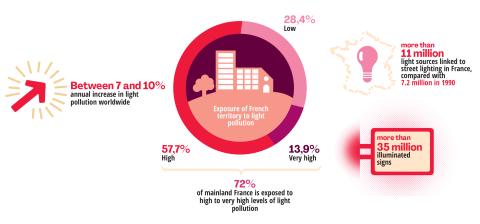
Anders Møller and his team accounted for these differences by the impact of light on the insects themselves. As the study explains, although some light sources attract certain insect species, light pollution is "detrimental", "leading to overall insect decline" in European cities. Insectivorous birds, which find it harder to feed than omnivorous or granivorous species, are thus indirectly affected and gradually disappear from urban areas. To mitigate these negative effects, the study suggestsa range of measures to increase avian diversity, such as expanding the numberof green corridors to maximise potential refuges for insects, and consequently the insectivorous birds that feed on them.
A potential role in the development of breast cancer
As with other species in urban environments, humans are not immune to these disruptions caused by street lighting. Like other living organisms, they are subjectto a day/night circadian rhythm, partly regulated by melatonin, the hormone responsible for inducing sleep. When this cycle and the action of this molecule are disrupted, it causes hormonal and physiological effects with a range of consequences, such as disturbancesin sleep, diet and the immune system. "Exposure to high levels of artificial lightat night has already been associated with a number of more serious health effects, such as cardiovascular disease, cancer and depression," explains Pascal Guénel, researcher emeritus at the Centre for Epidemiology and Population Health (Cesp - Univ. Paris-Saclay/French National Institute of Health and Medical Research, Inserm/UVSQ). He focuses in particularon the links between certain environmental and occupational factors and the development of human cancers. For several years, he has been studying night work - which is, by its very nature, highly exposed to artificial light - and its potential role inthe development of breast cancer. In 2019, the International Agency for Research on Cancer (IARC) had already evaluated night work as a probable carcinogen.
To gain a better understanding of the effects of artificial light at night on the development of breast cancer in the general population, Pascal Guénel and his colleagues studied 5,222 women with breast cancer and 5,222 healthy control participants from the E3N-Generations cohort, a large prospective cohort of women in France monitored since 1990. For each woman, exposure to artificial light at night was measured using satellite images of the place where she lived. The results published in 2025, support the hypothesis that exposure to artificial lighting at night increases the risk of developing breast cancer. Nevertheless, Pascal Guénel urges caution: "The difficulty with this type of study is that the women with the highest exposure to light pollution are also exposed to other environmental factors that are sometimes difficult to assess accurately, including urban air pollution, which is also strongly suspected of increasing the cancer risk." However, a weak positive association between breast cancer and artificial light at night does still persist after adjusting for various breast cancer risk factors - such as hormonal and reproductive factors, or exposure to certain air pollutants, for example.
Although the origins of cancers are often multifactorial, Pascal Guénel believes that the proportion of breast cancer cases attributable to artificial light at night represents a significant public health problem, given the widespread prevalence of exposure. "Light pollution is one of the environmental factors to which everyone is subject, so it's important to understand its long-term effects on health." He continues: "Our study now concludes a possible link between breast cancer and artificial light at night, and thus indicates the need for more detailed studies on the effects of light pollution on human health."
To continue investigating this issue, Pascal Guénel suggests conducting new studies incorporating more comprehensive and precise measurements of exposure to artificial light at night. He cites, in particular, recent studies that have used a method of assessing light exposure capable of distinguishing between different wavelengths. "Blue light, such as that produced by light-emitting diodes (LEDs), is known to be more likely to disrupt circadian rhythms and may therefore have potential effects on health. A large-scale study on this issue in France now seems necessary given the rapid rise in the use of LED lighting." On streets and indoors, LEDs are gradually replacing traditional lighting with their warmer colours, not least for economic reasons.
The French largely in favour of reducing light pollution
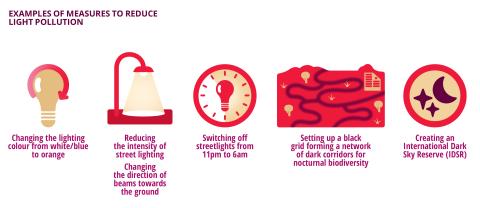
Given these impacts on human health and biodiversity, one question naturally comes to mind: how can we reduce people's exposure to artificial light, especially at night? Although most of the existing solutions for reducing light pollution in urban and peri-urban areas are already well known - such as switching off lighting at certain times, reducing light intensity, changing lamp colour or adjusting the height and orientation of street lights - theimplementation of these measures has been slow to develop in major cities. As an environmental economist in the PSAE laboratory, Chloé Beaudet's work focuses on the socio-economic impacts of these various measures. She also explores the acceptability of changes to public lighting policies to the French public, in order to help local authorities in these matters.
In 2022, together with Maïa David and Léa Tardieu, her two PhD supervisors, she published a study conducted in the Montpellier area on this subject. Light pollution in this region is of particular importance in view of its proximity to the Cévennes National Park, one of the six French parks designated as International Dark Sky Reserves (IDSR). Through an online survey that attracted 1,715 responses across France, including 1,148 in the Montpellier region, the research team identified two categories of reaction to proposed measures to reduce light pollution. Chloé Beaudet explains: "The largest group, made up of around 80% of those surveyed, is fairly supportive of light reduction measures. The remaining 20% are generally opposed, particularly to switching off streetlights from 11pm to 6am, which is the most divisive measure. However, some measures, such as changing the lighting colour from white to orange, meet with very little resistance."
Cross-referencing these responses with the socio-demographic characteristics ofthe residents, the scientist notes that those least in favour of reducing lighting mostly live in urban areas. "This can be explained by the fact that people living in cities make greater use of public space at night and are more likely to travel on foot. Residents of peri-urban areas, on the other hand, are more likely to travel by car at night and therefore have less need for lighting, even on their own streets." The study also concludes that people in favour of reducing lighting at night are more sensitive to environmental issues, work less at night and feel safer in their neighbourhoods.
A response at the local level
So how can the preferences of city dwellers be reconciled with recommendations to switch off lighting in order to preserve biodiversity? For Chloé Beaudet, the two are not mutually exclusive. In 2025, working with Léa Tardieu, Maïa David and a team of geomaticians and ecologists, she published a scientific paper that attempted to reconcile these two aspects.
By analysing very high-spatial - resolution satellite images, the research team modelled the ecological corridors of different species in the Montpellier region, both with and without taking the impact of light pollution into account. The work was repeated for six groups of nocturnal species sensitive to such pollution, including insects, bats, amphibians and a family of nocturnal birds. The data obtained, cross-referenced with the preferences of the region's residents, identified actions to be implemented on public lighting in the Montpellier area, without compromising between population and biodiversity. "Our work shows that neighbourhoods with a high biodiversity value can rapidly reduce their light pollution by switching off lights, with the support of the local population. In areas with moderate ecological importance, lighting switch-offs are less well received, but other measures, such as reducing lighting intensity or adjusting the position of streetlights, would be more readily accepted." However, some neighbourhoods where the ecological stakes are higher are stil lencountering great reluctance on the part of the local population when it comes to proposals to turn off street lights completely.
For Chloé Beaudet, these varied result sdemonstrate the importance of designing solutions at a local level. "Night lighting is currently still reduced to a binary choice between switching on and switching off, but no single universal approach will be effective against light pollution. Our study suggests adapting lighting policies to the context - both environmental and social - of each area." As part of its commitment to contributing to the transformation of the region, the research team has incorporated the results of its study into an interactive application designed for urban planners and decision-makers. This is intended to provide a better understanding of the different potential small-scale solutions.
Cities that are more respectful of the living world
Faced with all these constraints andthe abundance of existing solutions, researchers are urging planners to take scientific studies into account in their future modernisation work. Anders Møllerand his team are calling for certain "naturally dark or poorly lit" areas in cities to be kept as such. In their view, these spaces contribute to increasing biodiversity and "therefore deserve the same conservation attention as clean air, water or soil." Pascal Guénel also supports the idea that urban greenery would help mitigate the role of exposure to artificial light at night in breast cancer, and would therefore have a positive impact on human health.
Chloé Beaudet, whose current research focuses on the potential impact of reduced lighting on crime, has just completed a map of French municipalities documenting the light-reduction measures implemented at local level. She highlights the progress made in France on this issue. "Although light pollution worldwide continues to increase by 7% to 10% per year with urban expansion, France is an exception, and one of the few countries to have reduced its artificial lighting at night in recent years," she enthuses. While rising electricity prices are probably responsible for the sharp uptake in the number of municipalities switching off their public lighting since 2022, Chloé Beaudet maintains that a fall in light pollution was already visible in some rural municipalities as early as 2014, rejecting the idea that the motivation is purely economic. This is good news for the scientist, who believes that "the subject of light pollution in economics is still very under addressed from an academic perspective" and that "there is still a lot of room for innovation on this issue".
References :
- Tardieu L., Beaudet C., (...) David M., Planning sustainable urban lighting for biodiversity and society, Nature Cities, 2025.
- Moller A. et al., Effects of light and noise pollution on avian communities of European cities are correlated with the species’ diet, Scientific Reports, 2023.
- Guénel P. et al., Outdoor Exposure to Artificial Light at Night and Breast Cancer Risk: A Case–Control Study Nested in the E3N-Generations Cohort. Environmental Health Perspectives, 2025.

This article was originally published in L'Édition n°28.
Find out more about the journal in digital version here.
For more articles and topics, subscribe to L'Édition and receive future issues: