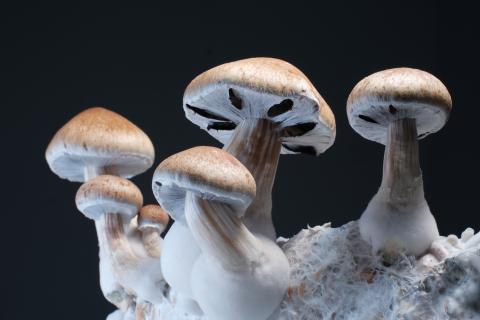
Mycelium Technologies: will mycelium soon be on our plates?
Founded in April 2022, the start-up Mycelium Technologies aims to market mycelium as a food for human consumption. Mycelium is grown on discarded pulses and repurposed agricultural by-products. It enriches and adds texture to this plant-based base, whilst offering a good alternative to meat. The start-up is able to control its texture and colour to develop bespoke products.
In April 2022, two alumni of Université Paris-Saclay, Laetitia Pierazzi and Jaafar Kilani, along with Olivier Hiezely, founded Mycelium Technologies in Nice. This deep-tech start-up specialises in the production of foods made from mycelium, the root-like structures of fungi. That same year, it received the French Tech Emergence Grant (BFTE) worth €90,000. In 2023, it won the i-Lab competition. In 2024, the company was selected for the NETVA (New Technology Venture Accelerator) deep-tech programme in the USA.
It also moved to the Saclay plateau that year: “It’s very hard to be an entrepreneur, especially when you’re a woman. Although our first incubator was in Nice, we then continued our support during our acceleration phase with IncubAlliance Paris-Saclay, which encourages women’s projects in deep tech, within a rich environment where we feel supported,” reveals Laetitia Pierazzi. She continues: “We need to encourage young women to become entrepreneurs and to pursue careers in tech; there are far too few of them in science. There is still a lot of work to be done to achieve this.”
In total, five people currently work at the company: the three co-founders, a biotechnology engineer responsible for quality and food safety, and an engineer in charge of production – fermentation. The team will expand following the fundraising round planned for 2026.
Repurposing downgraded pulses and agricultural by-products
“At first, we wanted to repurpose a variety of agricultural by-products and residues, such as the silver skin of coffee — the thin layer of cellulose surrounding green coffee beans — as part of a partnership with the Malongo brand. But creating new foods from by-products is very complicated in terms of regulations,” explains Laetitia Pierazzi. The start-up therefore turned to less exotic products – pulses – sourced from French agricultural cooperatives. By using this substrate to grow the mycelium, the food developed by the start-up is not classified as a "novel food" – a category subject to stricter regulations than those for conventional food. For the past year and a half, Mycelium Technologies has been offering tastings of its food products at various trade fairs, including the 2024 International Food Exhibition (SIAL) and Sirha 2025, the global trade fair for the catering, hospitality and food industries, where it was named Best Culinary Innovation.
Using the pulses it collects, the start-up creates a plant-based base using its own proprietary process, which it places in trays. Fungal spores are then introduced. The whole mixture is placed in fermenters – large cabinets where humidity and temperature are controlled. In less than 48 hours, the mycelium — the white roots of the mushrooms, invisible to the naked eye — consumes the entire plant-based base, and the product is then ready to be packaged and cooked. It can be kept chilled in vacuum-sealed packaging and can even be frozen, with a shelf life of several months. This is the option favoured by Mycelium Technologies for logistical and storage reasons, and is also better suited to professionals.
A bespoke product with multiple potential benefits
“The colour of the product depends on the substrate. If we use light-coloured pulses, then the final product will be light-coloured too. The mycelium will boost the nutritional properties of the base ingredients and add mycoproteins. The substrate is also rich in fibre,” explains Laetitia Pierazzi. The start-up is able to create bespoke products – in terms of colour, texture and taste – for professionals, thanks to its strategic choice of substrates and mushroom strains. “We carry out extensive screening to identify combinations of plant-based substrates and mushrooms that work well together. The aim is to avoid adding additives and to put naturalness back at the heart of the plate,” she explains.
As we need to reduce red meat consumption for health, cost and sustainability reasons, INRAE and INSERM are working on replacing animal proteins with alternative proteins such as mycelium. “Mycelium is a food rich in protein, fibre (including beta-glucans, which protect the cardiovascular system), vitamins and antioxidants, and contains very little fat or sugar. Inserm in Nice in particular, where we are based, is interested in the introduction of mycelium and its health benefits for insulin-dependent individuals or those suffering from severe obesity. We are also working with INRAE to demonstrate the benefits of mycelium on the microbiome,” explains Laetitia Pierazzi.
Bringing Mynion to market
The start-up is already well advanced, as the food product is at a TRL (Technology Readiness Level) of 8–9 and the production technology at TRL 6. “We wanted to gauge market interest before scaling up. We are currently raising €5 million to fund this phase,” adds the co-founder. The key challenge in scaling up is to fine-tune the fermenters so that we can control mycelium production on an industrial scale. To this end, the start-up is collaborating with equipment manufacturers and is regularly putting out calls for partnerships. “We want to integrate various sensors into these culture chambers and modify the existing technology so that it replicates the natural environment of the mycelium. We’ll be tweaking various parameters, particularly by using artificial intelligence,” explains Laetitia Pierazzi.
The start-up’s ambition is to bring a new, very natural food product to market, which would be called "the mynion". Unlike mushrooms, which are very spongy, the mycelium produced through solid-state fermentation has a texture similar to meat, with an umami flavour that is both woody and meaty. Despite its significant nutritional benefits, it will be sold at around €10 per kilo to professionals. The product is expected to be launched in the second half of 2026. After several years of R&D, Mycélium Technologies has entered its pre-industrial phase this year, with the aim of setting up a pilot plant with a production capacity of one tonne per month. Production will be scaled up gradually, reaching 10 tonnes per month by 2027 and 1,500 tonnes per year by 2030.
The start-up Mycelium Technologies will be present on Friday 19 June 2026 at stand 3H19 of Université Paris-Saclay at the Viva Technology 2026 trade fair at Paris Expo, Porte de Versailles.