


Following on from Master's 1, the Master's 2 year of the Ergonomics and Human Factors program aims to train students to carry out ergonomics interventions in any sector of activity. The program includes a research option for students who wish to learn about ergonomics research.
The graduation gives access to the Certified Junior Ergonomist certification: https://www.artee.com/la-certification-ejc/
The Master 2 year builds on and deepens the knowledge and skilss acquired in the first year of the Ergonomics and Human Factors program. It focuses on the progressive mastery of the professional skills needed to carry out an ergonomic intervention with relative autonomy. This second year is completed entirely through a work-study program throughout the year in the form of an apprenticeship contract.



Information
Skills
The second year of the Master's program in Ergonomics and Human Factors focuses on the five areas of expertise covered by the Ergonomics major:
- Understanding human activities in context using a systemic approach
- Collaboratively establishing the social, technical, and financial conditions for an intervention
- Conducting an ergonomic intervention independently
- Adapting one's ergonomic practice to societal changes
- Conducting a reflective analysis of ergonomics, the profession of ergonomist, and one's own practice.
These areas of expertise are consistent with the RNCP (National Register of Professional Certifications) file for the Ergonomics major, which lists all the skills targeted by the degree: https://www.francecompetences.fr/recherche/rncp/38544/
Objectives
L'année de master 2 comprend un ensemble d'unités d'enseignements thématiques en complémentarité avec la première année de formation. Elle comprend également une unité d'enseignement dédiée à l'accompagnement méthodologique pour la conduite d'une intervention en entreprise des alternants. Une autre unité d'enseignement est dédiée à une mise en débat de l'activité des alternants en entreprise pour échanger sur les pratiques professionnelles des ergonomes et les questions vives qui traversent le métier et la discipline.
L'ensemble des enseignements sont construits dans une logique de complémentarité de plusieurs formats : apport de connaissances, mini projet, étude de cas, présentation par les étudiants de situations professionnelles.
Une partie importante des unités d'enseignements s'articulent avec l'intervention ergonomique que les étudiants doivent réaliser tout au long de l'année en entreprise. Ce travail en entreprise donne lieu à plusieurs rendus au cours de l'année ainsi qu'un mémoire académique et une soutenance en fin d'année.
Career Opportunities
Career prospects
Ergonomics
Ergonomist, consultant ergonomist
Occupational/industrial risk prevention ergonomist
Human-computer interaction ergonomist - HCI
Industrial ergonomist
Ergonomist in charge of keeping disabled people in employment
Ergonomist in the scientific research field
Human factors ergonomist
Product and service ergonomist
Prevention officer
Human and Organisational Factors Specialist (FOH)
Human Factors Engineer
Prevention project manager
Calendar
Admission Route
Capacity
Available Places
Target Audience and Entry Requirements
For direct entry into the second year, the Master's in Ergonomics and Human Factors recruits students with a solid foundation in ergonomics and the ergonomics profession: graduates of a Master's 1 in ergonomics, those who have completed continuing education modules in ergonomics, graduates of an engineering program with a foundation in ergonomics, etc. A minimum of 200 hours of instruction in ergonomics is an essential prerequisite.
Application Period(s)
From 09/03/2026 to 03/05/2026
Supporting documents
Compulsory supporting documents
Motivation letter.
Professional project.
All transcripts of the years / semesters validated since the high school diploma at the date of application.
Certificate of French (compulsory for non-French speakers).
Curriculum Vitae.
Additional supporting documents
VAP file (obligatory for all persons requesting a valuation of the assets to enter the diploma).
Supporting documents :
- Residence permit stating the country of residence of the first country
- Or receipt of request stating the country of first asylum
- Or document from the UNHCR granting refugee status
- Or receipt of refugee status request delivered in France
- Or residence permit stating the refugee status delivered in France
- Or document stating subsidiary protection in France or abroad
- Or document stating temporary protection in France or abroad.
| Subjects | ECTS | Semester | Lecture | directed study | practical class | Lecture/directed study | Lecture/practical class | directed study/practical class | distance-learning course | Project | Supervised studies |
|---|---|---|---|---|---|---|---|---|---|---|---|
| Option professionnelle | |||||||||||
| Construire la santé au travail | 3.5 | Semestre 1 | 17 | 19.5 | |||||||
| Adapter les situations à la diversité des populations | 3 | Semester 1 | 24.5 | 7 | |||||||
| Gestion des risques : appréhender les Facteurs humains et organisationnels | 3.5 | Semester 1 | 19 | 17.5 | |||||||
| Option Initiation à la recherche | |||||||||||
| Conduire une recherche en ergonomie | 10 | Semestre 1 | 120 | ||||||||
| Subjects | ECTS | Semester | Lecture | directed study | practical class | Lecture/directed study | Lecture/practical class | directed study/practical class | distance-learning course | Project | Supervised studies |
|---|---|---|---|---|---|---|---|---|---|---|---|
| Conception des systèmes complexes 2 | 6 | Semestre 1 | 31 | 30.5 | |||||||
| Designing work rhythms adapted to societal changes and human characteristics | 2 | Semester 1 | 16.5 | 3.5 | |||||||
| Designing work in complex systems transitioning to sustainability | 2 | Semester 1 | 7 | 14 | |||||||
| Subjects | ECTS | Semester | Lecture | directed study | practical class | Lecture/directed study | Lecture/practical class | directed study/practical class | distance-learning course | Project | Supervised studies |
|---|---|---|---|---|---|---|---|---|---|---|---|
| The intervention: a project to be carried out within the company | 5 | Semester 1 | 14 | 26 | 7 | ||||||
| Demonstrate a point of view on work or users' activities | 3 | Semester 1 | 9 | 11 | |||||||
| L'intervention en ergonomie : agir sur les questions de l'activité | 4 | Semestre 2 | 24.5 | 31.5 | |||||||
| Supervision of ergonomic intervention: debate on professional practices | 4 | Semester 2 | 50 | ||||||||
| Principle of a value chain: what economic model for ergonomics intervention? | 2 | Semester 2 | 21 | ||||||||
| Communiquer à l'international | 2 | Semestre 1 | 20 | ||||||||
| Subjects | ECTS | Semester | Lecture | directed study | practical class | Lecture/directed study | Lecture/practical class | directed study/practical class | distance-learning course | Project | Supervised studies |
|---|---|---|---|---|---|---|---|---|---|---|---|
| Intervention or Research within a company | 20 | Semester 2 | |||||||||
Teaching Location(s)
Academic Partner(s)
Training campus
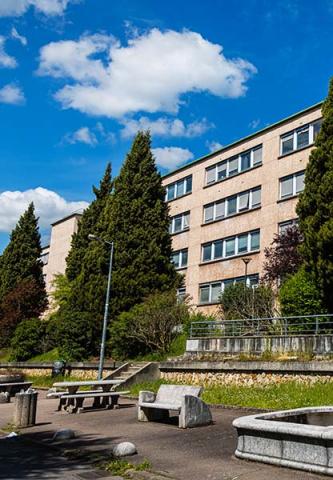
Orsay Bures
Contact
-
Vincent BOCCARA