



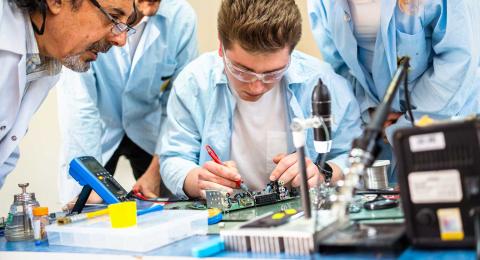
From an educational perspective, the ICMM Master's degree programme at the Evry campus, a high-level programme that keeps pace with the latest technologies and has strong links with industry and renowned research laboratories in the field, provides students with the skills they need to take on the many technological challenges facing the industry and quickly assume positions of responsibility.
Apprentices trained at the Science and Technology Research Training Unit (UFR ST) must be operational, adaptable and have a global vision of organisations.
Information
Skills
• Independently formulate a mechanical problem to meet a given objective, from modelling the system under study to modelling stresses and boundary conditions, proposing an associated solution approach.
• Apply theoretical or practical concepts and knowledge to understand a problem and translate it into equations.
• Implement analytical, numerical or experimental problem-solving tools at a proficient level: justified choice of existing tools or ad hoc creation of specific tools and critical analysis of results.
• Design and optimise an innovative scientific and/or technological solution with a view to development or research (this may concern a product or an experimental protocol).
• Communicate ideas clearly, concisely and pedagogically, both in writing and orally,
with scientific arguments, interpretations and discussions with a view to their promotion and exploitation by the scientific community (professional or student).
• Carry out an individual or team project in terms of organisation and interpersonal skills (coordination or management of actions, project management, perspective, teamwork, autonomy, responsibility, initiative, etc.).
Objectives
Ce parcours forme les étudiants en : conception mécanique, méthodes avancées de conception, calcul des structures (modélisation et simulation). Cette spécialisation est accompagnée d’une formation, au niveau des sous parcours, dans les domaines complémentaires de l'ingénierie en modélisation et simulation , l'ingénierie en conception des systèmes mécaniques, l'ingénierie en design industriel.Outre les savoirs scientifiques fondamentaux, les connaissances transversales au métier d'ingénieur (communication, management, qualité, droit des entreprises…) sont également acquises. Une part de cet enseignement est réalisée par des intervenants industriels. La pédagogie laisse une large place à l'initiative individuelle au cours des projets.
Career Opportunities
Career prospects
Après un Master ou Master + Doctorat : ingénieur (R&D, contrôle, production…)
Après un Master ou Master + Doctorat : chercheur ou enseignant-chercheur
Après un Master ou Master + Doctorat : ingénieur (recherche-développement, contrôle, production…) dans les domaines santé, pharmacie, agroalimentaire, biotechnologies, instruments et réactifs, cosmétique, dépollution et environnement
Après un Master ou Master + Doctorat : ingénieur (recherche et développement, contrôle, production…)
Ingenieur R&D
ingénieur étude conception
ingénieur maintenance
Chargé de mission développement durable
Chargé d'études développement durable
Chargé de développement
Ingénieur d’études dans les domaines de l’industrie
Ingénieur d’études dans les domaines de la recherche
Chargé d’affaires réglementaires dans les domaines concernés
Chargé.e de recherche et innovation
Ingénieur.e en production
Bureaux d'études spécialisés dans l'évaluation des impacts environnementaux
Gestion de projets de développement durable
métiers de la recherche
enseignant.e-chercheur.se (après un doctorat)
Chargé de mission / projets
Ingénieur d'études
Ingénieur de recherche
Ingénieur développement
Ingénieur conception-production
chargé de projet scientifique / santé publique
Chargé·e de développement
Further Study Opportunities
Chargé·e de développement
Chargé·e d’études
Chef·fe de projet/de mission
Doctorat
Ingénierie études, recherche et développement
Ingénierie méthodes et industrialisation
PhD
Professeur agrégé en classes préparatoires ou à l'université ou dans un institut scientifique
Thèse de doctorat
Fees and scholarships
The amounts may vary depending on the programme and your personal circumstances.
Calendar
Admission Route
Capacity
Available Places
Target Audience and Entry Requirements
Licence en Mécanique, en Sciences Pour l'Ingénieur, Physique (à dominante mécanique).
Application Period(s)
From 15/01/2026 to 16/03/2026
Supporting documents
Compulsory supporting documents
Rank of previous year and size of the promotion.
Copy diplomas.
Motivation letter.
All transcripts of the years / semesters validated since the high school diploma at the date of application.
Certificate of French (compulsory for non-French speakers).
Offer of employment with an approved a work-study contract.
Curriculum Vitae.
Detailed description and hourly volume of courses taken since the beginning of the university program.
Additional supporting documents
Proof of one year's study in France for non-European candidates.
VAP file (obligatory for all persons requesting a valuation of the assets to enter the diploma).
Supporting documents :
- Residence permit stating the country of residence of the first country
- Or receipt of request stating the country of first asylum
- Or document from the UNHCR granting refugee status
- Or receipt of refugee status request delivered in France
- Or residence permit stating the refugee status delivered in France
- Or document stating subsidiary protection in France or abroad
- Or document stating temporary protection in France or abroad.
| Subjects | ECTS | Semester | Lecture | directed study | practical class | Lecture/directed study | Lecture/practical class | directed study/practical class | distance-learning course | Project | Supervised studies |
|---|---|---|---|---|---|---|---|---|---|---|---|
| Tronc Commun de la Mention Mécanique FA | |||||||||||
| MMC Solides | 3 | Semestre 1 | 14 | 14 | |||||||
| MMC Fluides | 3 | Semestre 1 | 14 | 14 | |||||||
| Méthodes Numériques pour les équations aux dérivées partielles | 3 | Semestre 1 | 12 | 8 | 8 | ||||||
| Socle Scientifique ISM FA | |||||||||||
| Etude des systèmes mécaniques | 2 | Semestre 1 | 12 | 12 | |||||||
| Calcul des Structures par Eléments Finis | 2 | Semestre 1 | 8 | 8 | 8 | ||||||
| Outils mathématiques pour la modélisation | 2 | Semestre 1 | 12 | 12 | |||||||
| Préparation des Comptes Rendus 1 | 1 | Semestre 1 | 20 | ||||||||
| Subjects | ECTS | Semester | Lecture | directed study | practical class | Lecture/directed study | Lecture/practical class | directed study/practical class | distance-learning course | Project | Supervised studies |
|---|---|---|---|---|---|---|---|---|---|---|---|
| Tronc Commun ISM FA et Socle insertion professionnelle | |||||||||||
| Conduite de projet - Communication ISM FA | 3 | Semestre 1 | 6 | 18 | |||||||
| Anglais | 2 | Semestre 1 | 20 | ||||||||
| Qualité et Droit des entreprises ISM FA | 2 | Semestre 1 | 16 | 8 | |||||||
| Matériaux * | 2 | Semestre 2 | 16 | 8 | |||||||
| Conception des systèmes mécaniques | 2 | Semestre 2 | 8 | 0 | 16 | ||||||
| Vibration des Solides | 2 | Semestre 2 | 10 | 14 | |||||||
| Sous parcours "Ingénierie de la Conception des Systèmes Mécaniques" ICSM FA | |||||||||||
| Optimisation des Structures * | 2 | Semestre 2 | 8 | 16 | |||||||
| Organisation et Gestion de la Production | 2 | Semestre 2 | 4 | 8 | 12 | ||||||
| Conception mécanique avancée * | 2 | Semestre 2 | 8 | 8 | 8 | ||||||
| Simulation numérique fluide - Expérimentations – Motorisation, Propulsion et composants en aéronautique | 2 | Semestre 2 | 10 | 16 | 8 | ||||||
| Préparation des Comptes Rendus | 1 | Semestre 2 | 20 | ||||||||
| Subjects | ECTS | Semester | Lecture | directed study | practical class | Lecture/directed study | Lecture/practical class | directed study/practical class | distance-learning course | Project | Supervised studies |
|---|---|---|---|---|---|---|---|---|---|---|---|
| Savoir-être M1 ISM FA | 5 | Semestre 2 | 0 | 0 | 0 | ||||||
| Savoir-faire ISM FA | 5 | Semestre 2 | 0 | 0 | 0 | ||||||
| Mémoire ISM FA | 5 | Semestre 2 | 0 | 0 | 0 | ||||||
| Soutenance ISM FA | 5 | Semestre 2 | 0 | 0 | 0 | ||||||
Teaching Location(s)
Training campus
