The Vigie-Ciel project, winner of the participatory research award
On 3 July, the citizen science project Vigie-Ciel was awarded the 2025 participatory research prize in the “citizen data collection” category at a ceremony held at INRAE’s headquarters.
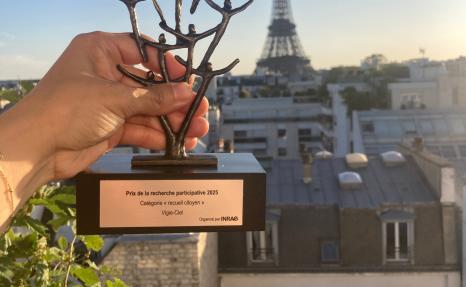
The citizen science project Vigie-Ciel, co-founded by Sylvain Bouley, professor at Université Paris-Saclay, a planetary scientist at the Géosciences Paris-Saclay laboratory (GEOPS – Univ. Paris-Saclay/CNRS) and vice-president of the Société Astronomique de France, together with Brigitte Zanda, professor at the Muséum national d’histoire naturelle (MNHN), has received the participatory research prize awarded by INRAE, in association with the French Ministry of Higher Education, Research and Innovation.
Winner in the “citizen data collection” category, Vigie-Ciel is thus recognised for the quality of its participatory process, the excellence of the results achieved, and the scope of its impact.
The Vigie-Ciel programme emerged from a desire to bring Earth and space sciences closer to the general public by involving citizens in a participatory science approach centred on the observation of meteorites and celestial phenomena. It builds on Vigie-Nature, a programme launched by the Muséum national d’Histoire naturelle, which demonstrated the value of mobilising citizens to collect scientific data.
In this context, several institutions decided to pool their expertise to create Vigie-Ciel as part of the national project 65 Millions d’Observateurs¹, supported by the Investissements d’Avenir scheme, in order to support the scientific programme FRIPON (Fireball Recovery and Inter Planetary Observation Network). Funded by the Agence Nationale de la Recherche, FRIPON deploys a network of cameras designed to detect fireballs and locate the associated meteorites.
Led by a collective of scientific stakeholders, the project brings together the Muséum national d’Histoire naturelle, the Observatoire de Paris, Université Paris-Saclay, the Observatoire des Sciences de l’Univers Pythéas, and several CNRS laboratories. This partnership pools a wide range of expertise to run a programme at the intersection of astronomy, geosciences and science outreach.
Université Paris-Saclay, and more specifically the Géosciences Paris-Saclay laboratory (GEOPS – Univ. Paris-Saclay/CNRS), has played a central role in this dynamic by providing the scientific leadership for part of the project and mobilising its specialists in the study of meteorites and impact structures. This involvement builds on the laboratory’s ongoing research and its commitment to fostering greater openness of research towards society.
Vigie-Ciel pursues a dual objective. On the one hand, it aims to renew knowledge of meteorites and impact structures in France, where well-documented discoveries had declined sharply since the nineteenth century. On the other hand, it seeks to strengthen scientific literacy around celestial phenomena and Earth’s history by inviting citizens to become active contributors to research. In this way, the project helps to democratise knowledge, inspire vocations, and enhance the natural and scientific heritage represented by meteorites and impact craters.
The Vigie-Ciel and Vigie-Cratère programmes are based on close collaboration between researchers and volunteer citizens. Vigie-Ciel offers an online tool that allows the public to report meteorite observations via a detailed questionnaire, based on a platform developed by the American Meteor Society (AMS). Designed to be accessible to the widest possible audience, this tool enables users to view all testimonies relating to a given event and to cross-reference these data with recordings from the FRIPON cameras. This approach facilitates the reconstruction of trajectories and the identification of potential impact zones, which are essential for organising searches and field campaigns to recover meteorite fragments. Vigie-Cratère, currently in a pilot phase, similarly engages citizens in identifying circular structures that may be linked to impact craters using satellite imagery, which is then compared with scientific data.
The participatory science methodology has led to several major advances. In February 2023, the fall of the asteroid 2023 CX1 was rapidly detected thanks to the camera network and the mobilisation of citizens, enabling the recovery in record time of valuable fragments for studying their origin and composition. In Sologne, despite challenging terrain and negotiations with private landowners, coordination between witnesses, local intermediaries and scientists made it possible to recover a significant fragment. These examples demonstrate that well-structured participatory science accelerates the collection of rare data while strengthening the link between society and research. Vigie-Ciel thus illustrates how collective mobilisation, supported by modern tools, can contribute to advancing science.
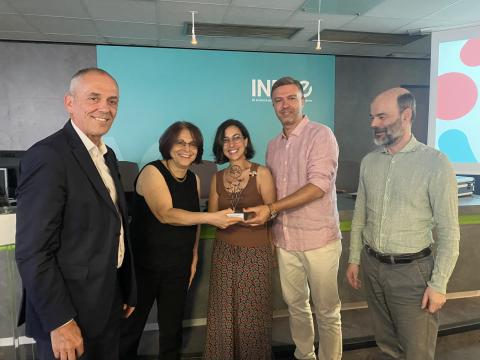
The Participatory Research Prize rewards work carried out through an approach that actively involves a broad public. Projects in the “citizen data collection” (or “crowdsourcing”) category mobilise many amateurs to collect and/or interpret data, often through digital platforms. In these initiatives, research objectives and protocols can be designed in varying degrees of collaboration with the participants.
For further reading:
Read the article published in L’Édition on Vigie-Ciel and the projects that are advancing science thanks to citizens: https://www.universite-paris-saclay.fr/en/news/citizen-science-projects-help-advance-sciences-thanks-public
Notes
¹ Launched in 2015, the collaborative project 65 Millions d’Observateurs aims to bring citizens and scientists together around participatory science initiatives to improve understanding of biodiversity and the environment. Led by the Muséum national d’Histoire naturelle, it brings together several programmes, including Vigie-Ciel. The project seeks to extend citizen participation to all stages of the scientific process through innovative digital tools.