Université Paris-Saclay institutional mission to South Korea and Japan to strengthen academic and scientific partnerships
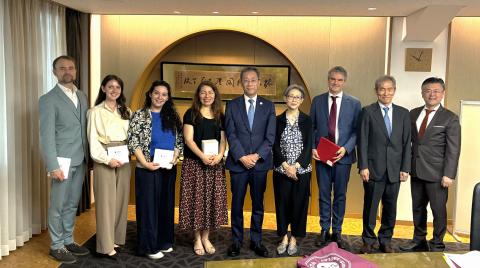
From 17 to 30 May 2026, a delegation from Université Paris-Saclay travelled to South Korea and Japan on an institutional mission aimed at strengthening academic, scientific and strategic collaborations with several leading higher education institutions and research organisations across East Asia.
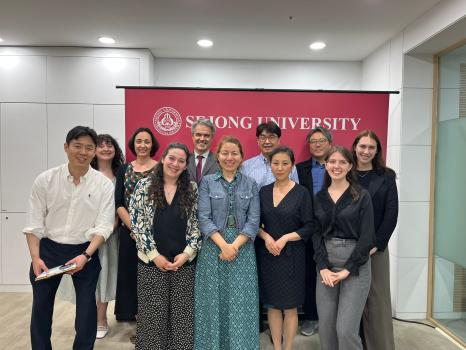
Led by Delphine Placidi-Frot, Vice-President for European and International Affairs at Université Paris-Saclay, the delegation brought together representatives from the University's Directorate for European and International Affairs, CentraleSupélec, ENS Paris-Saclay, several Graduate Schools (Life Sciences and Health, Health and Drug Sciences and Physics), and the Paris-Saclay Faculty of Medicine. The mission forms part of the University's international strategy to develop long-term strategic partnerships with leading higher education and research institutions worldwide.
The mission took place against the backdrop of strengthened scientific cooperation between France, South Korea and Japan. President Emmanuel Macron's state visits to Japan and South Korea in April 2026, together with the bilateral Joint Committees on Research and Higher Education held during the visits, reaffirmed the shared commitment to deepening partnerships in North-East Asia in strategic fields such as artificial intelligence, quantum technologies, semiconductors, space, energy and health.
This momentum is also supported by increasingly robust cooperation frameworks, including the association of South Korea and Japan with Horizon Europe, as well as the growing presence of French national research organisations in the region, illustrated by the recent opening of an Institut Pasteur representative office and the forthcoming establishment of an Inserm office in Japan.
A mission focused on developing partnerships with leading global higher education institutions
The mission pursued several key objectives:
- to strengthen academic and scientific ties with South Korean and Japanese universities and research organisations;
- to enhance the international visibility of Université Paris-Saclay and, more broadly, of French higher education and research;
- to identify new funding and collaboration opportunities through bilateral, European and international programmes;
- to support the growing interest among research communities in developing joint projects with partners in both countries;
- to respond to increasing student demand for mobility opportunities in South Korea and Japan, while enhancing the attractiveness of Université Paris-Saclay for students and doctoral candidates from these two leading scientific nations.
Over the course of two weeks, the delegation met with university leaders, researchers and institutional representatives to explore new avenues for collaboration in fields ranging from fundamental sciences and engineering to health, information technologies and energy.
From Paris-Saclay to Seoul: a week exploring Franco-Korean academic partnerships
The first part of the mission took place in Seoul and Daejeon, with visits to several of South Korea’s most prestigious institutions.
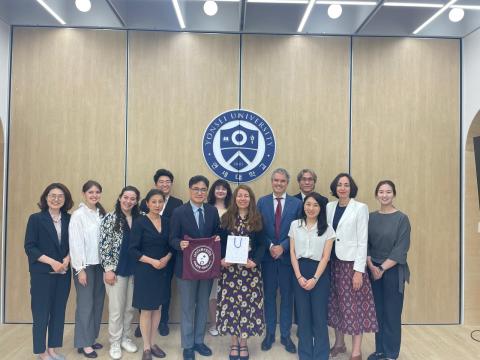
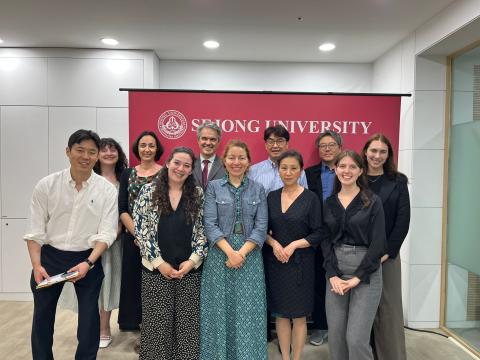
The delegation was welcomed by the leadership teams of Yonsei University, Korea University, Hanyang University, Sejong University and Seoul National University. These meetings provided an opportunity to showcase Université Paris-Saclay’s strengths in education, research and innovation, while identifying new avenues for cooperation in student mobility, dual degree programmes, collaborative research and doctoral training.
A visit to the Korea Institute for Advanced Study (KIAS) also provided an opportunity to discuss the challenges of conducting high-level fundamental research and explore potential areas of cooperation, particularly regarding the hosting of quantum science interns.
The mission continued in Daejeon with a visit to KAIST (Korea Advanced Institute of Science and Technology), a major player in scientific and technological innovation in Asia, where discussions focused on developing research partnerships and academic mobility initiatives.
The delegation also met with representatives of the French Embassy in South Korea to discuss prospects for Franco-Korean cooperation in higher education and research, available funding opportunities, and ways to better balance mobility flows by attracting more South Korean students to France and Université Paris-Saclay.
In Japan, renewed momentum for academic partnerships
The second part of the mission took place in Japan, with a packed programme bringing together universities, national research funding agencies and institutional stakeholders.
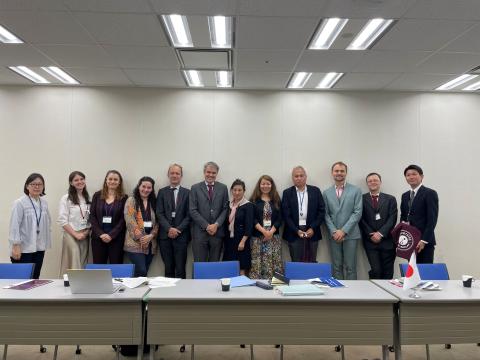
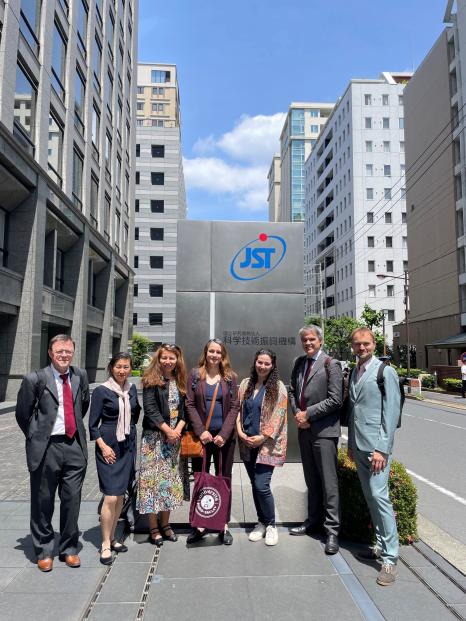
In Tokyo, the delegation was welcomed at the French Embassy in Japan, as well as at the Japan Science and Technology Agency (JST) and the Japanese Ministry of Education, Culture, Sports, Science and Technology (MEXT). These meetings provided an opportunity to discuss research funding mechanisms, including Horizon Europe, the PHC Sakura programme and Japan Science and Technology Agency (JST) calls for proposals, as well as international mobility schemes and opportunities for bilateral and multilateral cooperation.
The academic exchanges then took the delegation to the University of Tsukuba, where several leading research laboratories were visited, notably in the fields of high-performance computing and sleep sciences.
Université Paris-Saclay also strengthened its ties with several strategic Japanese partners, including the University of Tokyo, the Institute of Science Tokyo and Tohoku University. Discussions focused on developing joint research projects, increasing student and doctoral mobility, and establishing new collaborations in engineering, information sciences, physics and health.
Thematic visits to deepen cooperation
The final day of the mission was dedicated to parallel visits aimed at further developing disciplinary collaborations.
One group visited Osaka University and Kyoto University to discuss prospects for research and education collaboration with several senior academic leaders.
Meanwhile, a second group met with representatives from Nagoya University and Gifu University, with a particular focus on developing partnerships in medicine and health sciences.
These discussions helped advance several cooperation projects and extend existing agreements into new disciplinary areas.
A strong international ambition
This institutional mission reflects Université Paris-Saclay’s ambition to strengthen its presence within major international scientific ecosystems and develop long-term partnerships with the world’s most recognised institutions.
By bringing together researchers, academics, university leaders and institutional stakeholders, the mission contributes to creating the conditions for new scientific collaborations, supporting student and staff mobility, and enhancing Université Paris-Saclay’s international profile in a region that is particularly dynamic in research and innovation.