Shaping the future of surgery: creation of a new university institute in the Paris region
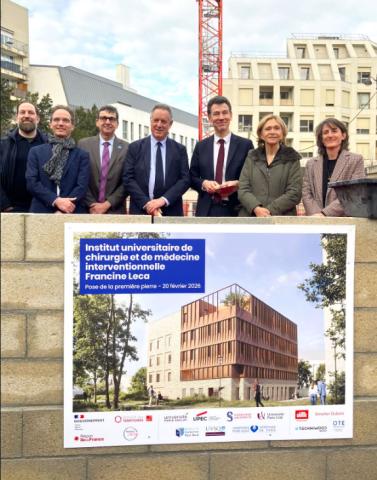
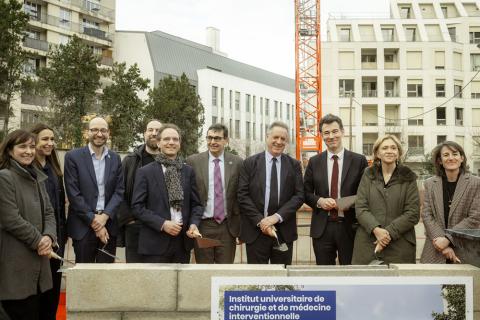
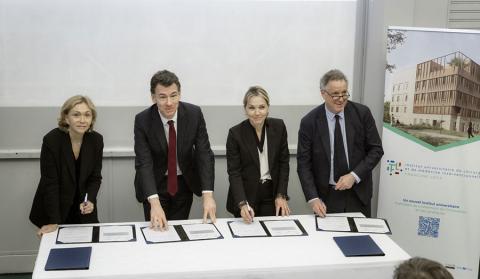
The creation of a new Institute of Surgery at the intersection of innovation and clinical practice was announced on Friday 20 February 2026. Led by a public interest group (GIP) bringing together Assistance publique-Hôpitaux de Paris (AP-HP) and the six universities in the Île-de-France region with health faculties, including Université Paris-Saclay, the Francine Leca University Institute of Surgery and Interventional Medicine will open its doors in September 2027.
Over the past few decades, surgery has undergone a profound transformation. Long based on major and invasive procedures, it has become more precise, more targeted and increasingly guided by imaging, digital tools and minimally invasive technologies. Today, clinicians can visualise in real time, intervene in an ultra-localised manner, preserve healthy tissue and significantly reduce the physical impact of treatment. These developments have already transformed the management of many conditions. Patients recover more quickly, with fewer complications and a better quality of life.
The surgery of tomorrow will go beyond simple repair to enter a regenerative, predictive and personalised era. It will enable the reconstruction of tissues and organs, transform transplantation, treat without incision through targeted energy-based techniques, anticipate disease thanks to digital technologies and artificial intelligence, and intervene earlier, before severe forms develop.
The creation of this new university training institute comes at a time of growing pressure on professional vocations and rapid transformation of surgical practices driven by technological advances. By 2028, a total of 60,000 visits per year are projected, compared with 12,000 today. The Institute’s mission is to accelerate the transformation of surgical practices and the dissemination of innovation in this field by establishing a national and European centre of excellence.
Initial and continuing training for healthcare professionals, as well as research, lie at the heart of the mission of the largest consortium in Europe, formed by Assistance publique - Hôpitaux de Paris and the six universities in the Île-de-France region with health faculties - Université Paris-Saclay, Sorbonne Université, Université Paris Cité, Université de Versailles Saint-Quentin-en-Yvelines, Université Paris-Est Créteil and Université Sorbonne Paris-Nord - which together constitute the university hospital centre (CHU) of the Île-de-France region.
These six universities have therefore joined forces with Assistance publique - Hôpitaux de Paris to build a new school of surgery and interventional medicine on the site of the former Broussais Hospital (Paris 14th arrondissement), covering nearly 5,000 square metres. Their objective is to bring together the strengths of the academic and industrial sectors, as well as the resources dedicated to university training for operating theatre professions (surgeons, interventional physicians, radiologists and nurses). The Institute is designed around medical advances enabled by the rise of new technologies such as robotics, image-guided intervention, digital tools and artificial intelligence.
An ambitious and innovative comprehensive offering for all professionals across the region
This new Institute will offer more than 500 initial and continuing training courses, delivered on site or remotely under university supervision, in surgery and interventional medicine. These programmes will be organised within the framework of Diplômes d’Études Spécialisées (DES), Diplômes Universitaires (DU) and certified masterclasses. The latter will provide advanced or excellence-level training (organ transplantation, spinal fracture repair, aortic valve replacement, etc.). The corresponding degrees will be awarded by the founding universities.
Each year, in initial training, the Francine Leca Institute’s educational offering will primarily target more than 2,000 third-cycle students enrolled for the Diplôme d’Études Spécialisées (DES) in surgery and medicine, as well as 500 operating theatre students from the Île-de-France region. In continuing professional development, it will serve 2,000 practitioners and 1,000 specialised paramedics.
This transformation follows a logic of acceleration and will ultimately be supported by its own economic model. The Institute represents a genuine driving force at both regional and national levels, responding to strong demand and serving as a vehicle for the international reach of French surgical and medical excellence.