Sarah Antier: a multi-messenger approach of astrophysics
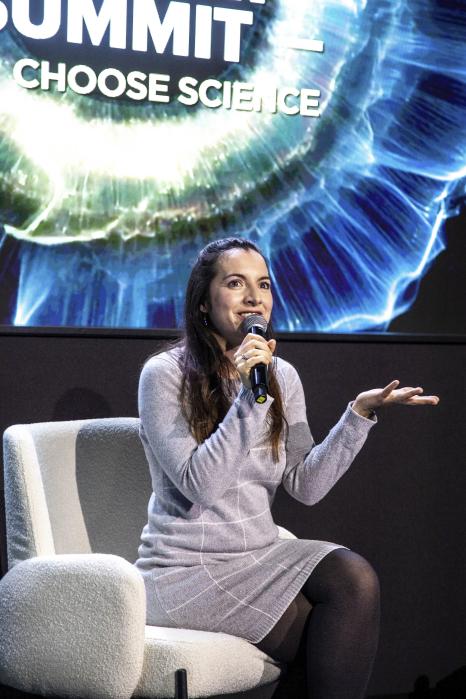
A new branch of astrophysics was born with the first detection of gravitational waves in 2015. Astrophysicist Sarah Antier, a member of the Laboratory of Physics of the Two Infinities – Irène Joliot-Curie (IJCLab – Univ. Paris-Saclay/CNRS/Univ. Paris-Cité), is one of the leading figures in multi-messenger astrophysics and the principal investigator of a global network of telescopes designed to identify the light signals associated with these phenomena.
Sarah Antier’s research focuses on a recent branch of astrophysics known as "multi-messenger". Whereas classical astrophysics observes and studies the electromagnetic radiation (light) emitted by phenomena in the Universe, multi-messenger astrophysics also combines other sources of information to explore the cosmos. One of these is gravitational waves, which lie at the heart of Sarah Antier’s current research. Detectable through violent phenomena such as black hole collisions, the collapse of massive stars or the merger of neutron stars, “gravitational waves provide information about the very first moments of these phenomena, whereas the electromagnetic signal is generally detected with a delay,” explains the researcher.
The first detection of gravitational waves
Gravitational waves were detected for the first time in 2015. Until then, they had been merely a prediction of Albert Einstein’s theory of general relativity, and their existence had been debated until their indirect detection in 1974 by Russell Hulse and Joseph Taylor.
Everything changed on 14 September 2015, a century after the physicist published his equations on general relativity. Scientists from the LIGO-Virgo collaborations announced that they had detected the famous gravitational waves using their instruments – giant interferometers based in the United States and Europe respectively. A new window thus opened onto the observation of the Universe and the understanding of cataclysmic phenomena.
Expertise in gamma-ray bursts
Even before this scientific revolution, Sarah Antier was already interested in the most energetic explosive and transient cosmic phenomena in the Universe, and the compact objects that result from them. A “child of the Saclay plateau”, she began her PhD in 2013 at the CEA’s Institute for Research into the Fundamental Laws of the Universe (Irfu), where she worked on preparing the Sino-French SVOM space mission, designed to detect gamma-ray bursts.
Gamma-ray bursts are among the brightest events in the Universe. They consist of brief, intense flashes of gamma-ray light directly linked to the collapse of massive stars or the merger of compact objects, resulting in the formation of a new compact object. This is accompanied by the ejection of matter in the form of two collimated jets, in which photons are accelerated to extreme energies: the gamma-ray burst.
An introduction to multi-messenger astrophysics
For Sarah Antier, it was towards the end of her PhD, in 2016, that a breakthrough occurred in her research. The LIGO-Virgo collaborations then published their results, a year after the signal was detected: these were indeed gravitational waves linked to the merger of two black holes, and not a detector-related artefact. From then on, the transient phenomena that the researcher tracked through gamma-ray bursts could now be observed simultaneously through the prism of gravitational waves and light. “A new branch of astrophysics was emerging,” known as multi-messenger astrophysics.
For the young researcher, the continuity was obvious: detecting brief, unpredictable signals in the sky was exactly in line with the methods she had developed during her PhD. She chose to pursue this during a postdoctoral fellowship at the IJCLab. “It was this field of science that I wanted to develop, as it was quite exhilarating to play an active part in this new branch of astronomy.”
A race against cosmic time
Thanks to the advent of these new detectors, compact objects are now being revealed through their gravitational waves. However, the location of these signals remains very approximate compared to observations made with telescopes: the source is not identified at a precise point in the sky, but within a vast region. Tracking down the electromagnetic counterpart “is like looking for a needle in a haystack. “To give you an idea, we’re talking about scanning hundreds of square degrees – that is, a search area several times the apparent size of the Moon!” explains Sarah Antier. Capturing an image of this phenomenon is all the more difficult because the associated light signal fades within a few days, or even a few hours. “If you’re not there at the right moment, you won’t find a thing!” smiles the researcher.
The GRANDMA telescope network
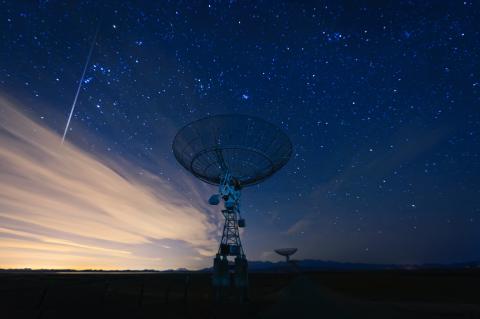
As soon as a gravitational wave signal is announced, “everyone rushes to scan the sky, in a chaotic manner and with little coordination”. This confusion gave Sarah Antier the idea of creating a network of telescopes located across the globe and available at short notice to share the workload. In 2018, she launched the GRANDMA project (Global Rapid Advanced Network Devoted to the Multi-Messenger Addicts) with her colleagues Nicolas Leroy and Patrice Hello from IJCLab, in partnership with the Institute for Research in Astrophysics and Planetology (IRAP) and the Côte d’Azur Observatory. The aim was to ‘bring this network together to scan the search area efficiently and rapidly.’ Today, the GRANDMA network comprises more than 35 telescopes and involves some twenty countries. Its members include specialists from various disciplines and it develops new tools to support the multi-messenger effort.
The initiative doesn’t stop there. Aware of the importance of speed in observations, Sarah Antier launched the Kilonova Catcher programme in 2019, alongside Alain Klotz from IRAP, which was open to amateur astronomers. “Equipped with their own telescopes, they contribute directly to data collection and even become co-authors of our scientific publications.” A groundbreaking approach to citizen science that helps “break down barriers in research and involve citizens in the scientific adventure.” This pioneering initiative has earned Sarah Antier's international recognition. She received the L’Oréal-UNESCO For Women in Science International Award and a postdoctoral grant from CNES, enabling her to continue her research within the GRANDMA network. In 2021, she reached a new milestone when she was appointed as an astronomer at the National Council of Astronomers and Physicists (CNAP), becoming the first astronomer to be appointed in the field of gravitational waves.
A childhood dream worth fighting for
For Sarah Antier, becoming an astronomer is a childhood dream. “My father used to watch a lot of science fiction films.” But it was the film Contact, released in 1997, that made a particular impression on the young researcher. The story follows an astrophysicist listening to the skies who one day detects an extraterrestrial signal. “She then fights for her research and defends what science teaches her against people who don’t believe her. When I saw that film, I thought to myself: ‘That’s what I want to do!’”
But gaining recognition for science and ensuring scientists’ views prevail is sometimes an uphill battle. Sarah Antier is concerned, for example, about the proliferation of satellite constellations that hinder sky observation: “We see straight lines on our images. The operators [Starlink, Amazon...] have created a network without any real consultation with the astronomy community. Yet preserving ground-based observation is a heritage that must be defended.”
The researcher is now looking to the future, with the new Vera Rubin Observatory. Perched in the Chilean mountains, this telescope “will continuously scan the sky and offer a new way of observing transient and explosive phenomena”. The images, obtained across wavelengths ranging from the near-ultraviolet to the near-infrared, will complement those from gravitational wave detectors. “The idea is always to cross-reference the sources and the messengers, but here we need new expertise in data science. Université of Paris-Saclay is the ideal setting for this research as it allows us to build bridges with other laboratories on the campus, such as the Interdisciplinary Laboratory for Digital Sciences (Lisn). I also hope that the citizen science project will be open to data science students keen to combine machine learning and astrophysics,” concludes Sarah Antier.