POLY MATH: A cycle of events to encourage an intuitive approach to mathematics
What are the possibilities after a degree in mathematics? What kind of research is done in geometry, algebra or topology? POLY MATH, the new cycle of events organised by the Graduate School Mathematics, offers some answers by exploring unexpected research opportunities. (Cet article est issu de L'Édition n°29)
The term "polymath" refers to an individu-al who possesses knowledge in multiple fields. It is in this spirit of interdisciplinarity that the Graduate School (GS) Mathematics has conceived a new cycle of events aimed at students, researchers and curious minds of all kinds. Launched last November, the POLY MATH cycle aims to "introduce mathematics in a different way" by presenting mathematical research topics in an engaging manner.
The idea behind the cycle arose from an observation. The teaching of academic mathematics takes place in an abstract and formal setting, which must be grasped before the concepts covered can be understood. While rigorous proof is essential to a solid foundation in mathematics, without prior intuition it can be intimidating and discouraging. Here, the aim is to work in the opposite direction, starting from intuition to open the way to abstraction. The goal, as described by Ainhoa Aparicio-Monforte, research project manager at GS Mathematics, is to show "research in a lively way by mobilising all forms of intelligence and sensitivity" in order to stimulate curiosity and imagination, organise meetings, bring out vocations, and perhaps even discover an unexpected research topic.
Manual activities in the spotlight
The senses play a prominent role in the events of the cycle. The first of them, the exhibition Tangible Maths organised at the end of November 2025 in the Jacques Hadamard library of the Orsay Mathematics Institute (IMO), was an opportunity to get a hands-on feel for complex concepts such as non-Euclidean geometry, tessella-tions and isometric immersions, using objects designed by the exhibitors through folding, modelling, 3D printing and even crochet.
The art of origami was also in the spotlight in December 2025, with an event hosted by Ainhoa Aparicio-Monforte herself. An enthusiast origami maker, the mathematician introduced a large and varied audience to modular origami, which involves creating complex structures from several identical "bricks". During the cycle, Adrien Abgrall, a post-doctoral researcher at Orsay Mathematics Laboratory (LMO - Univ. Paris-Saclay/CNRS), also led a workshop on the power of origami for constructing algebraic numbers. Origami allows operations that are impossible with a ruler and compass, opening the way to solutions that are inaccessible with the traditional approach.
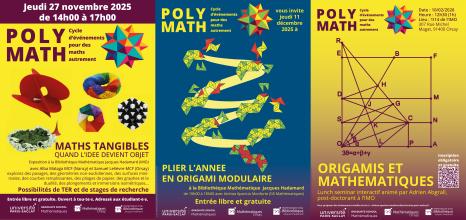
In the same spirit, another event hosted in January 2026 by Anaïs Meunier, a PhD student at the French Alternative Energies and Atomic Energy Commission (CEA), highlighted knot theory and its possibili-ties. Around fifteen people took part, discovering the colouring and knotting that form the basics of this little-known mathe-matical field, as well as current areas of research. Like previous events, this meet-ing took the form of a lunch seminar, offering students the opportunity to exchange ideas in an informal setting.
"Mathemusical" research and mathematical jewellery
The aim of POLY MATH is to offer an intuitive approach to mathematical concepts through other disciplines, such as music. In December 2025, Moreno Andreatta, a researcher in mathematics and musicology at the University of Strasbourg, gave an introduction to "mathemusical" research. He highlighted the interdisciplinary nature of his work, which combines graph theory, harmony, topology, melody, algebra and polyrhythm, whether to analyse compositions by Mozart, Beethoven or Bach, play jazz or even compose Hamiltonian pop music!
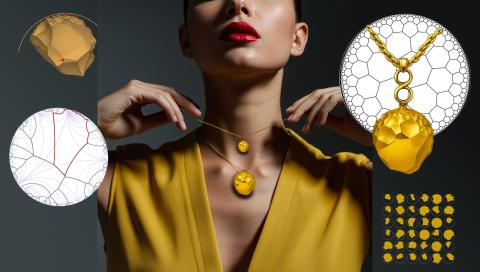
Mathematics also plays a role in the creation of works of art and jewellery, as revealed in the exhibition StoKaChic: Haute Bijouterie Mathématique (StoKaChic: Mathematical Fine Jewellery) presented as part of the cycle. It showcased the eponymous project by Nicolas Curien, professor at Université Paris-Saclay, and Matteo D'Achille, mathematics researcher at the Élie Cartan Institute of Lorraine, which involves using complex mathematical concepts to create unique jewellery. By combining statistics with random processes, topology and hyperbolic geometry, the researchers have created strange and unique volumes that resemble clusters of bubbles. These surprising shapes and a jeweller friend gave them the idea of turning them into jewellery.
These creations were unveiled in December at the Jacques Hadamard Library in a fun and interactive exhibition designed by Vasilisa Nikiforova, aimed at helping visitors understand the concepts behind these surprising objects. In this “low-tech” installation, a manually animated cartoon explained the transition to the limit in hyperbolic geometry, an ultraviolet lamp revealed Poisson-Voronoï patterns hidden in giraffe spots, and the famous mathematical pendants took pride of place in the centre. This exhibition is expected to be on display soon at other locations of Université Paris-Saclay.

From origami to jewellery and music, the first edition of POLY MATH brought together many students, who were amazed by the wealth of possibilities offered by mathematics. Building on this success, the GS Mathematics team is already buzzing with ideas for new events to extend the cycle and continue to reveal the unexpected sides of mathematics. From 25 February to 3 April, the break room of the Jacques Hadamard Library will host an exhibition dedicated to Emmy Noether, a German mathematician who left a fundamental mark on her discipline.
- Learn more about the POLY MATH cycle and the next events: https://www.universite-paris-saclay.fr/poly-math-cycle-devenements-pour-des-maths-autrement-0
This article was originally published in L'Édition n°29.
Find out more about the journal in digital version here.
For more articles and topics, subscribe to L'Édition and receive future issues: