The Oser pour innover programme: Discovering innovation in the academic environment
The Innovation Alliance Université Paris- Saclay University Innovation Cluster has launched a new programme to raise awareness among all higher education and research staff about innovation and its challenges. The result of a long collaborative effort, the Oser pour innover (Dare to innovate) programme takes various forms to suit the needs of each individual. (This article was originally published in L'Édition n°29.)

Raising awareness about innovation and its challenges plays a key role in encouraging creativity and promoting research within the academic world. That is why it is one of the fundamental missions of the Innovation Alliance Université Paris-Saclay University Innovation Cluster* (in French, Pôle universitaire d’innovation - PUI), which recently unveiled a new awareness programme. Led by the Institute of Staff Education and Skills Observatory of Université Paris-Saclay and the Graduate School Research and Higher Education, the programme is called Oser pour innover (Dare to innovate) and aims to inform all higher education and research (ESR) staff about innovation.
Whether participants are administrative staff, researchers, students, or PhD candidates, the programme has been designed to suit everyone. “The aim is to raise awareness of the concepts of innova-tion, inspire new methods and generate ideas for creating value in one's work,” explains Monica Henao, project manager for the innovation training programme for ESR executives at the Institute of Staff Education and Skills Observatory of Université Paris-Saclay.
The aim is not to turn everyone into a start-up founder. The idea is above all to inform: to show that innovation is within reach, that it can take a thousand different forms and that everyone has the opportunity to find their own path. Whether it's an idea born in a laboratory, a student project or even a discussion between colleagues around the coffee machine, anything can be turned into a concrete project if you know the ecosystem and the levers to move from idea to action.
From testing phase to launch
To build a customised programme, a dedicated team immersed itself in researching and exploring the needs of each profile. “After identifying the needs of the member institutions of Innovation Alliance Université Paris-Saclay, we invited the entire academic community to cocreate the programme,” says Monica Henao.
Workshops, focus groups and qualitative and quantitative surveys provided an opportunity to test activities based on edutainment, an approach that uses games to learn through experience. This enabled initiatives such as serious games, designed to build expertise in a fun way, and the entrepreneurial spirit fresco, an educational and collaborative workshop, to be tried out. The feedback gathered was then used to develop an initial programme model.
At the same time, a mapping of existing initiatives was carried out, listing all the initiatives, training courses and pro-grammes related to innovation and entrepreneurship already in place in the ecosystem. Thanks to this overview, the team understood what already exists, what needs to be adapted and what is missing. While there is a wide range of entrepreneurship education on offer, innovation remains a vast territory to be explored, with its own typologies, methods and challenges, and which is often poorly understood.
Now launched, the Oser pour innover programme is structured around several MOOC (Massive Open Online Course) type modules, with online videos and educational content for learning at one's ownpace, and a document listing all the concepts and elements relating to innovation in France andwithin the PUI. Throughout the year, activities are also offered, each targeting different skills and ways of learning.
These include, for example, raising awareness of the importance of innovation as a structured approach, identifying one's own position on innovation in a professional or academic context, knowing how to define and identify types of innovation, and understanding the issues surrounding certain technical concepts such as intellectual property protection.
“The programme is open to everyone, there are no prerequisites and it is not necessary to take part in all of the activities on offer,” adds Monica Henao. Badges are awarded at each stage of the programme and, at the end, participants receive a certificate.
A closer look at the entrepreneurial spirit fresco
Among the initiatives offered by the program, the entrepreneurial spirit fresco perfectly illustrates the approach to raising awareness of innovation. On 20 November 2025, around thirty participants with varied profiles and different levels of knowledge gathered for an afternoon to try out this collaborative workshop.
Divided into groups, participants spent the session dissecting, analysing and discussing key concepts of entrepreneurship using real-life examples. Using cards tracing the journeys of different characters discovering the innovation ecosystem, potentially leading to the creation of a start-up or the signing of a licence agreement, each team had to reconstruct the path in the correct order.
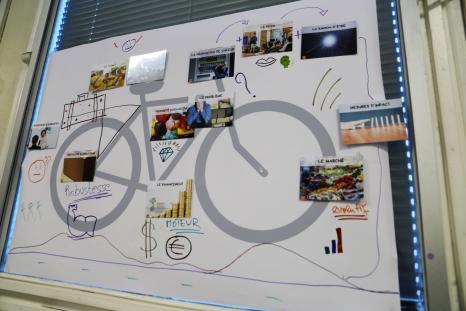
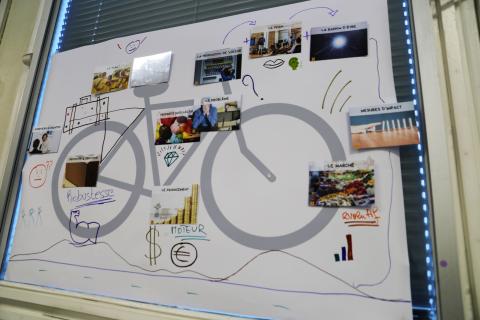
Among these characters is Alex, a researcher who discovered during his work that pulsed light, thanks to LED technology, can help dyslexic people read better. He then wanted to promote this discovery without giving up his main research activity, which takes up most of his time. Through ten stage cards, participants retraced his journey, the different phases of promoting his research, and the people who supported him in combining scientific activity and innovation.
In a second stage, the teams took a step back to reconstruct the key words and the importance of the different dimensions to be considered in building an entrepreneurial project: team building, market research, value creation, fundraising, industrial property protection, among others. The aim is to acquire a comprehensive and concrete vision of what an entrepreneurial path really represents.
Finally, the participants engaged in a collective discussion throughout the afternoon, before being invited to reflect individually on the steps they should prioritise in their journey. “They discovered that entrepreneurship is also part of everyday life, and that it is above all about knowing why you do things,” emphasises Monica Henao. “We will now adapt this fresco to the scope ofInnovation Alliance Université Paris-Saclay in order to offer several workshops during 2026.”
A day to understand and embrace innovation
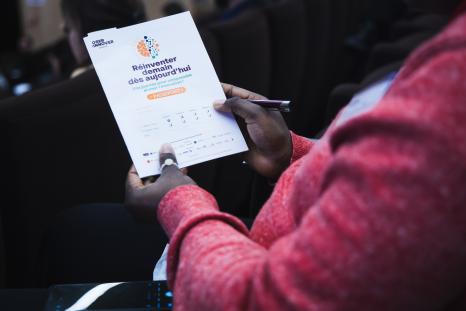
The year 2026 promises to be a busy one, with numerous innovation initiatives planned. It hasalready kicked off with the event Réinventer demain dès aujourd’hui (Reinventing tomorrow, starting today), held on 3 February to mark the official launch of Oser pour innover programme. Nearly 120 people took part in this launch day.
Throughout the event, visitors discovered the first building blocks of the programme and met the people behind it. They also had the opportunity to challenge certain preconceptions about promotion and innovation and talk to key players in the Innovation Alliance Université Paris-Saclay ecosystem. A village of stands, divided into four areas to explore, also brought together PUI innovation experts who presented the innovation venues and courses available, and discussed topics such as protecting innovation through intellectual property and seeking funding.
In addition, attendees immersed themselves in the programme through workshops covering key themes to consider when seeking to innovate, offering them a taste of the challenges of innovation in a fun and educational way. “It's a very enriching and inspiring programme,” said one participant. Finally, the event was an opportunity to honour all those who cocreated the project throughout 2025. Among the new features announced for 2026, an online course will be added to the existing programme, with content available on the eCampus and FUN-MOOC platforms. The Oser pour innover programme will also be promoted during other events throughout the year.
* The Innovation Alliance Université Paris-Saclay University Innovation Cluster (In French, Pôle universitaire d’innovation - PUI), brings together Université Paris-Saclay, Université d’Évry, Université de Versailles - Saint-Quentin-en-Yvelines, AgroParisTech, CentraleSupélec, ENSParis-Saclay, Institut d’Optique Graduate School, the National Centre for Scientific Research(CNRS), the French National Research Institute for Agriculture, Food and Environment (INRAE), the National Institute for Research in Digital Science and Technology (Inria), the French National Institute of Health and Medical Research (Inserm), IncubAlliance Paris-Saclay, SATT Paris-Saclayand fifteen partners including the French Alternative Energies and Atomic Energy Commission (CEA), the French Aerospace Lab (ONERA), Gustave Roussy, Genopole, the SystemX Institute for Technological Research, the Vedecom Institute for Energy Transition, the Paris-Saclay urban community, the Saint-Quentin-en-Yvelines urban community, the Grand Paris Sud urban community, Bièvre Scientific Valley Association, Grand Orly Seine Bièvre Local Authority Public Institution (EPT), Systematic, Medicen, French Tech Paris-Saclay, Paris-Saclay Public Development Institution (EPA), and is financed by the French government as part of France 2030.
- Learn more about the Oser pour innover programme: https://www.universite-paris-saclay.fr/programme-oser-pour-innover
This article was originally published in L'Édition n°29.
Find out more about the journal in digital version here.
For more articles and topics, subscribe to L'Édition and receive future issues: