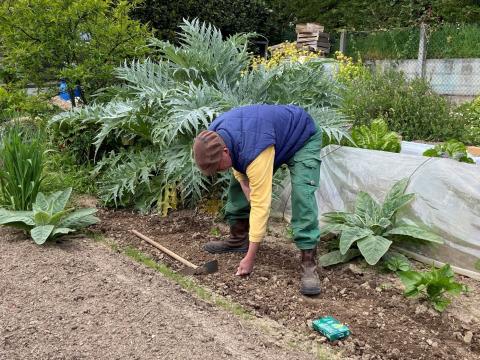
Gardens and allotments: spaces for fostering positive emotions towards wild animals
Living in contact with nature, even on a small scale, influences the way individuals perceive wild animals. A study conducted by scientists from the Ecology, Society and Evolution laboratory (ESE - Université Paris-Saclay / CNRS / AgroParisTech) has highlighted the role of domestic gardens, and in particular allotments, in shaping people’s perceptions of certain species.
In a context of biodiversity decline, understanding what shapes people’s perceptions of wild animals has become essential. The emotions associated with them - compassion, fear, disgust or aesthetic appreciation - in turn influence attitudes and conservation behaviours.
To analyse these mechanisms, researchers from the Ecology, Society and Evolution laboratory (ESE – Université Paris-Saclay / CNRS / AgroParisTech) conducted a survey of a representative sample of the French population. Participants were asked about their interactions with nature, particularly their gardening practices, and were then invited to respond to more than fifty images of animals, including both vertebrates and invertebrates. For each species, they assessed their levels of compassion, fear, disgust and aesthetic appreciation. These responses made it possible to measure their overall degree of affinity with living organisms.
The results show that living in a home with a garden is associated with more positive and less negative emotions towards wild animals. This link is most likely explained by more frequent and concrete interactions with nature in everyday life.
Differentiated effects depending on species
Gardening contributes to these interactions, but its effects are not uniform. They vary depending on the ecological roles of the species observed. Among individuals engaged in allotment gardening, higher involvement is associated with more positive emotions towards insects that help control crop pests. However, this effect is not observed for other beneficial species, such as pollinators or organisms involved in the decomposition of soil organic matter. Emotions towards species perceived as pests do not appear to be directly linked to the level of involvement in gardening.
Better understanding links between practices and perceptions
These findings suggest that domestic gardens are environments conducive to the development of positive emotions towards wildlife. They also indicate that these effects may be linked to a better understanding of the ecological functions of certain species, particularly in the context of allotment gardening.
In a context of increasing urbanisation and reduced contact with nature, this work opens up new avenues for understanding how everyday experiences shape our relationship with living organisms and, ultimately, behaviours that support biodiversity.
Reference
Cultivating biophilia: Domestic gardens foster positive emotions towards wildlife, with gardening influence shaped by species' ecological functions
https://besjournals.onlinelibrary.wiley.com/doi/full/10.1002/pan3.70283