ERC Synergy 2026: MAGNET project, coordinated by Bruno Lévy of the Inria Centre at Université Paris-Saclay, awarded a grant
On Thursday 12 November 2026, the European Research Council (ERC) announced the 48 successful research projects involving international collaborations to receive Synergy Grants 2026, with a total funding of €500 million. The MAGNET project, coordinated by Bruno Lévy of the Inria Centre at Université Paris-Saclay, is one of the recipients.
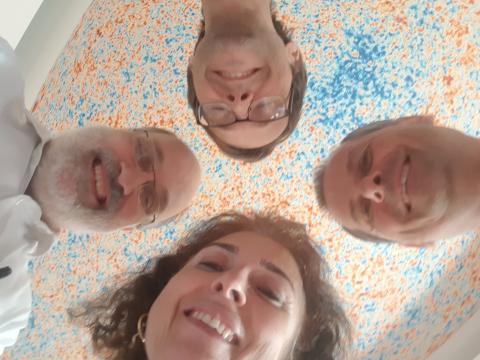
Bruno Lévy, an Inria research director in the ParMA team (Particle Methods using Monge-Ampère), jointly based at the Inria Centre at Université Paris-Saclay, the Orsay Mathematics Laboratory (LMO – Université Paris-Saclay/CNRS) and the CNRS, is the coordinator of the successful MAGNET project, which is also led by Charles Dapogny (CNRS, Jacques-Louis Lions Laboratory), Roya Mohayaee (CNRS, Paris Institute of Astrophysics) and Édouard Oudet (Université Grenoble Alpes, Jean Kuntzmann Laboratory).
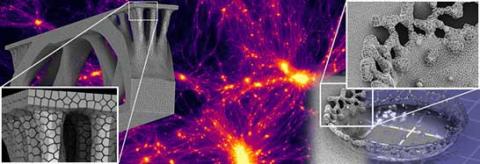
The MAGNET project, Monge-Ampere Geometry and Numerical Effective Transport for Computational Physics, focuses on the simulation of physical phenomena involving the transport of matter or geometric evolution, such as fluid flows, shape optimisation and cosmology. A recurring challenge is to combine accurate simulation of the phenomenon with reliable tracking of its interfaces, which can undergo substantial deformation and changes in topology.
Starting from the question of how to construct a Lagrangian representation of a complex physical system that can accurately track its moving interfaces while remaining differentiable with respect to its parameters, the project draws on optimal transport theory. The team will develop a fast solver for the Monge–Ampère equation, a nonlinear equation that generalises the Poisson equation. Its principle is similar to that of the fast Fourier transform applied to the latter. The solver will be released as open-source software, building on existing libraries such as Geogram.
MAGNET has two main applications. The first is shape optimisation. The aim is to determine the ideal geometry of a mechanical component, heat exchanger or pipe according to criteria such as strength, heat transfer or flow. As the shape can evolve substantially during the computation, including through the formation or closure of holes, MAGNET aims to make these three-dimensional optimisations more reliable.
The second application is in cosmology. The project aims to map the Milky Way’s dark matter from the positions and velocities of tens of millions of stars measured by the Gaia mission. This would provide the first three-dimensional map of this invisible matter.
The methods developed could also be used in machine learning. In particular, they could speed up the measurement of differences between datasets, which is currently computationally expensive.
Lasting six years and providing up to €10 million in funding, Synergy Grants are intended for groups of two to four scientists from EU Member States or associated countries, working on an ambitious, frontier-of-knowledge research project addressing questions that could not be solved individually.