Botanical Garden: discovering the green heritage of Université Paris-Saclay
Every year, from March to November, the Botanical Garden of Université Paris-Saclay offers a series of themed tours to explore its collections and history, and to learn about botany. This is an opportunity to highlight the garden’s activities, which are part of a long tradition of scientific and educational work. (This article was originally published in L'Édition n°30.)
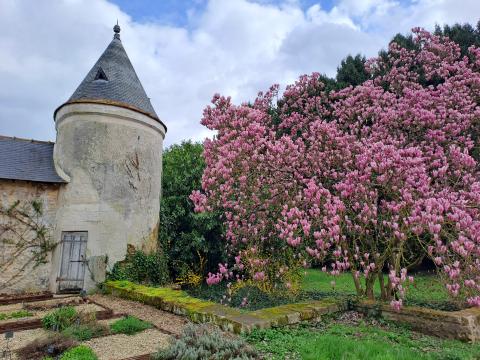
On this Thursday afternoon in March, a small group gathered at the entrance to the Orsay campus. The sun was already warm for the eve of spring. Its rays streamed through the branches of a magnolia tree covered in blossoms. It seemed like a fitting introduction to the experience awaiting the fifteen or so curious visitors who had come to take part in the tour of the Botanical Garden of Université Paris- Saclay. This is the first of the tours organised each year, between March and November, by the Environment and Landscapes Service of the Planning, Heritage and Property Department (DAPI) of the university, which is responsible for the preservation and promotion of the garden. On today’s programme: a lookback at the history of the site and its collections, and a discovery walk through this unexpected heritage.
Hidden amongst the maze of buildings on the Orsay campus are indeed many botanical treasures spread across some two hundred hectares. But you need to look closely along the edges of the paths to spot the scattered collections that make up the Launay Botanical Garden, as it is historically known. “The name Launay comes from the alder trees. These are trees that like to have their roots in water,” explains Delphine Albert, deputy head of the Environment and Landscapes Service. With the nearby River Yvette, the trees have found just what they need on the estate.
Nearly 2,500 taxa from all over the world
The Botanical Garden was established in the 1960s, shortly after the installation of what was then the Orsay Centre of the Paris Faculty of Sciences. Since then, its collections have continued to grow and now comprise some 2,500 taxa from all over the world. In addition to these, there are many other plant species found in the natural environments of the campus. “The Botanical Garden has a threefold mission: a conservation mission,a scientific mission and an educational mission,” explains Delphine Albert during the tour, which continues in front of building 300.
This is where the Oriental landscape - a collection of Chinese- and Japanese-inspired plantings - is located. Here you can see azaleas, boxwoods and bamboo. “There is also a Zen rock garden made up of mineral elements – stones and sand – which invites contemplation,” explains the deputy manager. A few metres further on, a grove of trees provides an opportunity to illustrate the garden’s mission through its labelling system. Every plant in the collection bears a label indicating its genus and species, its common name, its range, and its number in the park’s database.
In a small grove, a Japanese maple shares the space with a Persian ironwood, a Himalayan cedar and a pedunculate oak, offering a glimpse of the diversity of the collections. Whilst this oak is certainly impressive, it cannot be compared to the venerable 35-metre-tall, 200-year-old specimen that lined the path up to building 300 until it fell in the summer of 2024. To admire truly exceptional trees, however, you need to head to another area: the arboretum.

The arboretum of the Botanical Garden

The Alpine rock garden (© UPSaclay-Service environnement et paysages)
Trees at risk, apple trees and camellias
Located in the eastern part of the campus, the arboretum features around fifty species listed onthe International Union for Conservation of Nature (IUCN) Red List. It is home to trees such as the Chinese dawn redwood and the Bermuda juniper, both of which are endangered. The arboretum does not play a significant role in conservation, as a few individual trees are not enough to ensure the survival of vulnerable species. However, this collection raises awareness of the threats facing plant species worldwide.
A little further south, near building 360, lies another iconic site: the Nozeran orchard, which houses a collection of apple, pear and plum trees of heritage varieties. It is managed by the Association Bures Orsay Nature (ABON), which is responsible for maintaining the trees and harvesting the fruit. But the site is adjacent to another highly prized collection. Started in 1993 by Max Hill, a research engineer in plant physiology, it showcases around a hundred varieties of camellias.
“The aim was to create a reference collection in the Île-de-France region, which is not the ideal habitat for camellias,” explains the deputy manager. “Initially, 77 varieties were planted. The collection was then expanded with plants from other nurseries.” Pink, white, single, double, ruffled or smooth: the collection as a whole offers a remarkable insight into the diversity of camellia shapes and colours.

Between science, conservation and education
The Botanical Garden’s threefold mission is also reflected in the plant biology greenhouse at the Faculty of Sciences of Université Paris-Saclay, which houses the garden’s indoor collections. As well as serving as a testing ground for research and teaching, it features an educational area that welcomes school groups for plant-themed workshops.
Among its many activities, the institution also maintains a seed catalogue, updated annually by the Nursery and Seed Production Unit. It contains some 90 species native to the site’s natural habitats, such as meadowsweet and wood angelica, which begin to flower in the summer. “You don’t see the same things every season,” confirms Delphine Albert. A good reason to set off this summer in search of the botanical treasures of the Orsay campus.
Learn more:
- 2026 Visit Programme of the Botanical Garden of Université Paris-Saclay : https://www.universite-paris-saclay.fr/luniversite/les-campus/le-jardin-botanique-de-launay
- To mark Heritage Days, a guided tour of the Botanical Garden is being organised on 19 September at 2.00 pm (More information on the dedicated event). The association Bures-Orsay Nature is also offering a self-guided tour of the Nozeran orchard on 19 and 20 September (More information on the event here).

This article was originally published in L'Édition n°30.
Find out more about the journal in digital version here.
For more articles and topics, subscribe to L'Édition and receive future issues: