Biomimicry: When the natural world inspires scientists with new ways of thinking about energy
As a living open-air laboratory, nature provides scientists with an unlimited field of observation. But it is also a major source of inspiration. The result of millions of years of evolution, living organisms have developed a multitude of ingenious strategies to feed, move and survive in their environment. Researchers at Université Paris- Saclay are now attempting to replicate this ingenuity to develop new solutions for capturing, storing and using energy. (This article was originally published in L'Édition n°29.)
In the light-filled interior of Lumen – the university library, innovation centre and cultural space located on the Moulon plateau in Gif-sur-Yvette – an intriguing installation has been set up. Mounted on a frame just over a metre high, long transparent pipes reveal a green fluid circulating at high speed. But you have to get closer to the demonstrator to understand what it is. The fluidin question is filled with microscopic algae travelling through the parallel network. Like plants, these organisms of the Chlorella genus perform photosynthesis using light energy. And this is the very reason for their presence at Lumen.
This module is a demonstration of a project led by the Université Paris-Saclay Foundation in collaboration with the company Data4 and the start-up Blue Planet Ecosystems. It aims to design a system that uses the heat released by data centres to produce microalgae that consume carbondioxide (CO₂). After two years of research conducted by scientists from the ABIOMAS innovation chair supported by the Foundation, a first prototype was unveiled in May 2025 in Marcoussis (Essonne), on the roof of one of Data4's data centres (see the article published in L’Édition No.27). A preview of this concept can be found at Lumen: it is part of an exhibition running from 9 February to 12 April 2026, exploring new ways of thinking about energy, inspired by living organisms.
Projects illustrating the potential of biomimicry
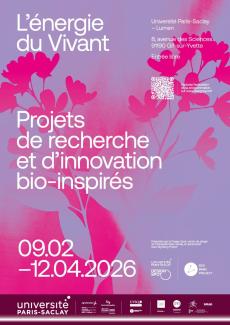
Conceived by Design Spot – the design centre of Université Paris-Saclay – in partnership with Guillian Graves, designer and founder of Big Bang Project, an agency specialising in biomimicry, the exhibition highlights some twenty research and innovation projects that draw inspiration from living organisms to develop ways of capturing, storing or using energy. It is divided into five parts, each showing very specific approaches to the links between biomimicry and the issue of energy.
The first part focuses on captured energies and explains how living organisms channel natural flows and transform them into energy. This is where the project that gave rise to the idea for the event, Bionergy, comes in. “The aim of this programme, initiated by Design Spot and which involved Guillian Graves and other entities such as FabLab of Université Paris-Saclay, La Fabrique of Centrale-Supélec and the Institute for Sustainable Energy (IES), was to develop aworking method for co-creating systems inspired by sea urchins,” says Yoann Montenot, director of Design Spot. The idea then arose to create an exhibition showcasing the concepts developed through the programme, which was later expanded into a more comprehensive event on biomimicry and bio-inspiration. “There are so many projects relatedto these themes.”
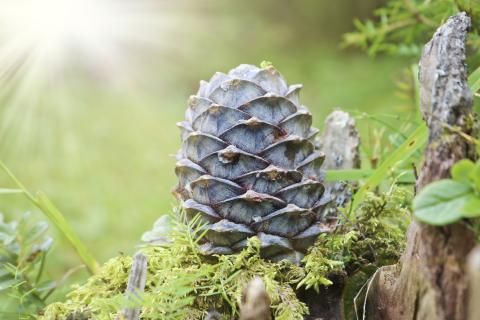
A solar tracker inspired by the ability of pine cones to deform, a robotic system that mimics the morphology of birds sitting on a branch, a suit that protects against heat using the radiative cooling process of desert silver ants... The selection of projects offers a broad overview of the multitude of ideas that arise from observing the interactions between living organisms and energy. It also shows how these ideas can be applied to a wide variety of research fields.
An "artificial lung" born from microfluidics
In medical research, biomimicry is attracting growing interest. The exhibition illustrates this through the "artificial lung" project developed by a team from the Centre for Nanoscience and Nanotechnology (C2N – Univ.Paris-Saclay/French National Centre for Scientific Research, CNRS/Univ. Paris-Cité). The aim is to design a device capable of reproducing the function of a real lung, in other words, oxygenating blood and removing the CO₂ it contains.
Currently, there are various techniques for maintaining oxygenation in patients whose lungs are no longer functioning properly. One of the most common is extracorporeal membrane oxygenation (ECMO). This involves inserting a cannula into the patient to carry the blood to a machine that oxygenate sit by circulating it through a network of fibres. The oxygenated blood is then returned to the patient via another cannula. “This type of system oxygenates the blood very well, but it has its limitations,” explains Anne-Marie Haghiri, Emeritus Research Director at C2N. After about 20 days, the device becomes unusable because the blood begins to clot, clogging the network of fibres. “When blood enters the reservoir, it immediately realises that it is not in the human body because it does not detect the chemistry normally present on the surface of blood capillaries. The blood then begins to clot.” In addition, the placement of cannulas in the neck and groin, as well as the size of ECMO machines, require the person to remains till throughout the treatment.
Drawing on biomimicry and its expertise in microfluidic technology, the C2N team has devised an innovative oxygenator solution in collaboration with Olaf Mercier, a thoracic surgeon specialising in cardiopulmonary transplantation at Marie-Lannelongue Hospital in Plessis-Robinson (Hauts-de-Seine). Launched in 2015, the project gave rise to a design inspired by the lung anatomy and composed of channels that mimic blood capillaries. “Our device consists of a thin membrane sandwiched between two networks of tiny channels,” explains Anne-Marie Haghiri. Blood circulates in one network while air (or pure oxygen) circulates in the other. The thin membrane, like the channels, is made of polydimethyl-siloxane (PDMS). “It is a transparent and biocompatible material that is already used for soft contact lenses.” It also has the distinctive feature of being gas permeable. Thanks to this property, oxygen passes through the channels and the membrane to reach the blood, which is at the same time freed of the CO₂ it contains. Each three-layer structure forms a disc with a diameter of ten centimetres, where blood is injected into the centre and is surrounded by dozens of curved capillaries. “The structure had to offer the largest possible exchange surface area while remaining compact.”
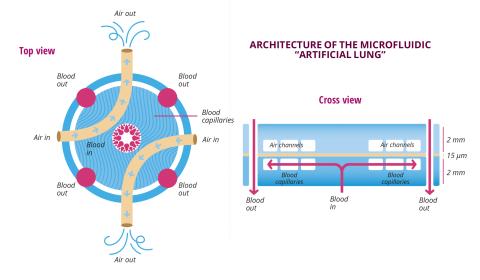
Initial analyses reveal that the structure exceeds researchers' expectations. “We found that gas transport occurs through the membrane to the blood capillaries, but also between the capillaries.” A disc is thus capable of oxygenating between fifteen and twenty millilitres of blood per minute. The result is conclusive, although insufficient to mimic a human lung, which oxygenates one litre of blood per minute. In order to increase the volume, Anne-Marie Haghiri's team stacks the three layers on top of each other, like CDs. “With five CDs stacked, which is the maximum stack we have achieved in the laboratory, we reach a flow rate of 80 mL/min.” This means that around 70 CDs would need to be stacked to achieve the performance of a human lung.
In 2022, a three-level system was tested on a pig model during surgery performed by Olaf Mercier. “The system worked for four hours. And the analyses carried out showed that the pig's vital signs remained perfectly stable.” During this test, the team also experimented a system with channels whose walls were covered with endothelial cells to mimic the chemistry of capillaries and lure blood. At the end of the operation, the scientists observed that the cells had come loose under the strong pressure of the blood pumped by the pig's heart. “This is an aspect that we need to continue researching,” acknowledges Anne-Marie Haghiri. But “the results remain encouraging because we see no difference in how the system works with or without cells.”
Although research on the "artificial lung" has been on hold since 2022, it is expected to resume soon within the team that patented the microfluidic system and its manufacturing technology. At the same time, scientists are also hoping to find an industrial partner to manufacture and test larger stacks.
Tackling the challenges of artificial photosynthesis
Although they are not featured in the exhibition at Lumen, there are other projects at Université Paris-Saclay that have placed living organisms and energy at the heart of their DNA. Sometimes this becomes a real quest, as Ally Aukauloo, a lecturer at the Orsay Institute of Molecular Chemistry and Materials (ICMMO – Univ. Paris-Saclay/CNRS), explains. “Nature shows us the way, but it is careful not to reveal its secrets,” he smiles. And yet, for several decades, the chemist has been tackling a well-known natural phenomenon: photosynthesis. It is through this process that plants and other organisms produce organic matter from sunlight, water (H₂O) and carbon dioxide (CO₂). “Nature is a huge laboratory that uses photons of light to synthesise everything. This is how life began to develop on Earth three billion years ago.”
Although photosynthesis has been studied for a long time, the process is currently experiencing a revival of interest due to the prospects it offers: not only the use of solar energy, a renewable source, but also the recycling of CO₂, considered to be the main gas responsible for climate change. “CO₂ is a molecule that is very difficult to attack,” explains Ally Aukauloo. And this is not the only difficulty encountered by chemists. Although photosynthesis appears simple on paper, it is in fact a series of complex reactions for which nature has developed sophisticated machinery.
We now know that the process takes place in chloroplasts, which are compart-mentalised organelles found in the cells of photosynthetic organisms. Inside, there is an enzyme complex called photosystem II (PS II). This structure absorbs light energy via photosynthetic pigments, chlorophylls, which “act as antennas to capture photons”. Once these have been captured, “the molecules enter an excited state and trigger a series of transfers of electrons (e-)”, which are then conducted to another structure, photosystem I (PS I). At the same time, PS II carries out the first crucial reaction of photosynthesis: the oxidation of water, which leads to the production of dioxygen (O₂) and protons (H+). The second phase of the process takes place starting from PS I, where the previous electrons are used to produce a powerful reducing agent, NADPH (nicotinamide adenine dinucleo-tide phosphate). The proton gradient that develops after water oxidation, meanwhile, is used to produce adenosine triphosphate (or ATP). It is with the help of these two molecules, NADPH and ATP, that CO₂ reduction and the production of sugars such as glucose (C6H12O6) are carried out.
In their research, Ally Aukauloo and his team are attempting to reproduce the processes involved in PS II, namely electron transfer and water oxidation. However, matching nature's talents is proving to be a delicate task. It has been shown that PS II has a structure as complex as it is precise. Changing just two amino acids is enough to render the system inoperative. And scientists are still far from understanding the role of all the elements present within the system and its complex responsible for water oxidation.
In these studies, “we try to take a part of nature and design a model to understand how the relationship between structure and activity works,” explains Ally Aukauloo. As part of a recently completed thesis, the team looked at how water molecules are captured and directed within the catalytic site. “We tested a porphyrin [a molecule with a cyclic structure] that manages to confine water molecules at the catalyst so that they can then be oxidised. In nature, there are water channels that do something similar.” Another difficulty lies in the ingredients that nature has selected. To oxidise water, the oxygen release centre (ORC) uses manganese, which is one of the most abundant metals in the Earth's crust. "But for us chemists, manganese is very difficult to control.” Instead, “we are developing a technology basedon iridium, which has the disadvantage of being one of the least abundant metals on Earth.”
The ICMMO team faces similar challenges in replicating the processes involved in the second phaseof photosynthesis. CO₂ reduction is an energy-intensive reaction that requires enzymes whose functioning is only just beginning to be understood. “We are looking for catalysts that borrow the principles of these enzymes to achieve CO₂ conversion more quickly, without losing efficiency.” One promising avenue has emerged with bio-inspired iron porphyrin catalysts. Taking inspiration from nature rather than reproducing it, artificial photosynthesis is a good example of how this works. “If we try to mimic nature, it doesn't always work. That's why we prefer to learn from nature. Our goal is to create simple models inspired by the very complex things that nature has created,” summarises Ally Aukauloo.
The resistance of a deep-sea sponge
At the laboratory of Fluids, Automation and Thermal Systems (FAST – Univ. Paris-Saclay/CNRS), scientists draw their inspiration from the depths of the ocean. Euplectella aspergillum is a species of sponge found in the Pacific Ocean, generally at depths of between 200 and 1,000 metres. Measuring between ten and thirty centimetres in size, it resembles a tube of lace standing upright and undulating under the effect of ocean currents. It is difficult to imagine that this animal is exceptionally tough. And yet it is. “This sponge is composed of approximately 99% biogenic silica, which is intrinsically fragile on a material scale,” explains Lamine Hattali, a lecturer at the FAST laboratory. The ocean depths are an environment with extremely harsh conditions. Yet the sponge survives very well there. It even provides a feeding shelter for small shrimp with which it lives in symbiosis, earning it the nickname "Venus's flower basket". How does the sponge resist ? “We have understood that it is not the material but the structure of the sponge that is responsible.”

Euplectella aspergillum stands out for its complex morphology, which resembles a Russian doll. By observing the species from every angle, biologists have identified a multiscale structure spanning seven levels. “On a macroscopic scale, we see a simple grid. When we look inside, we see that the grid is made up of spicules. When we make a cross-section of a spicule, we see that it is made up of several filaments. Then, when we cut the filament, we see that it forms an interlocking structure of several tubes,” describes Lamine Hattali. Looking even closer, silica nanoparticles appear, before giving way, at the atomic scale, to silicon-oxygen bonds.
It was after reading an article about structures inspired by the skeleton of sponges that the lecturer became interested in E. aspergillum. “The idea was to see if there was anything in this sponge that could be used to make materials capable of absorbing mechanical energy in the event of shock, impact or compression.” To find out, the FAST laboratory team focused its research on the macroscopic scale of the skeleton. The grid is “like a chessboard”: it is formed by an assembly of square cells, open or closed by a double diagonal. Using computer-aided design software, scientists modelled different structures of this type, varying their density. In the laboratory, these were then printed in three dimensions using polylactic acid (PLA) and an additive manufacturing technique called filament deposition.
The next step was to characterise the mechanical properties of the structures by conducting compression tests. “These tests allow us to observe the behaviour of each structure. We are interested in the plateau phase, which corresponds to the phase where energy is absorbed.” Through repeated testing, the team succeeded in defining design rules that lead to an energy absorption capacity approximately 20% higher than that obtained by directly transposing the structure of the sponge in a biomimetic manner. Now patented, these design rules have paved the way for several application ideas, including the development of personal protective equipment such as bicycle and motorcycle helmets.
“Our lattice structures have the advantage of absorbing shocks while remaining very light,” argues the lecturer. “Additive manufacturing also allows us to customise equipment, which adds anaesthetic aspect.” Similarly, the team is proposing a solution to replace one part of car bumpers which is usually made of solid steel. In addition to providing better resistance performance, this replacement would have the benefit of reducing vehicle weight. However, “this remains speculative. For now, we have only conducted low-speed compression tests. We would need to carry out dynamic impact tests at higher speeds,” admits Lamine Hattali.
While the macroscopic scale has already demonstrated promising results, the team plans to take things further in the skeleton of E. aspergillum. After the grid and its cells, future researchwill focus on exploring the spicules and their interlocking cylinders, whose thickness varies between the centre and the periphery. “The aim is to test the spicules and understand the variationin thickness. We will then test different configurations and try to insert them into the macroscopic structure. Ultimately, we want to create a multiscale material that is resistant to damage.”
Whether the goal is to withstand shocks, oxygenate blood or recycle CO₂, biomimicry and bio-inspiration offer scientists a highly fertile research environment, where observing nature becomes a source of solutions proven by millions of years of evolution. In addition to paving the way for new perspectives on energy, this approach repositions living organisms not only as a resource, but as an innovative model for addressing scientific, technological and environmental challenges.
References :
- The exhibition The Energy of life is on display at Lumen from February 9 to April 12 2026: https://www.designspot.fr/evenements/lenergie-du-vivant
- Lachaux et al., A compact integrated microfluidic oxygenator with high gas exchange efficiency and compatibility for long-lasting endothelialization, Lab on a Chip, 2021.
- Sheth et al., Proton Domino Reactions at an Imidazole Relay Control the Oxidation of a TyrZ-His190 Artificial Mimic of Photosystem II, Chemistry - A European Journal, 2024.
- Fernandes et al., Mechanically robust lattices inspired by deep-sea glass sponges, Nature Materials, 2021.
This article was originally published in L'Édition n°29.
Find out more about the journal in digital version here.
For more articles and topics, subscribe to L'Édition and receive future issues: