Film screening and discussion: "Being a woman and resisting the state, yesterday and today". November 7, 2 pm
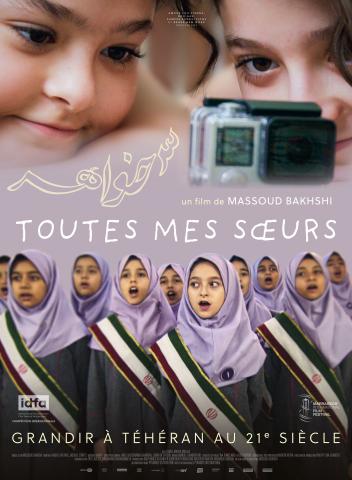
Screening of the film “Toutes mes sœurs” by Massoud Bakhshi, preceded by an excerpt from “1768 – Résister sous Louis XV, à la tour de Constance”, a play by Jean-Jacques Néré.
Lumen - Université Paris-SaclayThe Play
The Troupe des Deux Vallées has created this play, which depicts the liberation of the last female prisoners from the Tour de Constance. The Tour de Constance has been a women’s prison since 1717. Imprisoned there are ‘religious prisoners’ guilty of having taken part in gatherings in the Désert, or of having married without the blessing of the Roman Catholic Church.
Beyond the religious conflict between Catholics and Protestants, this play raises the question of resistance – the choice between resignation and a refusal to submit. These women are a symbol of this resistance, one that the royal authorities refuse to acknowledge, fearing a resurgence of unrest.
The Film
Growing up in Tehran in the 21st century… From 2007 to 2025, within a loving family, eighteen years in the lives of three sisters, from their early childhood to their daily lives as young women in search of freedom.
Raised in the traditional way, witnesses to the struggles of a youth in constant flux, what does the future hold for them in today’s Iranian society?
Born in Tehran, Massoud Bakhshi worked as a film critic, screenwriter and producer before directing 12 documentaries and short films that have won awards worldwide. His first feature-length fiction film, *A Respectable Family*, was screened at the 2012 Cannes Film Festival (Directors’ Fortnight), and his second, *Yalda, the Night of Forgiveness*, won the Grand Jury Prize at the 2020 Sundance Film Festival. With *All My Sisters*, he returns to documentary filmmaking.
INTERVIEW WITH MASSOUD BAKHSHI by Mahnaz Tischeh (excerpts)
How did this project come about? Did you have the idea of a long-term study of the sisters right from the start? What period does the film cover?
The idea for the film came about just after the two sisters were born, in 2005 and 2006. The main aim was to make a film about them growing up and the impact that family, cultural, educational and traditional values would have on them.
Initially, I planned to film them from a very young age until they turned 7, when they would start primary school.
But as filming progressed, I realised that this project couldn’t end when they turned 7, and that what came next was even more interesting. That is why I continued filming, adapting the script’s ideas to reflect the changing reality. The film therefore features footage shot over 18 years (from 2007 to 2025) and follows the sisters’ growth through the key stages of childhood (play, nursery, primary school), adolescence (secondary school, puberty, leaving school) and early adulthood (starting university, getting a driving licence, social engagement…).
Do you regard your film as a film ‘about children’, in the well-known tradition of Iranian cinema?
I think that every Iranian film is, in a way, a social film. It is true that in the 1970s, 80s and 90s, films ‘about’ and ‘featuring’ children formed a celebrated strand of Iranian cinema. This genre was recognised and acclaimed internationally, with directors such as Abbas Kiarostami, Amir Naderi and Bahram Beyzaie.
My film is, above all, a human story about growing up. But more than that, it is a film about women, accessible to all countries and cultures, as the characters are girls and mothers from different generations. Men, however, are absent from the film.
In fact, for years, the project was titled ‘Daughters and Mothers’, before being renamed ‘Sisters’, then ‘Three Sisters’ (the Iranian title), and finally ‘All My Sisters’ (the international title).
Has the situation for women changed in recent years?
Over the past few decades, broadly speaking, the socio-cultural situation of the younger generation has undergone a gradual evolution, despite its ups and downs. This applies particularly to women, not only because of their high expectations—which they express courageously—but also because of their awareness and clear-sightedness. What is important is that this awareness — which often emerges as early as adolescence — influences older, more traditional women and men. This conflicting influence is shaking up Iranian society and driving it forward. This is what makes it one of the most fascinating societies undergoing change in the world.
How do young women experience this dichotomy between traditional moral concepts, religion and the opportunities offered by social media and the internet?
I think this duality has long been part of our culture and our identity. Today, with new technologies, it is becoming more evident, sometimes more strange, but also more interesting.
What is fascinating is the enormous curiosity and thirst for knowledge amongst young people, and their strong determination to choose and build a better future, despite the difficulties, and not necessarily through emigration. Even though many do choose that path.
I am particularly interested in those who choose to remain in Iran to stand up for their rights. They are often the ones most aware of this duality.
Do you see your film as a metaphor for Iranian society? Or rather as a purely realistic documentary?
I think that every art form is, in a way, metaphorical. All the works that have left a mark on me contain some form of metaphor. I don’t know whether viewers will see metaphors in this film, but I, for one, perceive them in every scene.
Without them, it would be harder to understand or bear the raw reality. But of course, every viewer is free to interpret the film in their own way.