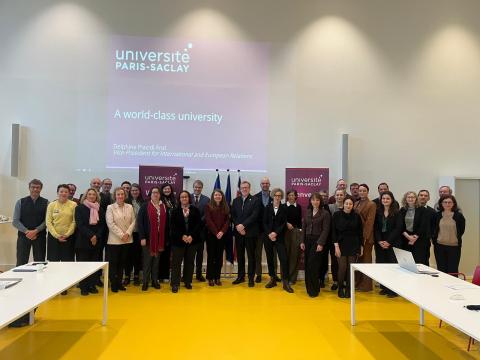
Université Paris-Saclay and University College London strengthen their strategic collaboration
Two leading European research institutions are consolidating their strategic partnership. The goal: to create a doctoral bridge between France and the United Kingdom and to expand their collaborations across multiple scientific fields.
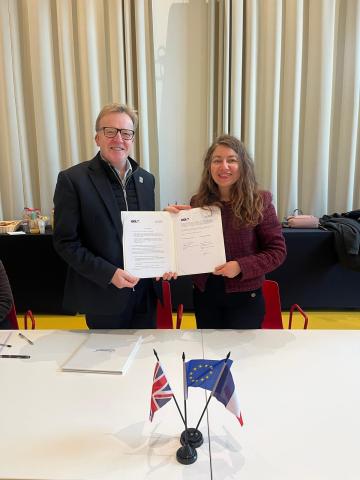
Professor Geraint Rees, Vice-President for Research, Innovation and Global Engagement at University College London (UCL), and Professor Delphine Placidi-Frot, Vice-President for International and European Relations at Université Paris-Saclay, have signed a letter of intent to formalise this partnership: the establishment of a joint PhD supervision agreement in oncology. Built on pre-existing research collaborations, notably in oncology, this alliance comes at a strategic moment, marked by the forthcoming UK association with the Erasmus+ programme, opening up new opportunities for academic exchanges.
Oncology as the starting point for the collaboration
On the UK side, the UCL Cancer Institute represents a £40 million investment (approximately €46 million), based in central London, bringing together over 400 scientists working on translational cancer research, and hosting the most comprehensive CAR T-cell programme in Europe.
In France, Université Paris-Saclay relies on key strengths through its Graduate Programme in Biotherapy and Oncology, which brings together master’s students, doctoral schools, and research teams. The university is also a founding member of the Paris Saclay Cancer Cluster, a leading ecosystem dedicated to innovative cancer treatments.
A joint supervision framework at the heart of the partnership
The institutional commitment of the two universities is reflected in the establishment of a joint PhD supervision framework. This arrangement will allow doctoral students to benefit from dual academic supervision between UCL and Université Paris-Saclay.
The partnership is not limited to oncology. The two universities are actively exploring the extension of this agreement to other departments and faculties, as well as to new research areas. Efforts are also underway to organise workshops and scientific events, strengthen student mobility agreements, and identify new opportunities for collaboration in education and research.
The EUGLOH alliance as a framework for global health
This meeting also takes place within a broader reflection on the opportunities offered by the European University Alliance for Global Health (EUGLOH), of which Université Paris-Saclay is the coordinating institution. EUGLOH brings together nine leading European research universities, pooling their expertise to address today’s societal challenges. Although UCL is not a member of the alliance, the two institutions have discussed the opportunities offered by EUGLOH and potential synergies to strengthen Franco-British cooperation in global health.
A visit highlighting new opportunities
This visit also highlighted new avenues for collaboration, particularly in the field of quantum technologies, where highly promising exchanges have emerged between the two ecosystems. The discussions paved the way for cooperation around the Quantum Technology Cluster initiative, as well as the organisation of an event in London before summer, designed to host doctoral students from Université Paris-Saclay as part of the Quantum PhD-Days. This momentum takes place within a highly favourable bilateral context, marked by the quality of relations between France and the United Kingdom, and reinforced by the forthcoming UK return to the Erasmus+ programme, opening up new opportunities for student mobility and exchange agreements. The holding of a Franco-British joint political committee (COMIX) in the spring will also help to strengthen this strategic framework.
This Franco-British alliance highlights the quality and excellence of two leading institutions, UCL and Université Paris-Saclay, and lays the foundations for a strategic partnership set to develop across multiple research and teaching fields.