
Sleep: Listening to the sleeping brain
Long perceived as a simple period of rest, sleep is now recognised as an essential component of human health. Every night, when the body slows down, the brain does not fall asleep, but rather changes its rhythm. But how does this work? And what role does this brain activity play in processes such as memory? At Université Paris-Saclay, research teams are venturing into the sleeping brain to shed light on its silent mechanisms. (This article was originally published in L'Édition n°29.)
Every night, when the lights go out and the eyelids close, human beings gently slip into sleep. Little by little, the outside world fades away, muscles relax, and breathing slows down. The body is then a far cry from the activity it had a few hours earlier, when fully awake. Because of this apparent immobility, sleep has long been considered a simple period of rest. We now know that it is no coincidence that human beings spend about a third of their lives sleeping. This stage is an essential part of the body's function, during which the brain is far from resting.
Because this component is still too often neglected, it has its very own event: every year in March, World Sleep Day raises awareness about the importance of good sleep hygiene. According to official recommendations, adults need between seven and nine hours of sleep per night. However, the ideal amount of sleep is highly individual. It depends on biological factors as well as other criteria such as daily activity. “A top-level athlete who trains twenty hours a week needs to sleep at least ten to eleven hours,” explains Arnaud Boutin, a lecturer at the Complexity, Innovation, Motor and Sport Activities laboratory (CIAMS – Univ. Paris-Saclay/ Univ. Orléans), who
explores the links between sleep and athletic performance.
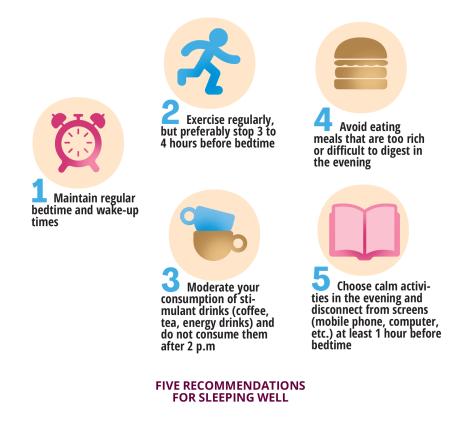
Quantity isn't everything. It's also important to ensure good quality sleep in order to sleep well. “There are a whole series of recommendations for reducing sleep difficulties and improving the quality of your nights.” These include maintaining regular wake-up and bedtimes, avoiding heavy meals in the evening, disconnecting from screens at least an hour before bedtime, and not engaging in intense physical activity in the hours before bedtime. “Above
all, it is important to avoid missing what is known as the sleep train,” notes the lecturer. In other words, resist the urge to sleep when it comes knocking, often around 10 or 11 p.m. “If we wait too long, it takes time to catch the next train.”
A specific structure divided into several phases
The image of the train is not just a metaphor. Sleep has a very specific structure that is divided into several phases. Falling asleep marks the beginning of the sleep process. This is followed by a series of cycles – between four and
five per night – each lasting between 90 and 120 minutes. Each cycle consists of a sequence of light slow-wave sleep and deep slow-wave sleep, followed by a phase of REM (Rapid Eye Movement) sleep. Finally, there is a latency period, during which people wake up or catch the next train.
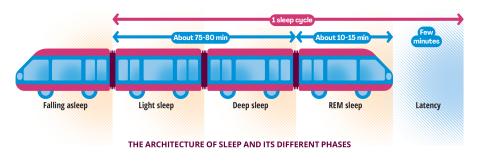
"By analysing the electroencephalographic (EEG) signal, we can determine which stage of sleep the subject is in," explains Arnaud Boutin. Each stage is character-ised by specific brain activity. "When we are in deep sleep, for example, the signal amplitudes are very large, with fewer oscillations per second. Using EEG, we can determine very precisely when a subject moves from one stage to another". Observations show that the architecture evolves over the course of the cycles. During the first part of the night, there is much more deep sleep than in the second. Conversely, there is much more REM sleep in the second part than in the first. REM sleep is the phase mainly associated with dreams. And it is when people wake up during this stage that they are able to remember their dreams.
In addition to having characteristic brain activity, each stage has a function. "Deep sleep has a recovery function," explains the lecturer. "The first two to three hours of the night are therefore very important for athletes who need a lot of recovery time.” During this phase, all the information collected during the day that is deemed unnecessary is also filtered out. "It's a bit like a beach: at the end of the day, there are lots of footprints in the sand. Then the sea comes in and only the biggest ones remain."
This trimming is crucial for memory and the neurons involved. “As the day goes on, neural networks become less available and the brain's ability to process new information decreases.” This explains the feeling that everyone has experienced at some point, of being unable to take in any more informa-tion at the end of the day. “We then need to sleep to ’recharge’ the neurons and restore their availability by making room.” Making room, but without erasing everything that was learned during the day. This is where consolidation comes in.
"Sleep spindles" to reactivate learned in formation
Consolidation is the process by which memories or learnings are stored for the long term in the memory. And this process mainly occurs during sleep. To understand how it works and identify the structures involved, Arnaud Boutin and his team are focusing specifically on light sleep, during which brain activity shows particular signals: sleep spindles.
“These signals are evidence of a reactivation of memory,” explains the neuroscientist. They take the form of peaks of activity lasting between 300 milliseconds and two seconds. “We have a model that shows that these reactivations are very well organised.” They are generated according to a precise rhythm, every three to four seconds, and in the form of trains consisting of three to seven successive reactivations. This is followed by a refractory period – when nothing happens – until a new train appears about fifty seconds later. These spindles do not occur just anywhere. It has been shown that reactivation occurs in the same brain areas that were involved in the learning to be retained.
“After learning, the neural networks involved are reactivated during sleep, particularly during sleep spindles: this is a window during which the brain replays and consolidates what has been learned.” Thanks to this process, the networks involved become much stronger and more effective at reactivating learning later on.
In their research, Arnaud Boutin and his colleagues put these processes to the test in motor learning. In 2024, these scientists invited 45 subjects to participate in a study involving learning a sequence of finger movements – “a bit like playing the piano” – but using different methods. Some of the subjects practised the sequence, others observed someone else doing it, and a third group imagined themselves performing the task without actually practising it. The participants then slept for an hour and a half. "The EEGs recorded during sleep showed the same reactivation patterns in all three cases: physical practice, observation and mental imagery. However, the neural networks activated differ depending on the practice modality.” By testing the subjects' abilities after sleep, the study reveals “that we learn really well through observation and mental imagery,” even if physical practice leads to slightly better performance.
Although these results shed light on the processes of reactivation and consolida-tion, the mechanisms are not fully understood. Analysis of brain activity indicates that sleep spindles are coupled with slow oscillations. The better the coupling, the more effective the reactivation appears to be. "In older people, there is a delay between sleep spindles and slow waves, which leads to less effective reactivation." How these patterns evolve with age is another question that the scientist is interested in exploring in his research. In collaboration with a team from the NeuroSpin centre, he is currently conducting a study on babies and children to find out how these mechanisms develop as the brain matures. “There are no spindles in babies a few days old. They appear from around two months of age,” explains Arnaud Boutin. “The aim of future studies is therefore to determine how these consolidation mechanisms evolve with age and the maturation of brain structures.”
Studying brain states from every angle
At the Paris-Saclay Institute of Neuroscience (NeuroPSI – Univ. Paris-Saclay/French National Centre for Scientific Research, CNRS), sleep is also keeping scientists busy. “One of our areas of focus is understanding the
physiological mechanisms involved in changes in brain state,” begins Alain Destexhe, who heads the Integrative and Computational Neuroscience team. “When we sleep in the deep sleep phase, we produce slow waves. The question is how these waves are generated.”
To answer this question, Alain Destexhe's team is studying different models and using several imaging techniques in addition to EEG. In mice, it uses wide-field calcium imaging, which provides a window into the activity of the entire brain, with spatial and temporal resolutions superior to those of magnetic resonance imaging (MRI). Based on the data collected, the team also uses modeling to link molecular aspects to emerging aspects of the brain. "Our originality lies in combining experimental activity measurement techniques with modeling and computational techniques. This is interesting because it gives us the opportunity to virtually test possible mechanisms of how drugs alter brain activity," confirms the research director. Thanks to a computational framework they have developed, the scientists are able to modify specific elements, such as synaptic receptors, and predict the changes induced.
This approach is used to study the differences in brain activity between states of wakefulness, sleep, and under anesthesia. “The mechanisms that induce the state of anesthesia and sleep differ greatly,” Alain Destexhe points out. Sleep is induced by molecules called neuromodulators, which are naturally present in the body, such as acetylcholine, norepinephrine, and serotonin. By gradually decreasing their production, these molecules cause the system to switch to a slow-wave mode. Anesthesia, on the other hand, is induced by external molecules that bind to receptors distinct from those of neuromodulators, but which have a similar effect on overall activity. "When these receptors are stimulated, the brain completely disconnects and shifts to a slow-wave dynamic." In a study published in 2025, the team illustrates its computation-al approach by simulating the molecular mechanisms at work in general anesthesia. In addition to reproducing experimental observations, the simulation highlights a similar type of neural activity in the transition phases to anesthesia and sleep.
However, the two states have other similarities. "During sleep, as under anesthesia, brain activity follows connectivity. This means that the areas of the brain that synchronise are often those that are connected. However, this is not at all the case when the brain is awake. Very often, areas synchronise even though they do not exchange any connections.” By exploring the different states – sleep, wakefulness, and anesthesia – experimentally and through modeling, the team hopes to better understand their fine structure and the succession of brain states.
Improve sleep with slow-wave music
Exploring brain activity led Alain Destexhe to venture into another, more unexpected field, where slow waves are transformed into music for sleeping. “The idea came about by accident a few years ago,” he recalls. At the time, "a
colleague and I had fun creating music from brain activity." Using human recordings, the duo captured sleep activity, which they then used to generate sounds. This hobby gave rise to a variety of electronic music tracks that were posted online. Then a twelve-hour flight to San Francisco opened up new possibilities.
On that day, Alain Destexhe took advantage of the flight to listen to music samples recorded before departure. It turns out that this time, the sequences were composed using the slow brain waves of the scientist, who recorded
himself while asleep. Although he usually has great difficulty sleeping on planes, he didn't see much of his flight. On the return flight, the same thing happened: “I listened to the music again and fell asleep once more.” Back in France, “I told my colleague that there was something interesting to explore.” The duo had no trouble finding subjects willing to try the experiment in the laboratory.
In 2023, their research led to the creation of a start-up, myWaves, which markets a device for recording nocturnal brain activity and transforming it into music for sleeping. At the same time, Alain Destexhe, in collaboration with researchers from the Sleep and Vigilance Center at Hôtel-Dieu Hospital, in Paris, began a clinical trial to evaluate the effects of the approach. The study, published in 2025, was conducted on thirteen patients suffering from chronic insomnia, on whom different musical sequences were tested: one was created from their slow waves, while the other was a non-personalised placebo sequence. “The music lasts thirty minutes. The idea is that the subjects
go to bed, turn off the light, and listen to the music before sleeping,” explains the neurobiologist.
The trial was repeated over five nights, during which the subjects' brain activity was recorded. At the end of the protocol, a clear difference appeared between the sequences. “We can clearly see the effect of personalisation on sleep structure,” explains the research director, for whom this comes as no surprise. “Everyone has their own way of generating slow waves. Studies have even shown that brain activity during sleep is so personalised that it can be used as an identity card.” The effects on individuals' sleep, on the other hand, are more surprising.
Thirty minutes that influence the entire sleep process
“We expected personalised music to have an effect on slow waves and the correspond-ing sleep phase. But that wasn't the case at all.” The results show effects on sleep as a whole, including an increase in REM sleep. “The fact that this phase occurs more quickly is an indication of better sleep,” explains Alain Destexhe. This is especially true for people suffering from chronic insomnia, which significantly disrupts sleep structure. In addition to this effect on the REM phase, there is a decrease in the duration of falling asleep and a significant increase in the total duration of sleep.
How does this music work? It's a complex question. “We have no idea what mechanisms are at play,” admits the scientist. “But we have some hypotheses.” One of them takes into account the specific characteristics of the auditory cortex. Hearing is the only sense that has a direct connection to the centers of the brain stem that regulate sleep. "The reason for this is very simple: it's a matter of survival. If you hear the sound of a predator during the night, you need to be able to wake up immediately." The hypothesis assumes that slow wave music would take advan-tage of this connection to do the opposite: induce sleep through sound. Another theory suggests that music somehow simulates the slow-wave sleep phase and thus brings on REM sleep more quickly.
In any case, slow-wave music has already begun to find its way into the spotlight, according to Alain Destexhe, who has been contacted by several sleep centers around the world. The US space agency (NASA) has also shown interest in helping its astronauts, who often struggle to sleep on the International Space Station (ISS), where day/night cycles last only an hour and a half. After testing the night function of the myWaves device, the team still needs to test the nap function, which offers fifteen minutes of music, “ending with birdsong to wake you up.”
Napping and its underestimated benefits
When it comes to sleep, we often think of nighttime rest. However, more and more studies are highlighting the underestimat-ed benefits of napping. At CIAMS, most of Arnaud Boutin's studies incorporate naps into the protocol. “Even if a nap is not exactly equivalent to a night's sleep, it mobilises very similar mechanisms and can support learning consolidation.” Taking a nap after learning would therefore be an excellent way to consolidate it and reduce the risk of it interfering with other knowledge acquired during the day.
But not all naps are equally beneficial. “It depends on the length,” confirms Arnaud Boutin. "A very short nap of fifteen-twenty minutes is ideal for improving concentration, alertness, and energy levels." However, it has no effect on memory consolidation. For that, you need to take a nap of an hour or more. As for anything in between, it's best to avoid it, according to the lecturer. "A nap of thirty to forty minutes can cause sleep inertia, especially if you enter deep sleep. This feeling can last from a few minutes to around thirty minutes, sometimes longer depending on the individual." In other words, taking a good nap is something that can be learned. This includes high-level athletes. "Naps are increasingly being incorporated into sports routines because they provide restorative sleep."
This is one of the strategies used by the neuroscientist and his colleagues in a recent study conducted on 36 professional rugby players. According to the analysis, 34 of them slept less than eight hours per night and 22 were considered "poor sleepers". “The goal is to see how a sleep hygiene program, including various recommendations [such as incorporating naps during the day], lengthens and improves sleep periods.” One month after their intervention, more than 90% of the athletes continue to follow at least one of the recommendations. And 19 of them report taking regular naps. Between fundamental and applied research, the study of sleep highlights the complexity of the
brain, while laying the groundwork for essential knowledge to shed light on this crucial aspect of human health. Human, but not only. “Studies have shown that slow-wave sleep and REM sleep exist in the dragon [an Australian reptile], it’s incredible!” says Alain Destexhe. While the function of the REM phase remains very enigmatic, sleep is certainly not done fueling the dreams of scientists.
References :
- Conessa et al., Sleep-related motor skill consolidation and generalizability after physical practice, motor imagery, and action observation, iScience, 2023.
- Sacha et al., A computational approach to evaluate how molecular mechanisms impact large-scale brain activity, Nature computational science, 2025.
- Montagni et al. Mapping brain state-dependent sensory responses across the mouse cortex. iScience, 2024.
- Aloulou et al., Listening to the sound of your own brain waves enhances sleep quality and quantity, Sleep Medicine, 2025.
- Goldberg et al., Enhancing sleep in professional rugby players: Observation and sleep interventions, Journal of Sports Sciences, 2024.

This article was originally published in L'Édition n°29.
Find out more about the journal in digital version here.
For more articles and topics, subscribe to L'Édition and receive future issues: