Pedagogical innovation: An ecosystem to support and guide the evolution of teaching practices
Pedagogical innovation is now one of the pillars of the Université Paris-Saclay teaching and learning project. To encourage the evolution of teaching practices, a dedicated ecosystem has gradually developed, driven by a range of support and guidance initiatives. (This article was originally published in L'Édition n°30)
Higher education is currently undergoing profound changes driven by technological, social and cultural evolutions that are redefining learning methods and students’ needs. In this context of change, one approach is gradually emerging as a key driver for renewing teaching practices and promoting student success: pedagogical innovation.
"Pedagogical innovation is the successful implementation of an idea, an initiative or a transformation in the field of education,"summarises Claire Lartigue, Vice-President for the Education and University Life Commission (CFVU) of Université Paris-Saclay. "This brings together all the reflections on teaching practice and student learning." At Université Paris-Saclay, this idea of developing teaching practices is much more than a mere aspiration. It lies at the heart of an entire ecosystem that has been established within its community.
A place and time for sharing ideas on teaching practices
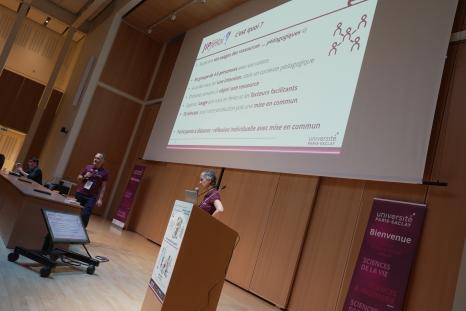
On 1 April, the topic was in the spotlight with a new edition of the Pedagogical Initiatives Day (JIP) (in French, Journée Initiatives pédagogiques - JIP), held at the ENS Paris-Saclay in Gif-sur-Yvette. "The aim of this annual event is to provide a space and an opportunity for sharing ideas and experiences about teaching practices, in order to contribute to pedagogical reflection and development," explains Lionel Husson, project manager for pedagogical innovation at Université Paris- Saclay, who heads the JIP organising committee.
Each year, the JIP is organised around a theme that resonates with the challenges facing the education community. This 11th edition, which brought together some 300 people, was therefore built around the theme of enabling environments. "Is a learning environment enough to facilitate learning, or can it actually hinder it?," asked Solveig Fernagu, the guest expert invited for the occasion, during a conference. An educational village, as well as workshops, were also held to highlight various actions and initiatives, and to address topics as varied as acculturation to artificial intelligence (AI) or the use of mental representations in education.
"With the JIP, we also aim to highlight pedagogical initiatives and innovations, and encourage their wider dissemination," confirms Lionel Husson. The aim is also to establish a link between the projects presented and any support they may have received. This is where the JIP really makes its mark: by showcasing what is happening on the field to illustrate the momentum at work. "It’s not just a showcase," emphasises the mission manager. "We want to promote synergies and the emergence of a shared culture [around pedagogical innovation] and show that this is also part of an ecosystem of support and guidance."
A department dedicated to pedagogical innovation
The Department of Pedagogical Innovation (DIP) at Université Paris-Saclay is one of the roots of this ecosystem. Its mission is to transform teaching practices in line with the university’s academic programmes and in support of the teaching community. This mission, however, encompasses a wide range of activities.
"Our team is organised into three divisions," explains Éric Briantais, director of the DIP. "The first is responsible for the digital environment." This includes the eCampus platform, which has over 70,000 users, as well as around ten other applications. A second division is responsible for producing teaching resources and tools. These include SPOCs (Small Private Online Courses) for the university’s programmes, and MOOCs (Massive Open Online Courses) for other audiences. But the unit is also behind other initiatives such as the BrevetAI app, developed in collaboration with the DataIA Institute – the artificial intelligence institute of Université Paris-Saclay – to introduce users to the key concepts surrounding AI and its implications.
Finally, the third division focuses on education and academic development. In particular, it offers a training programme in teaching methodology, including sessions to learn about digital tools, discover new practices, and refine teaching design. This division also coordinates two annual calls for proposals: "Oser" and "Transformer". The first supports the development of innovative pedagogical initiatives, whilst the second focuses on the dissemination or scaling up of existing initiatives. In addition, there are calls for proposals on specific themes such as digital technology or serious games. Since 2020, these calls have funded around a hundred projects, to the amount of 3.5 million euros.
Time saved to transform working practices
Whilst anyone can come up with ideas for transforming their teaching practices, it is not always easy to put them into action. This is particularly true when you have a busy schedule. That is why the DIP coordinates two other schemes: leave for educational innovation (in French, CIP) and leave for educational projects (CPP). "Their role is to free up time for teachers by relieving them of some of their teaching duties," explains the director.
Rachel Méallet, a lecturer at Molecular Science Institute of Orsay (ISMO – Univ.Paris- Saclay/CNRS), and Jonathan Piard, professor at the Department of Chemistry at ENS Paris- Saclay, have benefited from the CIP twice for their GLASS (Green, lowcost, attractive, safe, and simple) project. This involves developing chemistry experiments using everyday items to explore concepts such as colour and the emission of light. "We work with coloured substances such as eosin, turmeric, tonic water and washing-up liquid, to demonstrate, for example, that some of them become luminescent after absorbing light," explains Rachel Méallet.
The idea for these low-cost chemistry experiments first came about several years ago. However, the CIP provided "an extraordinary space for freedom" to develop the concept. During this period, "we tested nearly 400 everyday products. This enabled us to create a number of experiments for use in teaching or for science outreach to the general public," explains Jonathan Piard. "This opened doors for us that we are now capitalising on." Articles are currently being written and published to promote the initiative and encourage its wider dissemination. At the same time, the team is also giving presentations at numerous conferences, seminars and congresses.
"The real value of the CIP is that it helps us devote mental energy and time to ideas that we don’t usually prioritise," says Rachel Méallet. "It also lends a certain legitimacy, on the part of the institution, to things we might otherwise consider a bit out of the ordinary." In addition to the GLASS project, Jonathan Piard is co-coordinator of the ENS Paris-Saclay Pedagogical Initiatives Group (GIPENS). He is also a project manager for pedagogical innovation at Université Paris-Saclay. This demonstrates that the network of actors involved extends widely within the university community.
A testing ground for educational innovation
On the Orsay campus, a place isentirely devoted to these issues of pedagogical transformation: the Villebon – Georges Charpak Institute. Established in 2013 through a collaboration between thirteen universities and grandes écoles, including Université Paris-Saclay, this public interest group (GIP) is dedicated to a mission of public interest. "This means that the Institute’s mission is to share the results of its work with as many people as possible," explains Gérald Peyroche, its director. "Work" is the appropriate term, as the Institute serves as a genuine testing ground for educational innovation.
This initiative is primarily expressed through the Science and Technology undergraduate degree offered there. Unique of its kind, this course stands out for the unconventional format of its teaching. "We really strip teaching back to its bare essentials," relying on simple, cost-effective methods and emphasising the role of the collective. Methods such as project-based learning and "maths at your own pace" are used. The degree also stands out for the extensive support provided to students, both in terms of personal and material resources.
It is worth noting that the students en-rolled on this undergraduate degree are also somewhat unusual. Students are selected to over-represent minority groups in higher education: at least 50% are grant recipients, at least 30% come from technological fields of study, between 20% and 30% have a disability, and the final criteria is gender parity, with 50% women and 50% men. "With these cohorts, we have a two fold objective: to help these young people - who, upon leaving secondary school, are not necessarily in the best position to enter higher education – to succeed, and to encourage them to pursue further studies."
However, innovation in this mission is not limited to teaching alone. At the Institute, we consider everything that contributes to learning, starting with the facilities provided. The fully renovated Orsay building features modular classrooms, a fablab for project-based learning workshops, and dedicated student spaces, including a rest room.
Since 2024, thinking about the physical environment has, moreover, taken on a new dimension with the opening of the Georges Charpak residence, which now accommodates the undergraduate students."This student residence is fully integrated into the Institute’s pedagogical strategy," confirms Gérald Peyroche. "Our team has put a great deal of work into the architecture and facilities ofthis residence," which prioritises shared accommodation and includes more study rooms than a conventional residence. The site is currently at the heart of a project led by designers, which explores how communal spaces are used in the daily lives of the young residents. "The idea is to come up with ideas that could potentially be used in other residences."
Action research in motion
In addition to the undergraduate degree and the residence, a third axis is at work at the Villebon – Georges Charpak Institute, which opened its Pedagogical Experimentation Centre (in French, Centre d’Expérimentation Pédagogique - CEP) in 2019. Like the DIP, the centre works to support experiments in teaching practices. "Except that we don’t do it in the same way at all," notes Gérald Peyroche. At the CEP, practising teachers are supported "in an exploratory, finely tuned and very early-stage process".
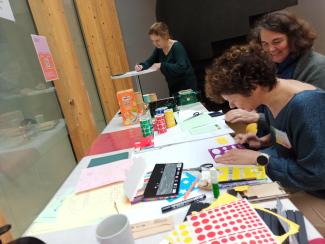
"The aim is to provide an opportunity to discuss teaching practices, learn about the latest innovations and meet other teachers to spark new ideas," continues Pauline Delpeuch, co-head of the CEP. Workspaces and equipment are available on site for designing and prototyping teaching tools.However, the centre also stands out for its research focus, developed in collaboration with the Chair in Pedagogical Innovation, held by a researcher from Université de Québec à Montréal (UQAM), and funded by Université Paris-Saclay, as well as the Villebon - Georges Charpak Institute, which also coordinates the initiative.
Focused on action research, this chair aims to document innovative practices tested in the field and make research in educational sciences accessible. To this end, two postdoctoral researchers arebased at the centre, and support is provided at every stage of the project: from defining the research question to drafting papers or publications.
Every December, the chair organises a week-long workshop during which teams have the opportunity to meet and either launch or pursue projects, alongside researchers from the centre and UQAM. "This is where new relationships are forged and new projectstake shape," explains Pauline Delpeuch. The seventh edition, held in late 2025, brought together 80 participants from 20 institutions to work on 15 different research projects.
Although each operates in its own way, all of these initiatives combine to create a collectivemomentum around the now essential issue of pedagogical innovation. "That is why this ecosystem is interesting: all the elements support one another to create opportunities for everyone to develop their professional practice, and contribute, at the university level, to making pedagogical innovation a collective and transformative capacity," concludes Lionel Husson.
Ressources :
- Pedagogical innovation at Université Paris-Saclay: https://www.universite-paris-saclay.fr/formation/
initiatives-et-innovations-pedagogiques/linnovation-pedagogique-luniversite-paris-saclay - Replay of the 11th edition of the Pedagogical Initiatives Day: https://www.youtube.com/watch?v=Fxeqi1DeGFw&t=1691s
- Website of the Villebon – Georges Charpak Institute: https://www.villebon-charpak.fr/
- Website of the Pedagogical Experimentation Centre (CEP): https://cep.villebon-charpak.fr/
This article was originally published in L'Édition n°30.
Find out more about the journal in digital version here.
For more articles and topics, subscribe to L'Édition and receive future issues: