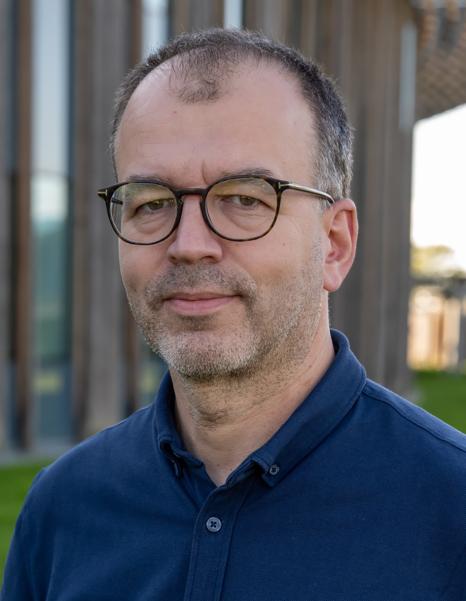
Olivier Berteau: radical enzymes at the forefront of health and life sciences
Olivier Berteau is a biochemist and a research director at INRAE within the Micalis Institute (Univ. Paris-Saclay/INRAE/AgroParisTech). A specialist in metalloenzymes and radical chemistry, he explores the fundamental mechanisms of life with a view to discovering new molecules of therapeutic interest, particularly innovative antibiotics. Working at the interface between chemistry and biology, he combines fundamental research with the development of applications in health and the environment.
Olivier Berteau’s research career has developed at the intersection of chemistry and biology. During his PhD, which he completed in 2002, he immersed himself in what was then an emerging field: the interface between chemistry and biology. Whilst working on the discovery and characterisation of new enzymes for the study of marine polysaccharides, he learnt to utilise these molecular tools capable of degrading or modifying matter with a high degree of selectivity. This work permanently steered his research towards understanding the chemical reactions within living organisms and their potential for the synthesis of new molecules.
The discovery of metalloenzymes
After an initial postdoctoral fellowship in Sweden, where he honed his skills in physical chemistry and NMR spectroscopy to investigate enzymatic mechanisms, Olivier Berteau returned to France to further his research. In 2003, he joined Marc Fontecave’s laboratory at the CEA in Grenoble. It was there that he discovered the metalloenzymes of the SAM (S-adenosylmethionine) radical family. These enzymes use radical chemistry, which enables them to transform low-reactivity substrates and, in particular, to form carbon–carbon bonds. “They therefore carry out reactions that, even in synthetic chemistry, we sometimes do not know how to achieve. At the time, only 600 were known; today, it is estimated that there are nearly a million, which clearly illustrates the unsuspected diversity and abundance of the living world,” the researcher emphasises.
Enzymes of the human microbiota
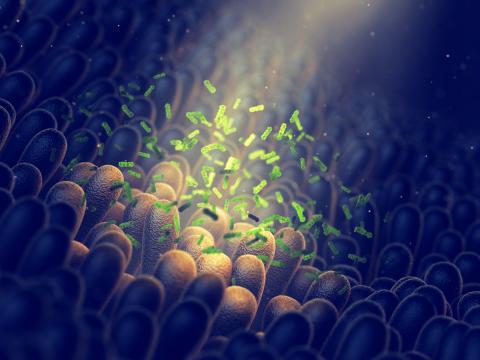
In 2005, Olivier Berteau joined INRAE with the aim of applying this expertise to a field that was then booming: the human microbiota. At that time, research into the bacteria that colonise the human body was expanding, but many of their functions remained to be elucidated. The researcher then took a gamble: to use SAM radical-containing enzymes, often found in anaerobic bacteria of the digestive tract, to understand how these microorganisms interact with the body. “Thanks to a collaboration with the American pioneer, Professor Jeff Gordon, we were able to demonstrate how one of these enzymes enables a major bacterium in the microbiota to colonise the human gut effectively,” explains the researcher. This pioneering work, carried out at what would become the Micalis Institute in 2010, laid the foundations for a new understanding of the links between enzyme chemistry and human health.
Understanding enzyme structure with support from the ERC
The year 2013 marked a turning point in Olivier Berteau’s career with the award of funding from the European Research Council (ERC). “We were then able to adopt biochemical approaches to study enzymatic reactions by analysing their three-dimensional structure. Indeed, to understand how these catalysts work, we need to be able to visualise them in three dimensions, which poses a major challenge given that these enzymes are extremely fragile, sensitive to oxygen and sometimes even to light,” explains Olivier Berteau. Under his leadership, the team developed cutting-edge structural biology approaches, requiring complex anaerobic facilities to crystallise the proteins without denaturing them. This methodological requirement led him to collaborate closely with the SOLEIL synchrotron. The aim was not merely to obtain a static image, but to capture snapshots of the chemical reaction as it unfolds in order to identify its most fleeting intermediates.
Towards new antibiotics
This fundamental research opens up new prospects in the field of healthcare. Olivier Berteau’s team is, in particular, studying the role of enzymes from the SAM radical family in the production of molecules of therapeutic interest. Two years ago, a paper published in the journal *Nature Chemical Biology* described the discovery of a new family of antibiotics and the structure of the enzyme involved in their biosynthesis. The researcher is also working to capitalise on these discoveries by filing patents and seeking industrial partners. “We are trying to carry out fundamental research whilst, at the same time, exploring the potential of our discoveries for applications that benefit society,” he explains.
A collective commitment to interdisciplinary science
Beyond his own research, Olivier Berteau is actively involved in the scientific community. Elected to the board of the Graduate School of Life Sciences and Health (LSH) at Université Paris-Saclay and a member of the board of directors of the French Federation of Biochemistry and Molecular Biology, he is working to shape his discipline.
The future of artificial intelligence and the challenges ahead
Olivier Berteau is also interested in the possibilities opened up by artificial intelligence. Whilst tools such as AlphaFold now make it possible to predict protein folding, the researcher emphasises that understanding the active site of the enzyme and its metal cofactors remains a challenge for these approaches. “In particular, we plan to extend our research to environmental issues, using these enzymes to develop more environmentally friendly synthetic chemistry processes,” adds the researcher.