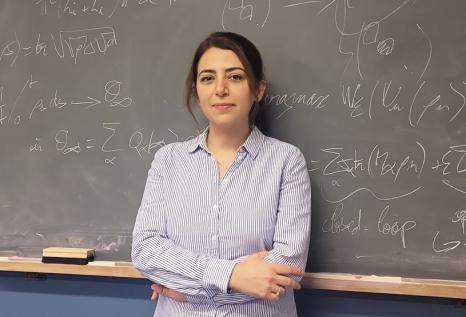
Nina Hadis Amini: exploring the quantum world through mathematics
Nina Hadis Amini is a CNRS research director and member of the Signals and Systems Laboratory (L2S - Univ. Paris-Saclay/CNRS/CentraleSupélec). The researcher specialises in combining mathematics and physics to develop methods for controlling quantum states and providing stability for the machines of tomorrow.
Born into a family that valued education and science, Nina Hadis Amini developed a taste for mathematics at an early age, with a particular interest in probability. She studied physics at Sharif University in Tehran, Iran, her native country. In 2005, she followed in the footsteps of her older brothers who had come to France and enrolled at École Polytechnique after passing the entrance exam reserved for foreign students. She was particularly interested in applied mathematics and approached quantum physics from a new perspective. In 2009, she began a PhD at the École des Mines de Paris after completing a master's degree in financial mathematics and statistics at ENSAE. Her PhD thesis focused on "the stabilisation of discrete-time quantum systems and the stability of continuous-time quantum filters" and was the result of her meeting with researchers Mazyar Mirrahimi and Pierre Rouchon, who co-supervised her work and played an important role in growing her interests in the field. "Our challenge was to find a way to control these systems, for example, to keep three photons in a cavity without the environment disrupting everything," explains Nina Hadis Amini. A first publication, resulting from a collaboration between experimental physicists and mathematicians, marked the starting point of her career in 2011.
In 2012, after defending her thesis, Nina Hadis Amini decided to spend six months as a postdoctoral researcher at the Australian National University to deepen her knowledge of quantum control by working with Matthew R. James. She then went on to do a second postdoctoral fellowship in the United States, at Stanford University, working with Hideo Mabuchi. She stayed there for two years. "I mainly perfected my skills in optics and quantum physics, while broadening my perspective on the field. I also learned a language common to physicists, which was essential for my research." The researcher gained international renown. Her return to France in 2014 was marked by a brilliant recruitment to the CNRS: ranked first in the competition, she joined the Signals and Systems Laboratory (L2S) as a research fellow.
Reducing complexity
The researcher continues to develop new control methods to stabilise other quantum states or subspaces, with the aim of making these systems increasingly robust. Nothing motivates her more than finding the mathematical law that will reduce the complexity of a quantum system. In 2020, she is coordinating the ANR project Estimation and control of open quantum systems - Q-COAST. "My research consists of developing the mathematical theory that will enable quantum systems, which are naturally very fragile, to function in a stable manner. This is because quantum uncertainty is omnipresent: the slightest measurement can modify or collapse a state," she explains. As a result, complexity at the quantum scale increases exponentially. "Adding a single qubit doubles the size of the computational space. This quickly becomes unmanageable, even for supercomputers. We are no longer working on two or three isolated qubits, but on real multi-body systems. One of my goals is therefore to find mathematical approaches that reduce complexity while preserving the essence of quantum dynamics."
For all of her work, Nina Hadis Amini collaborates with numerous researchers from different disciplinary and geographical backgrounds. "These interactions are vital. It is by discussing hard mathematics with people who do physical experiments that we find the most daring solutions.
Mean field theory and the behaviour of quantum trajectories
One of the tools Nina Hadis Amini uses in her work is mean field theory, which drastically simplifies the problem and reduces the complexity of the calculations. "If qubits interact weakly, then why not just look at the behaviour of a single one?" Instead of studying the complex interaction of each body, this method considers a single system to represent the statistical behaviour of the whole at infinity.
The mathematician is also interested in Markovian and non-Markovian quantum trajectories, which describe the evolution of open quantum systems. In a Markovian process, the future state depends solely on the present state: the dynamics have no memory effect, which makes it easier to analyse long-term behaviour. By contrast, in a non-Markovian process, evolution is influenced by the history of the system and by persistent correlations with its environment. "So, if we want to predict the long-term behaviour of a quantum system, we must be able to model these memory effects accurately." The researcher's goal is therefore to mathematically formalise these different dynamics, with or without memory, in order to understand their long- and short-term behaviour. Beyond its theoretical interest, this work provides scientists with essential tools for analysing and controlling the quantum technologies of tomorrow, particularly in large-scale systems.
Quantum learning
More recently, Nina Hadis Amini has extended her work to quantum learning. She is studying how quantum dynamical systems themselves are used for machine learning tasks. The aim is to exploit the richness of quantum dynamics – a very large state space – measurement effects and complex interactions to better process and predict time series, particularly when their behaviour is chaotic. "It's about combining artificial intelligence and quantum physics in order to use the dynamics of quantum systems as tools for modelling and anticipating phenomena that are difficult to predict using conventional approaches."
Commitment to equality and parity
Nina Hadis Amini, who has been teaching at École Polytechnique since 2018, defended her habilitation to supervise research (HDR) in 2022. This was a significant year in her career, as she also received the CNRS bronze medal and the Irène Joliot-Curie prize. "These awards are a source of both great pride and encouragement." Recognising that her field of research remains largely male-dominated, Nina Hadis Amini is committed to promoting the place of women in the scientific world. She is an active member of her laboratory's Gender Parity and Equality Committee. The researcher also contributed to a comic book entitled "Portraits of Women Scientists in Digital Sciences", which was distributed to secondary school students. ‘The aim is to encourage them to choose digital sciences, especially young girls.’
She advises those who are passionate about physics and mathematics not to be discouraged, emphasising that although the journey can be difficult, it is also an opportunity to grow. "The most important thing is to remain free to do what you want," she concludes.