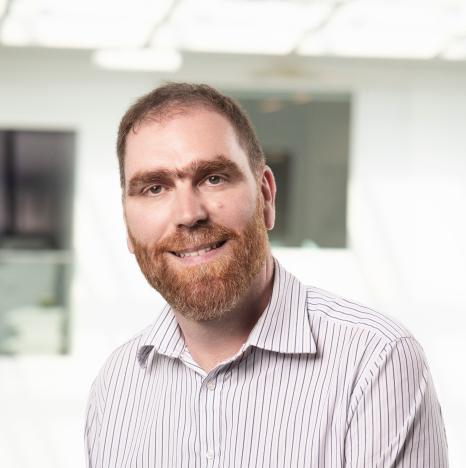
Laurent Daniel: characterising and modelling the behaviour of materials
Laurent Daniel is a professor at CentraleSupélec and a member of the Paris Electrical and Electronic Engineering Laboratory (GeePs - Université Paris-Saclay/CNRS/CentraleSupélec/Sorbonne Université), as well as director of the Graduate School of Engineering and Systems Sciences (SIS) at Université Paris-Saclay. His research focuses on the behaviour of ferromagnetic and ferroelectric materials with two main objectives: on the one hand, to enable the design of high-performance electromagnetic or electromechanical systems, and on the other hand, to develop new means of non-destructive examination for materials and structures.
Within GeePs (approximately 250 research staff), Laurent Daniel is part of the ‘Electromagnetism’ division, one of the laboratory's four divisions. His research group specialises in studying the multiphysical behaviour of materials with the aim to better predict their response when they are simultaneously subjected to mechanical, magnetic or electrical stresses.
Modelling for better understanding
"The multiphysical coupling phenomena we are studying have complex origins," explains Laurent Daniel. "They are a nuisance when they degrade the performance of electromagnetic devices. " One of the challenges of this research is, for example, to quantify hysteresis phenomena—i.e., the persistence of a phenomenon even after the underlying cause has disappeared—which is responsible for efficiency losses in energy conversion devices such as electrical machines. A better description of the behaviour of materials helps, among other things, to reduce mass and energy losses. The multi-scale modelling approaches developed by Laurent Daniel's team are the subject of a contribution to a recently published collective work.
"It is also possible to exploit these multiphysical coupling phenomena to develop innovative devices. This is what we are doing with piezoelectric ceramics and magnetostrictive materials, often referred to as active materials," adds the lecturer-researcher. One of the approaches being explored is to print structured materials to promote the development of miniaturised actuators or sensors, using a minimum of material.
Interpreting the magnetic signature of metal parts
Laurent Daniel's other area of research concerns non-destructive testing (NDT) using electromagnetic methods. "Electromagnetic NDT involves diagnosing the condition of materials and structures by measuring and interpreting their magnetic signature. By developing high-performance predictive models, we hope to broaden the scope of application of these methods, which are of interest to virtually all industrial sectors." NDT addresses both economic and environmental challenges by preventing potentially critical incidents and extending the operational life of components and infrastructure in complete safety, rather than replacing them prematurely.
No bad CarMA at GeePs
The research conducted by Laurent Daniel and his team combines modelling and experimentation. "We have developed a specific platform in the laboratory, called CarMA (Characterisation of Active Materials), which allows us to subject samples to multiphysical stresses and measure their response in different configurations." This ongoing dialogue between experimentation and modelling is at the heart of their approach. "These measurements inspire us to develop behaviour models, help us identify the parameters of these models, and provide the data essential for their validation. This experimental dimension obviously requires significant human and financial resources, but it is an indispensable connection to reality."
Connecting research and industry
"Engineering sciences are naturally application-oriented, and the wealth of external partnerships helps to fuel our research," Laurent Daniel points out. From 2014 to 2024, he headed the Forvia (formerly Faurecia) automotive mechatronics chair. Beyond providing feedback on real-world issues that are useful for research, this partnership offered Laurent Daniel "exceptional working conditions, great freedom of initiative and the means to explore new ideas and advance knowledge."
More recently, Laurent Daniel has turned his attention to exploring the "functional fatigue" of active materials. ‘We often know how to manufacture operational systems, but their performance deteriorates over time.’ The challenge is therefore to understand how the properties of materials evolve under repeated stress in order to integrate these phenomena into the design and manufacturing phases and produce more durable systems, even if this means sometimes accepting slightly lower initial performance.
Paris-Saclay before its time
Research was not an early vocation for Laurent Daniel. "During my engineering studies, I met researchers who instilled in me a taste for scientific inquiry and constructive debate with partners from around the world. I was drawn to it and have never regretted it. " After completing his PhD thesis in 2003 at ENS Cachan (now ENS Paris-Saclay), he was recruited the following year as a lecturer in the physics department at Université Paris-Sud (now Université Paris-Saclay), then left in 2011 to join the University of Manchester (School of Materials) as a Senior Research Fellow, where he remained until 2014. Upon his return from the United Kingdom, he became a professor at CentraleSupélec. ‘Apart from a few exceptions, I am therefore a product of Université Paris-Saclay, before it even existed," he jokes.
Serving engineering and systems sciences
Laurent Daniel currently heads the Graduate School of Engineering and Systems Sciences (SIS) at Université Paris-Saclay. It brings together some 60 laboratories, around 900 doctoral students spread across four doctoral schools, and nearly 1,500 students from nine master's programmes. The Graduate School's main mission is to structure and promote engineering research and training activities at the University. "We do our utmost to ensure coordinated and efficient work so that our colleagues and students can focus on their core missions: training and research. On a more personal level, this work gives me a unique perspective on the richness and diversity of Université Paris-Saclay. It also gives me the opportunity to play my part in the smooth running of our collective."
The director of the Graduate School also points out that France has a shortage of engineers. As such, he encourages the new generation to fully commit to this path. "Engineering puts science at the service of concrete applications, with major challenges to be met. As for research, it is an exciting path for those who want to expand the field of our knowledge," concludes Laurent Daniel.