The interstellar comet 3I/ATLAS observed thanks to the Juice mission
Thanks to the European Space Agency’s Juice mission, scientists have observed the interstellar comet 3I/ATLAS and analysed its composition. The Institut d’astrophysique spatiale (CNRS / Université Paris-Saclay) is contributing to this research through the MAJIS instrument.
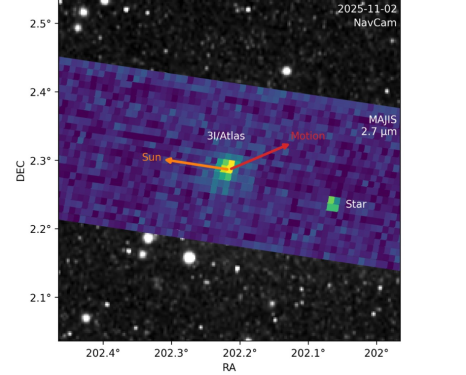
In November 2025, the European Space Agency’s Juice mission observed the interstellar comet 3I/ATLAS using several of its scientific instruments.
Among them, the MAJIS imaging spectrometer (Moons And Jupiter Imaging Spectrometer), developed under the responsibility of the Institut d’astrophysique spatiale (CNRS / Université Paris-Saclay), with support from CNES and ASI, enabled the analysis of light emitted and reflected by the comet, and the identification of infrared signatures of water vapour and carbon dioxide. These emissions were detected on 2 November 2025, four days after perihelion (the point in the orbit where the object is closest to the Sun) on 29 October 2025, with additional weaker signals observed on 12 and 19 November.
Outgassing driven by solar heating
As with all comets, an increase in solar flux leads to the heating of the surface layers, followed by the sublimation of ices as heat penetrates deeper into the nucleus. This sublimation drives the formation of a coma, a diffuse envelope of gas and dust surrounding the nucleus. Repeated detections of H₂O and CO₂ indicate that volatile ices buried beneath the surface were actively released into space shortly after perihelion, with an outgassing rate of approximately two tonnes per second.
Observations constrained by measurement conditions
Observing such a distant object, with very faint emissions, represents a significant challenge. Observation windows are short, and the emissions remain difficult to detect. The teams also had to wait several months to receive the full dataset, due to the spacecraft’s position.
Despite these constraints, the data collected help to improve our understanding of the comet’s composition and to assess the performance of MAJIS under conditions close to those encountered around Jupiter and its moons.
The instrument must analyse very low-density environments, where emissions are difficult to detect. The results obtained confirm its ability to capture such phenomena.
A comet from another stellar system
Beyond this observation, 3I/ATLAS is an object originating from another stellar system, formed billions of years ago. Its study provides access to very ancient materials and offers indirect insights into the conditions of formation in other regions of the Universe.
MAJIS data will make it possible to study its post-perihelion activity as well as the physico-chemical properties of materials formed around another star billions of years ago.