France becomes a full member of the SKA Observatory
France has officially become the 14th member state of the Square Kilometre Array Observatory (SKAO), the intergovernmental organisation responsible for building and operating the world's largest radio astronomy observatory. Scientists from Paris-Saclay University are involved in the SKA-France Consortium.
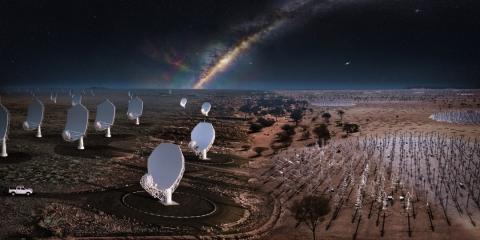
The SKA Observatory will operate two complementary telescopes: SKA-Low in Australia, dedicated to low-frequency radio astronomy, and SKA-Mid in South Africa, which will observe at higher radio frequencies. Together, they will open a new window onto some of the most important scientific questions of our time, including the formation of the first stars and galaxies, the evolution of galaxies throughout cosmic history, the role of magnetic fields in the Universe, the physics of pulsars and gravitational waves, the interstellar medium, transient phenomena, and the conditions that may lead to the formation of planets and, potentially, the emergence of life.
France brings to SKAO a long-standing tradition in astronomy, particularly in radio astronomy, as well as recognised expertise in high-performance computing, data processing and artificial intelligence. These capabilities are essential to SKAO, whose telescopes will generate vast volumes of data that must be processed in near real time before being transformed into scientific products that can be used by the astronomical community.
As recently highlighted during the national SKA conference held in Meudon in May 2026, French teams, coordinated through the SKA-France Consortium - CNRS, Inria, CEA, Observatoire de la Côte d’Azur, Observatoire de Paris-PSL, University of Bordeaux, University of Orléans, Paris-Saclay University and the University of Strasbourg - are already actively involved in many of SKAO’s major scientific fields. These include cosmology, the Epoch of Reionisation, galaxy evolution, pulsars, gravitational waves, cosmic magnetism, the interstellar medium, and the search for the conditions that lead to planet formation and the possible emergence of life.
Through its accession to SKAO, France is strengthening its role in a major global scientific and technological endeavour that brings together fundamental astrophysics, large-scale computing, sustainable digital technologies and long-term international cooperation.
For the full press release issued by the French Ministry of Higher Education and Research, please click here (in French).