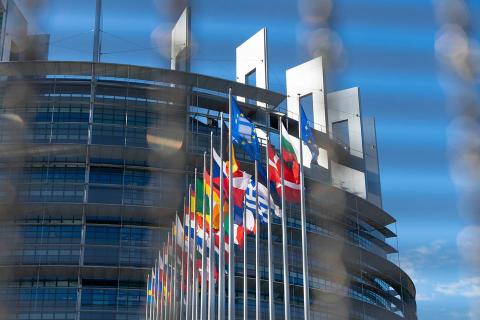
ERC consolidator: five researchers affiliated with Université Paris-Saclay awarded for their projects
The European Research Council (ERC) announced on Tuesday, 9 December, the recipients of the "Consolidator" grants, which each year support numerous projects led by mid-career researchers. In total, 349 projects from scientists from 25 countries were awarded, with a record budget of €728 million, including five researchers affiliated with Université Paris-Saclay.
Berislav Buca for his EmPhaSys project

A researcher at the Laboratoire de physique théorique et modèles statistiques (LPTMS - Univ. Paris-Saclay/CNRS), Berislav Buča is a mathematically oriented theoretical physicist working on non-equilibrium quantum systems. In the early months of his PhD, he formulated a method to understand non-ergodicity in open quantum systems and developed a set of theorems classifying possible symmetry structures in these systems, which he termed strong and weak symmetries. This classification has become a reference in the field, notably for phenomena of spontaneous symmetry breaking from strong to weak.
He received a grant from the European Research Council for his project EmPhaSys ("Emergence of quantum information as a phase of matter in non-equilibrium systems").
To develop quantum technologies, it is necessary to stabilise and manipulate quantum coherence and information in multi-body non-equilibrium quantum systems. The most advanced approaches rely on multi-body error correction to stabilise coherence and dynamics, but technologies such as fault-tolerant quantum computing have not yet been achieved. A recent discovery by the project leader, concerning algebraic principles governing multi-body quantum dynamics, could provide the basis for a theoretical framework to design quantum systems with intrinsically stable coherence and informational properties. Systems designed according to these algebraic principles would form stable dynamical phases of matter, significantly departing from existing approaches. The aim of the project is to establish a framework for designing quantum systems with robust emergent coherence and dynamics, as well as methods to manipulate these systems based on these principles. In the long term, this research could profoundly transform and accelerate the development of emerging quantum technologies.
Berislav has held postdoctoral positions at Oxford, where he developed an experimental intuition and was awarded Oxford’s Award for Excellence. He has also received a Villum Young Investigator grant and became an assistant professor at NBI Copenhagen. In 2024, he started a tenure-track position at CNRS, Université Paris-Saclay (Chaire de professeur junior, equivalent to associate professor), linking condensed matter theory and quantum information, the thematic focus of his ERC project.
He has supervised and co-supervised several PhD students and a postdoc, many of whom have performed among the top students at Oxford, as well as master’s students who continued to doctoral studies. He regularly publishes as a leading or single author in high-impact journals (e.g., PRX, Physical Review Letters, Nature Communications) and is invited to present his work at major mathematical and physics international conferences and workshops.
Antoine Levitt for his TENUMEL project
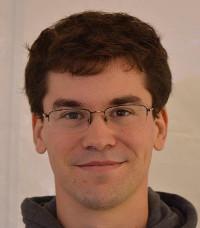
A researcher at the Laboratoire de mathématiques d’Orsay (LMO - Univ. Paris-Saclay/CNRS), Antoine Levitt studies the mathematics of molecular simulation, in particular numerical methods for electronic structure calculations. He joined Université Paris-Saclay in 2022 as a junior professor and became a professor in 2025.
The European Research Council awarded him a grant for his project TENUMEL ("Theory and numerics for electronic structure").
Electronic structure calculations allow the simulation, at the electronic level, of the properties of molecules and materials, and are now an indispensable tool in materials science and quantum chemistry. However, the practical methodology for performing these calculations suffers from limitations due to the size and complexity of the systems considered. The aim of the project is to combine mathematical analysis and numerical methods to improve the state of the art, thereby enabling practical advances in this type of calculation. The TENUMEL project will focus in particular on three aspects suitable for a mathematical approach: algorithms for solving the ground-state problem of inhomogeneous and correlated materials, the calculation of point defects in solids, and the dynamics of electrons under intense fields.
Dalimil Mazáč pour son projet HARMONICON
A research director at CEA within the Institut des hautes études scientifiques (IHES - Université Paris-Saclay), Dalimil Mazáč works in mathematical physics, at the interface between quantum field theory and mathematics, in particular harmonic analysis and number theory. He completed his doctoral studies at the Perimeter Institute for Theoretical Physics before holding postdoctoral positions at Stony Brook University and the Institute for Advanced Study in Princeton. In 2023, he became a permanent researcher at the Institut de physique théorique (IPhT - Univ. Paris-Saclay/CEA/CNRS).
The European Research Council awarded him a grant for his project HARMONICON ("Connecting Harmonic Analysis and Conformal Field Theory").
Nataliya Petryk for her REGEM project
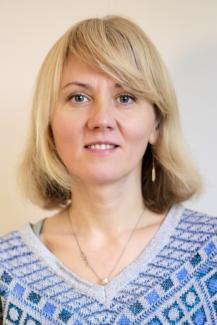
A CNRS researcher within the Genome Integrity and Cancer unit (IGC - Univ. Paris-Saclay/Gustave Roussy/CNRS), Nataliya Petryk leads the Genome and Epigenome Replication team (Réplication du génome et de l’épigenome). The European Research Council awarded her a grant for her project REGEM (“REvealing the mechanisms linking Genome replication and Epigenome Maintenance”). The ERC-funded REGEM project aims to uncover how cells coordinate the copying of their DNA with the preservation of their epigenome, the additional layer of information that controls gene activity and determines each cell’s identity and function. Although all cells contain nearly identical DNA, this information is organised in diverse ways through chromatin, a structure composed of DNA, proteins, and chemical marks.
During cell division, both the DNA and these chromatin components must be accurately reproduced. Yet DNA replication temporarily disrupts chromatin and poses challenges for genetic and epigenetic stability. The two DNA strands are copied using fundamentally different mechanisms: the leading strand is synthesised continuously, while the lagging strand is built in small fragments, called Okazaki fragments. As a result, the mechanisms that preserve epigenetic information differ between the two strands, and the lagging strand is particularly vulnerable to errors and the insertion of mobile genetic elements.
This project will reveal new principles and mechanisms linking DNA replication and chromatin maintenance, providing insight into how the (epi)genome is faithfully transmitted and how lagging-strand synthesis can influence cell identity, disease risk, and evolution.
Leandro Quadrana for his HosTEome project
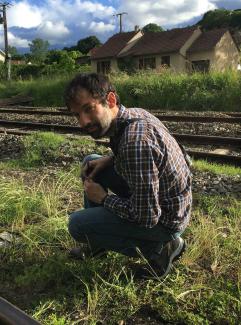
A CNRS researcher at the Institut des sciences des plantes de Paris-Saclay (IPS2 - Univ. Paris-Saclay/Univ. d'Évry/INRAE/CNRS/Univ. Paris-Cité), Leandro Quadrana has long been interested in molecular biology and genetics. He leads the Q-Lab team, which he founded upon joining IPS2 in 2021, and was previously awarded an ERC Starting Grant in 2020.
The European Research Council awarded him a grant for his project HosTEome (“Interplays and evolutionary dynamics of transposable elements and host proteins”).
Transposable elements (TEs), sometimes called "jumping genes", are DNA sequences capable of changing position and multiplying within the genome. Long regarded as "junk DNA", they are now recognised as key drivers of evolution and occupy a substantial fraction of the genomes of most organisms; their mobilisation can generate new mutations with large effects. So far, research has mainly focused on the "gymnastics" of their mobilisation, their impacts, and the epigenetic mechanisms that keep them under control.
Yet TEs are not just simple repetitive sequences: they encode specialised proteins that catalyse their movement and interact with the cellular environment. The nature of these interactions and their influence on the ability of TEs to spread remain largely unknown.
The HosTEome project aims to better understand how TE-encoded proteins and host proteins influence each other, and how these relationships contribute, in the long term, to shaping genome structure and evolution. To this end, the project will use approaches from proteomics, interactomics, epigenomics, bioinformatics, and AI-guided genomics to explore these interactions and their large-scale diversification during the evolution of eukaryotes.