The Chicago piles: on the trail of the first nuclear reactor
On December 2, 1942, Enrico Fermi and his team triggered the first controlled nuclear chain reaction in history. Eighty years later, researchers at the CEA embarked on a scientific and historical investigation to reconstruct the birth of this pioneering reactor, using modern simulation tools.
On December 2, 1942, physicist Enrico Fermi and his team triggered the first controlled nuclear chain reaction in history under the stands of Stagg Field at the University of Chicago, creating the first nuclear reactor, Chicago Pile-1. With World War II raging in the background, a race began to develop the atomic bomb before Hitler's Germany and end the global conflict. This was the Manhattan Project.
Eighty years later, Andrea Zoia, a research engineer at the Reactor Studies and Applied Mathematics Department - DES/ISAS/DM2S (SERMA - Université Paris-SaclayCEA), set out to celebrate the anniversary of this historic scientific event by taking on a challenge. “We sought to revisit the birth of this first nuclear reactor using modern simulation tools,” he explains. The researcher and his team embarked on a real investigation, combining science and history, in what he describes as one of the “most interesting projects of my professional life as an engineer.”
On the trail of a vanished reactor
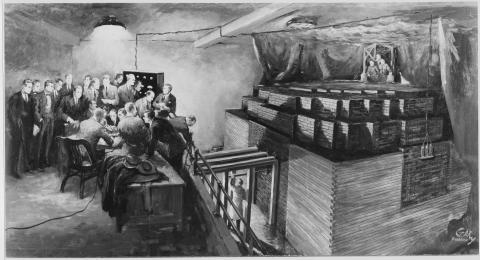
Right from the start, the scientists encountered their first problem: since the famous reactor had been demolished, there was virtually no trace of it left. “There weren't even any photos of the object,” comments Andrea Zoia. After extensive research in the American archives, the team came across the plans for Chicago Pile-2, the second reactor developed by Fermi's team. Although its geometry (cubic) was different from that of the first pile (spherical), its construction used the same elements. The large-format plans were extremely accurate. “It was a huge find; these plans had never left the Manhattan Project archives! Before finding them, we didn’t even know they existed.”
However, the team had to overcome a second difficulty: determining the geometry and composition of the materials used to build Fermi’s first pile. “We knew there were 40,000 graphite bricks and 20,000 fuel units of various shapes, but we didn't know exactly what their composition was. However, in order to reconstruct the behavior of the first reactor on a computer, we needed to have a complete understanding of the specifications of these materials,” explains Andrea Zoia. At the time, it was crucial for Fermi and his colleagues to obtain graphite bricks and fuel that met the project's requirements. Among other things, they built their own factory on site. But uranium and graphite were very rarely processed at that time. Since then, methods have changed radically.
Once again, the archives provided Andrea Zoia's team with data from a long experimental campaign conducted by Fermi and his colleagues to develop the materials for the reactor. They were then able to calibrate their simulations and refine the composition of the materials. “We had to understand what they were measuring, follow their reasoning, and put the pieces of the puzzle together one by one,” says Andrea Zoia.
As they immersed themselves in this 80-year-old work, the SERMA team realized just how pioneering Fermi and his colleagues had been. “When you think about the number of problems they had to solve, it's impressive. It makes you feel very small. They had primitive means of calculation, and no computers!” All the essential parameters of the reactor, such as “its dimensions, the mass of uranium required, and the number of graphite bricks to be added, were calculated on paper using a calculating machine.”
Nuclear fission: a scientific revolution
To understand what Fermi and his team had to calculate, it is necessary to look back at the phenomenon of nuclear fission discovered in Nazi Germany in 1938 by chemists Otto Hahn and Fritz Strassmann. After bombarding a uranium atom nucleus with neutrons, the two researchers observed the production of two lighter nuclei. As they were unsure of the explanation behind this phenomenon, they shared their findings with physicists Lise Meitner and Otto Frisch, who theorized and proved that the uranium nucleus had split in two during the reaction, releasing a colossal amount of energy of around 200 megaelectron volts. This energy is so considerable that a single gram of uranium-235 is enough to produce the same amount of electricity as three tons of coal!
In addition to releasing energy, nuclear fission has another quality: it produces other neutrons. When conditions are favorable, these secondary neutrons cause other uranium nuclei to split, releasing more neutrons and energy. Scientists at the time understood that such a reaction was self-sustaining: this is the principle of a chain reaction. By controlling it, they could produce an impressive amount of energy in a stable manner over time.
From theory to the pile
It was Enrico Fermi and his colleagues who put the theory into practice. But this was far from simple. On the one hand, the fission of uranium nuclei had to be encouraged. The researchers understood that the probability of this event increased when the neutrons were slowed down. By moving more slowly, the neutrons spent more time near the nuclei and were more likely to cause fission. On the other hand, a sufficient amount of uranium must be available to compensate for neutron losses. This is because some neutrons escape from the pile or are absorbed by impurities in the materials. Slowing down the neutrons without absorbing them is precisely the role of the moderator, the sufficiently pure graphite bricks placed at the heart of the nuclear reactor.
Fermi and his colleagues also succeeded in calculating the critical mass of the pile, i.e., the minimum amount of fissile material needed to maintain a nuclear chain reaction. By stacking the graphite and fuel bricks one by one and monitoring the reactor's progress, they gradually approached this critical mass. Using only a few bricks, the reactor is said to be in a subcritical state: it multiplies some of the neutrons through fission reactions, but there is not enough uranium to compensate for the loss of neutrons escaping from the edge of the pile. At this point, “the neutron population collapses exponentially over time,” explains Andrea Zoia. As bricks are added, the pile “reaches a size large enough for neutron production by fission to compensate for leaks: this is the critical size.” The neutron population is then constant and the pile stable over time.
When a nuclear reactor is started up, it must operate slightly above criticality so that the fission chains amplify and the neutron population increases. This phenomenon is called divergence. To stabilize the pile and control its power, “systems called control rods are inserted, which increase neutron absorption.” This was the case with Chicago Pile-1. A decade later, in his speech at the pile's anniversary ceremony, Enrico Fermi said that when he started the reactor for the first time, he was absolutely certain that the chain reaction would work and that the experiment would confirm the theory and calculations.
Today, research and development in nuclear technology relies on modern calculation tools, such as the TRIPOLI-4 Monte Carlo code, which was developed at SERMA and can simulate French reactors. By using these tools and conducting extensive archival research, Andrea Zoia's team has succeeded in simulating the operation of Fermi's reactors. This scientific achievement pays tribute to the work of a pioneering team eighty years later and builds a bridge between the early days of nuclear power and its contemporary developments.
Reference:
Zoia, A., Gagnepain, A. & Mancusi, D. The Chicago Piles unearthed. Sci Rep 15, 26850 (2025).