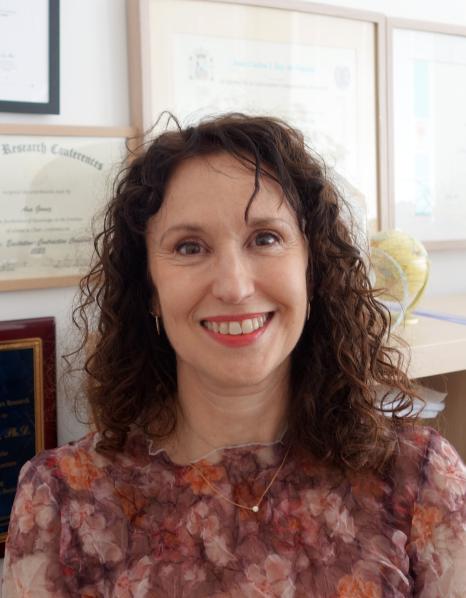
Ana María Gómez: understanding and treating women’s hearts
Ana María Gómez is a research director at Inserm and head of the Cardiovascular Signalling and Pathophysiology Laboratory (CARPAT – Univ. Paris-Saclay/Inserm). A world-renowned specialist in heart failure and arrhythmias, she now devotes a significant part of her research to a long-neglected field: the specific characteristics of the female heart. The researcher has recently been honoured for her work, which is characterised by numerous international collaborations and a growing commitment to gender-specific medicine.
Originally from Toledo in Spain, Ana María Gómez decided as a teenager that she wanted to contribute to improving human health through research, without necessarily being in direct contact with patients. Having been particularly affected by the death of one of her aunts from incurable cardiac hypertrophy, she set her sights on discovering new drugs to treat cardiovascular diseases. She therefore went on to study pharmacy at the Complutense University of Madrid, but it was not until her fifth year of university that she discovered how to become a researcher. "I learnt at a conference that I would need to write a thesis and that it could be funded by a scholarship, provided I had an excellent academic record." Despite her doubts, Ana María was awarded this scholarship and began her PhD on cardiac hypertrophy at the Complutense University under the supervision of Carmen Delgado.
Towards a new understanding of heart failure
As part of a Franco-Spanish collaborative research project involving a unit based in Clermont-Ferrand, she undertook several placements in France throughout her PhD. This period in Clermont-Ferrand also marked the start of a major scientific and personal collaboration with Jean-Pierre Benitah, then a young researcher, whose support and scientific exchanges would have a lasting impact on her career. Their work focused on the electrical mechanisms of the heart. "We were studying the electrical currents passing through the membrane of cardiomyocytes using a technique involving electrodes. The aim was to understand the origin of arrhythmias - which are often fatal - in patients suffering from hypertrophy or heart failure, conditions in which the heart muscle thickens in response to increased and prolonged exertion."
After defending her thesis in late 1994, the researcher travelled to the United States for a postdoctoral fellowship at the University of Maryland in Baltimore, working in the laboratory headed by Jonathan Lederer. "This researcher had just discovered the phenomenon of calcium sparks. These are fundamental releases of calcium at the intracellular level, which are vital for the heart’s contraction." Ana María Gómez decided to apply this fundamental discovery to the understanding of heart conditions. "I was analysing the physiological regulation of calcium and the fundamental processes that enable this gradual contraction, not from a purely physiological perspective, but within a pathological context - that of cardiac hypertrophy and heart failure."
The role of ryanodine, the heart’s protein
The researcher, whose international collaborations extend to Spain, the United States, Brazil and China, focuses on the ryanodine receptor (RyR), a protein that acts as a "gatekeeper" for the internal calcium stores of a cardiac cell organelle known as the "sarcoplasmic reticulum". "The process is nanometer-precise. An electrical signal triggers the entry of a small amount of calcium, which activates the ryanodine receptors. These channels then release the calcium stored in the sarcoplasmic reticulum, enabling the heart to contract. Under normal conditions, they open gradually to allow the heart to adapt to physical exertion. In a diseased heart, this regulation breaks down." Ana María Gómez was the first researcher to demonstrate that the disruption of these microscopic events is responsible for the heart’s inability to contract effectively or for triggering fatal arrhythmias. This pioneering work was published in 1997 in the journal Science as well as in other prestigious publications, catapulting her overnight into the spotlight of research into cardiovascular disease and calcium sparks. For the researcher, this fundamental research is a prerequisite for any treatment: "It is only when we know what is wrong that we can identify drugs to fix it."
Back in France in September 1997, Ana María Gómez was preparing to sit the competitive examination of the National Institute of Health and Medical Research (Inserm) when she realised she had just exceeded the age limit by a few days. Far from being discouraged, she turned to the National Centre for Scientific Research (CNRS) and secured a post as a research fellow in 1998 in Montpellier. Ten years later, she took a further step forward by becoming a research director at Inserm. Then, in 2011, she left Montpellier to join the Faculty of Pharmacy at Université Paris-Saclay in Châtenay-Malabry (now in Gif-sur-Yvette), joining the Cardiovascular Signalling and Pathophysiology Unit (CARPAT - Univ. Paris-Saclay/Inserm). "This unit now has around fifty staff members. It focuses on understanding the cellular mechanisms of heart disease." In 2015, she took over as head of the unit. After two terms in office, she is now its deputy director.
Towards a gendered approach to cardiology
From 2002 onwards, Ana María Gómez began researching the biological differences between the sexes in relation to heart disease, highlighting in particular a persistent historical bias whereby female models are sidelined because they are deemed ‘too complicated’ due to their hormonal cycles. "Yet cardiovascular disease is the leading cause of death among women in France, ahead of cancer.” She focused in particular on diabetic cardiomyopathy and catecholergic polymorphic ventricular tachycardia (CPVT), which is a genetic condition linked to stress and mutations in the RyR receptor. It causes severe cardiac arrhythmias that can lead to sudden death and disproportionately affects young women. Using pluripotent stem cells (iPSCs) differentiated into cardiomyocytes, the researcher has observed intrinsic electrophysiological differences between XX (female) and XY (male) cells, independent of any hormonal influence. "We have thus confirmed that women’s hearts exhibit slower repolarisation (a longer electrical cycle), independent of hormonal effects." This electrophysiological difference means that certain medicines are more dangerous for women than for men, as they are likely to trigger fatal arrhythmias. "The symptoms of a heart attack in women, such as nausea or severe headaches, are often very different from those in men," she also points out.
Encouraging women to pursue a career in science
In 2025, Ana María Gómez was awarded the 2025 Danièle Hermann – Women's Heart Fellowship by the Cardiovascular Research Foundation of the Institut de France and was also presented with the Lamonica Grand Prize in Cardiology by the French Academy of Sciences, two honours she received with pride. "They recognise both a collective effort and my entire career path," says the researcher, who recalls her early days, inspired by Carmen Delgado, her first mentor. Today, it is her turn to strongly encourage young women to pursue a career in science. "They must not hesitate, if that is their wish, to balance their vocation as a researcher with their family life. If the question does not arise for a man, it should not arise for a woman either," she concludes.