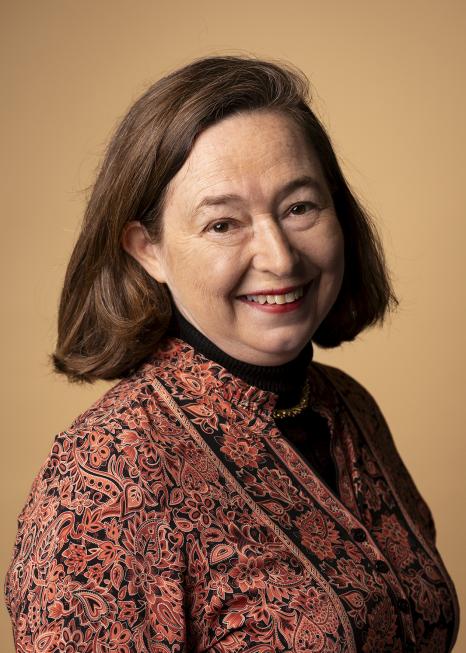
Amandine Aftalion: cutting-edge research with an international scope at the interface of mathematics and physics
Amandine Aftalion, a mathematician and CNRS research director at the Orsay Mathematics Laboratory (LMO – Univ. Paris-Saclay/CNRS), explores physical phenomena using rigorous mathematical tools. At the same time, she is deeply committed to science outreach, through the Videodimath channel and its competition, and to promoting science among young people and women.
A graduate of the École normale supérieure (ENS) in Paris, Amandine Aftalion was part of the first cohort of students on the mathematics-physics course launched in 1992 by the physicist Étienne Guyon, then director of the ENS and formerly a professor at Université Paris-Sud (now Université Paris-Saclay). This interdisciplinary training left a lasting mark on her scientific approach. From a very early age, she became interested in questions where mathematics is used to understand observed physical phenomena.
Translating reality into equations
Amandine Aftalion completed her PhD thesis in 1997, focusing on the study of non-linear partial differential equations and their applications to the physics of superconductors (materials in which electric current flows without resistance at very low temperatures) and combustion. From then on, the central theme of her career took shape: using mathematics as a tool to examine, structure and interpret phenomena drawn from the real world.
After three years at the ENS as a preparatory teacher, she was recruited in 1999, at the age of 26, by the CNRS, at the Jacques-Louis-Lions laboratory at Sorbonne University. When she became a research director, she continued her career at the École Polytechnique, whilst also teaching there, notably a course at the interface between mathematics and quantum physics with the physicist Jean Dalibard. She then moved on to other research environments, including the École des hautes études en sciences sociales (School for Advanced Studies in the Social Sciences, EHESS). In 2024, she joined the Orsay Mathematics Laboratory, within Université Paris-Saclay's ecosystem.
Understanding matter at very low temperatures
The core of Amandine Aftalion’s work focuses on the mathematical modelling of low-temperature physics phenomena, in particular Bose-Einstein condensates. These states of matter, which are obtained by cooling a gas of atoms to temperatures close to absolute zero, exhibit collective quantum behaviour, where a large number of atoms behave as a single system. “At these extreme temperatures, the atoms barely move. We then observe new phenomena, which we seek to understand through the equations that govern them.” Her work focuses more specifically on analysing the mathematical properties of the Gross-Pitaevskii equation, which belongs to the family of non-linear Schrödinger equations and serves as a model for Bose-Einstein condensates. The aim is to understand its structure, solution regimes and analytical difficulties. Amandine Aftalion has notably studied vortices – the quantum eddies characteristic of these systems – to which she has dedicated a reference work, Vortices in Bose-Einstein Condensates, published in 2006.
Her research takes place within an international scientific landscape and is conducted within a broad collaborative framework, with numerous partners in France and abroad. Dialogue with experimental physicists plays a central role in these collaborations.
From quantum physics to sports performance
In 2014, Amandine Aftalion broadened her field of application. Working at the interface between mathematics, physics and the humanities, she became interested in modelling sports performance, particularly in running. “Running involves expending energy, but it also involves exertion, particularly during interactions between the brain and the muscles. We model not only the mechanics and energetics, but also the mental and motivational aspects.” Her work involves formulating equations capable of mathematically structuring the various components of this human performance and describing how they evolve during exertion.
Bringing mathematics to as many people as possible
Alongside her research work, Amandine Aftalion is actively involved in science outreach “to show that mathematics is relevant, enjoyable and connected to the real world”. In 2017, she launched the Videodimath channel, which now has over 28,000 subscribers and is always on the lookout for sponsors and young people keen to make videos. In 2019, she also created the Videodimath competition for secondary school pupils, to encourage young people to produce videos showing that mathematics is all around them.
In 2023, she published Be a Champion - 40 Facts You Didn't Know About Sports and Science, a book of questions about sport and the links between mathematical and physical principles that underpin human performance. The book received widespread acclaim, with translations into English and Chinese and a nomination for the Tangente Prize. A free exhibition, launched online in autumn 2023 and widely promoted during the Olympic Games, extended the book's themes. The exhibition featured a selection of ten scientific questions taken from the book, presented with illustrations and designed as a freely downloadable educational resource. It was translated into several languages at the initiative of various embassies and circulated in different countries. The book and exhibition were described by parents and teachers as a “gem for the baccalaureate oral exam”.
Curiosity, interdisciplinarity and commitment
“What has always guided me is curiosity and the desire to build bridges between fields that do not naturally interact,” explains Amandine Aftalion. Committed to promoting women in science, she advocates an approach where diverse backgrounds enrich research. She emphasises the importance of breaking down disciplinary barriers and the central role of interdisciplinarity in the future of research. She observes that many women’s career paths often align with these cross-disciplinary approaches, which focus on connecting different fields of knowledge. Through her outreach activities and upcoming projects – notably the continued demonstration of theorems linked to experiments on quantum gases – she intends to continue showing that mathematics is a living, accessible science deeply rooted in reality.