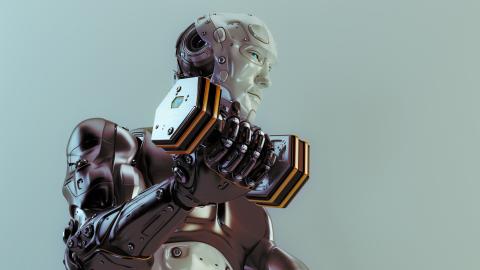
KALYSTA Actuation: towards the first European electrohydraulic humanoid robot
The start-up KALYSTA Actuation is developing a humanoid robot that can lift, manipulate and interact with the physical world. It grew out of the Servo ElectroHydraulic Actuator (SEHA) project led by Samer AlFayad from the Computer Science, Bioinformatics and Complex Systems Laboratory (IBISC – Univ. Paris-Saclay, Univ. d'Évry). The SEHA project, funded by SATT Paris-SACLAY, is based on hybrid actuation technology for embedded mechatronics and aims to build a European technological champion.
In 2009, at the end of his PhD thesis on humanoid robots at Université de Versailles Saint-Quentin-en-Yvelines (UVSQ), Samer AlFayad identified a major limitation. These machines were unable to handle heavy loads. Despite advances in artificial intelligence and control, their electric motors offered speed but not the necessary strength. “A humanoid ankle needs three actuators to reproduce natural movements. With all-electric systems, no motor can provide this force in such a small space.” The researcher then turned to hydraulics, “a thousand-year-old technique already used by the ancient Egyptians to move heavy loads. " While electric motors lack force, hydraulics can produce a lot of it, but at the cost of bulky pumps, pipes and power units. The challenge then is to combine the two worlds.
A hybrid architecture for unprecedented power
After a two-year post-doctorate in Germany, between 2011 and 2019, the researcher designed a hybrid architecture at the Versailles Systems Engineering Laboratory (LISV – Univ. Paris-Saclay/UVSQ) that was capable of overcoming the limitations of both approaches. Energy was transmitted electrically to each joint, where an integrated hydraulic microsystem converted this energy into movement. Each module comprised a small electric motor, a micropump and a miniaturised piston. In a volume of approximately 10 × 10 × 10 cm, the system produced the necessary force to move one tonne at 20 cm per second. The latest developed version, which is even more compact (4 × 4 × 8 cm and weighing 2.5 kg), achieves similar performance. This decentralised design drastically reduces bulk and offers a power-to-weight ratio that cannot be achieved with motors alone.
From the laboratory to the start-up: patent, maturation and creation of KALYSTA
In 2019, just before joining Université d'Évry as a professor and the IBISC laboratory, Samer AlFayad filed a patent at UVSQ for an integrated electrohydraulic actuator capable of generating high hydraulic pressure locally from an electrical power supply, without a power plant or pipe network. The technology combines compactness, high force and immediate energy absorption in the event of an impact, an important factor for the safety of collaborative robots. "In an electrical system, energy continues to flow in the event of an impact. With the technology developed in integrated hydraulics, the pressure is reversed immediately, which protects the user. "
This invention is the scientific basis for the maturation project funded by SATT Paris-Saclay. An agreement was then established between UVSQ and Université d'Évry, co-owners of the technology, and the creation of a start-up was chosen as the path to commercialisation. "SATT Paris-Saclay not only provides funding, but also a method and expertise. It challenges, structures, secures and guides strategic decisions. Without this support, we would not have been able to take the necessary steps to create the start-up." KALYSTA Actuation was thus born in 2020. Samer AlFayad is its scientific advisor and Jean-Claude Rassou, former president of Motorola France, is its director.
Concrete applications, from the laboratory to the field
In 2020, the first application targeted was the most ambitious: the humanoid robot. The team first developed legs capable of supporting heavy loads, then turned its attention to the upper body. Today, a demonstrator performs dynamic movements inspired by boxing. “We are aiming for a robot that is two to three times stronger than the world’s best boxer.” The goal is to meet industrial and societal needs, namely heavy lifting, physical assistance, sports training and rehabilitation.
From 2021 onwards, KALYSTA Actuation has been exploring the field of aeronautics, a sector where every kilogram removed equates to fuel savings and lower CO₂ emissions. The team was initially focusing on motorised first-class seats, a non-critical but highly demanding component in terms of comfort and safety. By replacing the electric actuators that control the recline, footrest and bed position with its system, the start-up showed that it was possible to reduce the weight of each seat by 5 to 7 kg.
In 2023, the start-up won the competition organised by BNP Paribas' We Are Innovation (WAI), enabling it to co-develop its technology with Poclain Hydraulics, a global specialist in hydraulic solutions. Together, they tested an electro-hydraulic actuator on an electric micro-excavator designed for confined environments such as urban or indoor construction sites. The aim was to replace a bulky electric motor with a compact system. The prototype validated the feasibility of the project and paved the way for future industrial applications in the compact machinery sector.
Passing on technology to the next generation of engineers
Since 2023, KALYSTA Actuation has been offering training courses to higher education institutions. These are educational kits that include the main components of a miniature hydraulic system, as well as a modern control environment based on the Robot Operating System (ROS) platform, now essential in robotics. "In France, hydraulic actuation is rarely covered in courses, even though the industry has a profound need for it. We are filling this gap with a solution that can be used directly in practical work." Two units have already been installed and other projects are currently under discussion with several engineering schools.
A European industrial ambition
The start-up is preparing its first round of fundraising (to the tune of €1 million) in order to industrialise its technology and finalise a complete humanoid demonstrator by 2029. “In hardware, cycles are long. You need investors who are prepared to commit for the long term, whereas many are looking for a quick return.” Once this milestone has been reached, KALYSTA Actuation will launch the first European hydraulic humanoid robot and the second in the world, behind Boston Dynamics’ Atlas. Unlike Atlas, which relies on a centralised hydraulic system and a network of high-pressure pipes, KALYSTA Actuation's robot has a decentralised architecture, with each joint generating its own hydraulic power.
This project is based on a strong continuum between research and industry. The proximity to Université Paris-Saclay provides a real pool of talent, and several young researchers trained in these technologies have already joined the company. “When PhD students see that their research can continue in a company just two offices away, it creates a unique dynamic between the laboratory and the start-up,” says Samer AlFayad.