


The international Master 2 GenE2 provides training in cutting-edge technologies in genetics, genomics, and epigenomics. Combining theory with hands-on workshops (ChIP-seq, Big Data), it develops highly sought-after skills in high-throughput sequencing data analysis.
A distinctive feature of this program is its innovative approach, which integrates the latest techniques (single-cell omics, spatial transcriptomics, ChIP-seq) with advanced training in data analysis.
The Master 2 GenE2 is a program entirely taught in English.
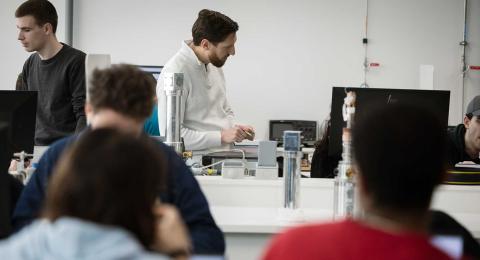
It is a research-based training program that combines scientific lectures, research projects, hands-on workshops and an internship.
Students develop autonomy through individual or group work under the supervision of specialists.
The program is structured around three skill blocks:
- Theoretical block (15 ECTS): organized as scientific lectures.
- 4 mandatory courses:
- Functional Genomics
- ncRNA and Epigenetics
- Genome Stability and Evolution
- Genomes, Phenotypes and Populations
- 1 optional course (choose one):
- Single-cell omics and spatial transcriptomics
- Metagenomics
- Scientific Project
- 4 mandatory courses:
- Experimental block (15 ECTS): two innovative practical workshops:
- ChIP-seq
- Big Data
- Research immersion block (30 ECTS): a six-month laboratory internship in France or abroad.
Website: http://www.gene2.fr/




Information
Skills
1. Scientific and Technical Skills
- Mastery of fundamental concepts and methods in genetics, genomics, epigenetics, and evolution.
- Design, execution, and analysis of genomics and epigenomics experiments.
- Use and interpretation of high-throughput sequencing data.
- Mastery of modern sequencing techniques (ChIP-seq, single-cell omics, spatial transcriptomics…).
- Application of bioinformatics and biostatistics tools to analyze complex datasets.
- Creation, management, and visualization of large biological datasets.
2. Analytical and Methodological Skills
- Synthesis and integration of scientific knowledge and results.
- Development of a scientific critical mind, with the ability to identify the limits of an analysis.
- Design and planning of innovative scientific projects.
3. Professional and Organizational Skills
- Work independently and collaboratively in a research environment.
- Adherence to scientific rigor, protocols, and laboratory safety rules.
- Project management and organization in an international and multidisciplinary context.
4. Communication and Scientific Dissemination Skills
- Writing and oral presentation of scientific results.
- Ability to communicate results to diverse audiences, including for scientific publication.
Objectives
By following this program, students will be able to:
- Master the fundamental concepts and methods in genetics, genomics, epigenetics, and evolution.
- Define and carry out all steps of an experimental approach in genomics.
- Apply basic concepts of high-throughput data analysis.
- Design and analyze experiments using modern sequencing technologies.
- Identify, select, and apply existing tools in bioinformatics and biostatistics to analyze high-throughput sequencing data.
- Acquire skills in creating, managing, manipulating, and visualizing complex data.
- Apply knowledge to biomedical, applied, or fundamental research problems.
- Synthesize and integrate knowledge and results to present them in writing and orally, developing a scientific critical mind to understand the limits of high-throughput genomic analyses.
- Develop the ability to design and plan innovative scientific projects.
- Master laboratory practices: teamwork, scientific rigor, autonomy, communication, and laboratory safety.
- Develop the ability to work in an international and multidisciplinary environment.
- Strengthen skills in scientific publishing and communication to diverse audiences.
Career Opportunities
Career prospects
After a Master's or Master's + PhD: engineer (R&D, control, production, etc.)
After a Master's or Master's + PhD: researcher or lecturer
After a Master's or Master's + PhD: engineer (research and development, control, production, etc.) in the fields of health, pharmaceuticals, agri-food, biotechnologies, instruments and reagents, cosmetics, pollution control and the environment.
Sectors of activity: fundamental or applied research in Biology, Health or Ecology in academia or the private sector
Fields: health, pharmaceuticals, agri-food, biotechnologies, instruments and reagents, cosmetics, pollution control and the environment.
After a Master's + PhD: researcher or lecturer
After a Master's or Master's + PhD: engineer (Research & Development, control, production, etc.)
Environment / Biodiversity Officer
Data Scientist
Bioinformatics Engineer (Research and Development)
After a Master's degree: Data scientist
After a Master’s degree: Research analyst
R&D Engineer
Quality assurance manager
R&D Project Manager
Project Manager
Consulting
Design engineer in the research / scientific sector
Design engineer industry / public research
Academic staff
Design Engineer
Research & Development Engineer
Research and Innovation Manager
Project Manager
Project manager in biotechnologies, biotherapies or healthcare innovation
Secondary school teacher
Cultural outreach professions
Laboratory Manager
Research or Design Engineer
Further Study Opportunities
Biology-Agrosciences
Biodiversity, Ecology and Evolution
Master of Bioinformatics
Master of Biology-Agrosciences
Master of Molecular and Cellular Biology
Master of Microbiology
Master of Education and Teaching Professions
PhD in Ecology / Evolution / Ecosystem Functioning
PhD in Ecology, Evolution
PhD in Chemistry / Biology
PhD in Bioinformatics
PhD
Engineering school
PhD thesis
Graduates can be recruited under private or public sector employment contracts, but can also take part in public sector competitive exams and professional examinations.
Students in this track can turn to research at the end of the 2nd year Master's.
Specialised Master’s programmes (MBA in Project Management, Business, and Innovation Management in the Bio-industries)
Master of Teaching Professions
Engineering, research and development
Engineering in agriculture and the natural environment
Master of BioMedical Engineering
Master of Innovation Management
train international specialists, producing competitive work within reputable teams from public scientific and technological institutions (EPST), in particular the French National Institute of Health and Medical Research (Inserm) and French National Centre
Multidisciplinary Engineering School
Generalist Engineering School through Apprenticeship
fields of statistical learning, artificial intelligence and advanced data analysis
the curriculum also enables students to enter the corporate world directly after their graduation, in positions such as Data Scientist, Data Analyst or Machine Learning Engineer.
Data Scientist, Data Analyst, Ingénieur·e en Machine Learning dans des secteurs innovants (tech, finance, santé, énergie, etc.) ;
R&D researcher or data modelling and analysis expert in leading-edge companies or laboratories.
Capacity
Available Places
Target Audience and Entry Requirements
- Students in Biology (Master degree or 4-year BSc), Medicine, Pharmacy, Veterinary Sciences, Biotechnology or Agri-food, or any other relevant scientific background.
- Professionals who wish to acquire skills in the manipulation, processing, and statistical analysis of high-throughput sequencing data.
- Researchers, engineers, or technicians in biology, biotechnology, genomics, epigenomics, or biomedical research laboratories, wishing to specialize in sequencing data processing and analysis.
- Hospital staff or clinicians in continuing education interested in medical genomics and patient data analysis for translational or clinical research.
Application Period(s)
From 09/02/2026 to 04/05/2026
From 15/05/2026 to 29/06/2026
Supporting documents
Compulsory supporting documents
Copy diplomas.
Copy of passport.
Motivation letter.
All transcripts of the years / semesters validated since the high school diploma at the date of application.
Curriculum Vitae.
Document indicating the list of local M2 choices available here : https://urlz.fr/i3Lo.
Additional supporting documents
VAP file (obligatory for all persons requesting a valuation of the assets to enter the diploma).
Supporting documents :
- Residence permit stating the country of residence of the first country
- Or receipt of request stating the country of first asylum
- Or document from the UNHCR granting refugee status
- Or receipt of refugee status request delivered in France
- Or residence permit stating the refugee status delivered in France
- Or document stating subsidiary protection in France or abroad
- Or document stating temporary protection in France or abroad.
| Subjects | ECTS | Semester | Lecture | directed study | practical class | Lecture/directed study | Lecture/practical class | directed study/practical class | distance-learning course | Project | Supervised studies |
|---|---|---|---|---|---|---|---|---|---|---|---|
| Functional Genomics | 3 | Semester 1 | 20 | 5 | |||||||
| Structure and Evolution of Genomes | 3 | Semester 1 | 25 | ||||||||
| Genomes, Phenotypes and Populations | 3 | Semester 1 | 22 | ||||||||
| Non-coding RNAs and epigenetics | 3 | Semestre 1 | 25 | ||||||||
| Single-cell omics and spatial transcriptomics | 3 | Semester 1 | 25 | ||||||||
| Introduction to Metagenomics | 3 | Semester 1 | 10 | 10 | |||||||
| Introduction to Metagenomics | 3 | Semester 1 | |||||||||
| UE libre | 3 | Semestre 1 | 25 | ||||||||
| Subjects | ECTS | Semester | Lecture | directed study | practical class | Lecture/directed study | Lecture/practical class | directed study/practical class | distance-learning course | Project | Supervised studies |
|---|---|---|---|---|---|---|---|---|---|---|---|
| Big Data Workshop | 9 | Semester 1 | 30 | 45 | |||||||
| ChIP-seq Worksop | 6 | Semester 1 | 10 | 36 | |||||||
| UE libre | 3 | Semestre 1 | 25 | ||||||||
| Subjects | ECTS | Semester | Lecture | directed study | practical class | Lecture/directed study | Lecture/practical class | directed study/practical class | distance-learning course | Project | Supervised studies |
|---|---|---|---|---|---|---|---|---|---|---|---|
| GenE2 Scientific Project | 3 | Semester 2 | 30 | ||||||||
| Lab internship | 27 | Semester 2 | 30 | ||||||||
Teaching Location(s)
Training campus
