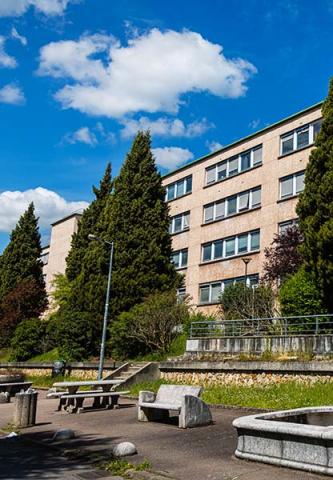



LASCALA is an Erasmus Mundus Master programme run in partnership with Sapienza Universita di Roma, Lund University and Salamanca University dedicated to large-scale high-intensity lasers, accelerators and gravitational wave detectors. This programme leads to joint degrees from the partner universities and, for Paris Saclay, is based on the M1 General Physics and M2 GI/PLATO programmes.
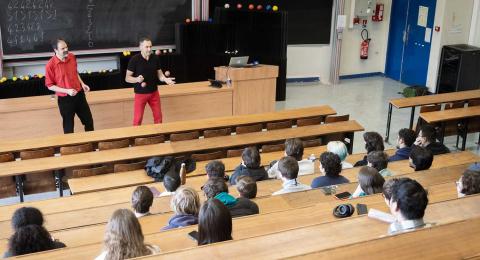
Students selected for the M1 programme choose to spend their first semester at Paris Saclay or Salamanca. For the second semester, they choose between Rome (focusing on accelerators and gravitational wave detectors) or Lund (focusing on lasers and femtosecond or attosecond physics). The third semester is spent at Paris Saclay with M2 GI/PLATO students. After a core curriculum and several immersion sessions on the major facilities at the Saclay plateau, students gradually specialise in one of three areas: intense lasers, accelerators, or gravitational wave detectors. The semester ends with a thematic winter school. The Master's programme concludes with a 5-month Master's thesis in a research laboratory or a company in the field.

Information
Skills
Students acquire solid knowledge of accelerator physics, intense lasers and their interaction with plasmas, as well as gravitational wave detection. Cross-disciplinary skills are also taught, such as cross-disciplinary technologies and large project management. Students also acquire experimental skills, the ability to work in groups and, of course, to work and express themselves in a highly international context.
Objectives
The aim of this programme is to train future researchers, engineers and project managers who will contribute to the European research landscape in the field of large-scale equipment for intense laser physics, accelerators and gravitational wave detectors. The programme is designed to be cross-disciplinary, international, fundamental and applied, with a specific focus on physical instrumentation. Most graduates go on to pursue doctoral studies in major European research laboratories.
Career Opportunities
Further Study Opportunities
R&D researcher or data modelling and analysis expert in leading-edge companies or laboratories.
Data Scientist, Data Analyst, Ingénieur·e en Machine Learning dans des secteurs innovants (tech, finance, santé, énergie, etc.) ;
PhD
Calendar
Admission Route
Capacity
Available Places
Target Audience and Entry Requirements
Students recruited for this programme are enrolled in the first year of a Master's degree (M1 level) for a period of two years. The target audience is students who are comfortable with the international context of research, the use of English in teaching, and who have a solid foundation (Bachelor's degree level) in fundamental or applied physics.
Application Period(s)
From 30/01/2026 to 25/04/2026
From 27/04/2026 to 10/07/2026
Supporting documents
Compulsory supporting documents
Motivation letter.
All transcripts of the years / semesters validated since the high school diploma at the date of application.
Certificate of English level.
Curriculum Vitae.
Additional supporting documents
VAP file (obligatory for all persons requesting a valuation of the assets to enter the diploma).
Supporting documents :
- Residence permit stating the country of residence of the first country
- Or receipt of request stating the country of first asylum
- Or document from the UNHCR granting refugee status
- Or receipt of refugee status request delivered in France
- Or residence permit stating the refugee status delivered in France
- Or document stating subsidiary protection in France or abroad
- Or document stating temporary protection in France or abroad.
| Subjects | ECTS | Semester | Lecture | directed study | practical class | Lecture/directed study | Lecture/practical class | directed study/practical class | distance-learning course | Project | Supervised studies |
|---|---|---|---|---|---|---|---|---|---|---|---|
| Numerical methods and simulations | 3 | Semester 1 | 20 | 10 | |||||||
| Projects and organisation of large-scale instruments | 2 | Semester 1 | 20 | 10 | |||||||
| Physics and transverse technologies | 3 | Semester 1 | 20 | 10 | |||||||
| Experiments in large-scale instruments | 4 | Semester 1 | 36 | ||||||||
| TOSCA summer school | 3 | Semestre 1 | |||||||||
| free option | 2 | Semestre 1 | |||||||||
| Subjects | ECTS | Semester | Lecture | directed study | practical class | Lecture/directed study | Lecture/practical class | directed study/practical class | distance-learning course | Project | Supervised studies |
|---|---|---|---|---|---|---|---|---|---|---|---|
| introduction to intense laser sources | 3 | Semestre 1 | 12 | 12 | |||||||
| advanced femto and attosecond metrology | 3 | Semestre 1 | 12 | 12 | |||||||
| femtosecond laser plasma interaction, compact acceleration | 3 | Semestre 1 | 12 | 12 | |||||||
| optical radiation sources | 3 | Semestre 1 | 12 | 12 | |||||||
| joint winter school on laser plasma interaction | 3 | Semestre 1 | |||||||||
| Subjects | ECTS | Semester | Lecture | directed study | practical class | Lecture/directed study | Lecture/practical class | directed study/practical class | distance-learning course | Project | Supervised studies |
|---|---|---|---|---|---|---|---|---|---|---|---|
| Accelerators Physics | 3 | Semestre 1 | 20 | 10 | |||||||
| Detection and measurements | 3 | Semester 1 | 20 | 10 | |||||||
| Advanced accelerators | 3 | Semester 1 | 20 | 10 | |||||||
| JUAS winter school | 3 | Semestre 1 | |||||||||
| sources of optical radiation | 3 | Semestre 1 | 12 | 12 | |||||||
| Subjects | ECTS | Semester | Lecture | directed study | practical class | Lecture/directed study | Lecture/practical class | directed study/practical class | distance-learning course | Project | Supervised studies |
|---|---|---|---|---|---|---|---|---|---|---|---|
| elements of general relativity and cosmology | 3 | Semestre 1 | 12 | 12 | |||||||
| quantum optics for gravitational wave detection | 3 | Semestre 1 | 12 | 12 | |||||||
| winter school on advanced gravitational wave data analysis | 3 | Semestre 1 | |||||||||
| metrology for advanced femtosecond and attosecond sources | 3 | Annualisé | 12 | 12 | |||||||
| sources of radiations | 3 | Semestre 1 | 12 | 12 | |||||||
| Subjects | ECTS | Semester | Lecture | directed study | practical class | Lecture/directed study | Lecture/practical class | directed study/practical class | distance-learning course | Project | Supervised studies |
|---|---|---|---|---|---|---|---|---|---|---|---|
| Internship and master thesis | 30 | Semestre 2 | |||||||||