‘AI & One Health’: EUGLOH co-creation workshop opens up new avenues for collaboration
How can artificial intelligence improve the health of humans, animals and the environment? This question was at the heart of...
Magnetic resonance imaging (MRI) is a medical imaging technique that produces images rich in information, which are complex and time-consuming...
The first 16 innovation projects from the scientific community of Université Paris-Saclay, selected through the A2-LINE call for proposals, are...
The Highly Cited Researchers 2026, published by Clarivate Analytics on 18 November, recognise 23 scientists from Université Paris-Saclay among the...
On 1 and 2 November 2026, Université Paris-Saclay took part in the “Studying in France” Fair, organised in Seoul by...
On Tuesday 17 November 2026, Quacquarelli Symonds (QS) published the latest edition of its global university sustainability rankings. Université Paris-Saclay...
Pedagogical innovation is now one of the pillars of the Université Paris-Saclay teaching and learning project. To encourage the evolution...
Based on research carried out at the Centre for Nanoscience and Nanotechnology (C2N – Univ. Paris-Saclay/CNRS/Univ. Paris-Cité), the start-up e-miRgency...
The issue 31 of the journal L'Édition is available online. In this brand new issue: BrevetAI to familiarise everyone with...
As part of the International Day for the Elimination of Violence against Women on 25 November, Université Paris-Saclay is dedicating...
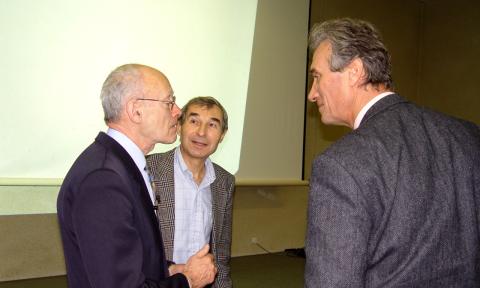
Henri Kagan, Professor Emeritus of Université Paris-Saclay, has been awarded the 2026 Nobel Prize in Chemistry for the discovery of...
Université Paris-Saclay is an inclusive institution, founded on the belief that everyone, whatever their differences or disability, can be welcomed...